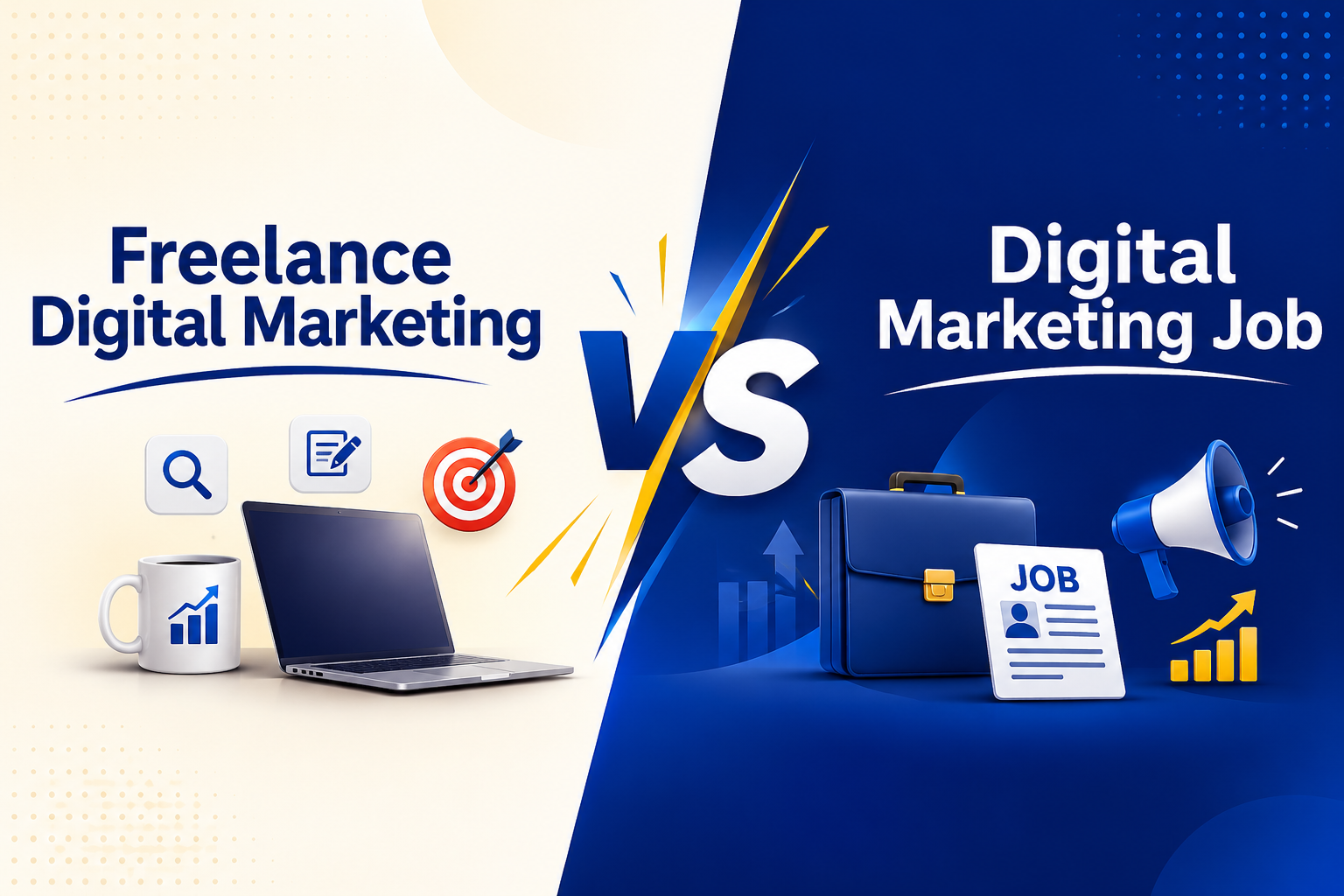
The freelance vs digital marketing job debate looks simple from the outside: be your own boss, or collect a steady paycheck. In practice, it is one of the most consequential choices a marketer makes, because it shapes how fast you earn, how fast you learn, and how much risk you carry.
In 2026 the question is sharper than ever. AI tools have changed what clients expect, companies are hiring more carefully, and more people than ever are launching freelance careers. A digital marketing job offers structure and mentorship. Freelancing offers freedom and a higher ceiling, but demands business skills most marketers never trained for.
This guide compares both paths on the factors that matter: income, security, control, skill growth, market outlook, and startup effort. You will finish with a practical framework for deciding which option fits your goals, budget, and experience.
Neither path wins for everyone. A digital marketing job is better for beginners, people who need predictable income, and anyone who wants to learn inside a team. Freelancing is better for experienced marketers with a network, some savings, and a tolerance for uncertainty.
The smartest route for many people is sequential: build skills in a job first, then move to freelancing once the foundations are solid. The sections below explain why.
Here is the quick view before we go deeper.
Treat this summary as a starting point. Real outcomes depend on your skills, your market, and how well you execute.
Money is usually the first thing people compare, and it is where the most misleading claims appear.
A digital marketing job pays a predictable amount. Salaries vary widely by country, city, and specialization, and performance roles such as paid media, marketing analytics, and SEO tend to pay more than general content or social roles. Raises usually arrive annually, and bigger jumps come from promotions or switching employers.
The advantage is certainty. You know what lands in your account each month, which makes rent, loans, and long-term planning far easier.
Freelancers set their own rates, so the ceiling is higher. A skilled freelancer who sells results instead of hours can out-earn a salaried peer within a few years. Specialists in areas like conversion-focused SEO, paid advertising, or email lifecycle strategy often command premium pricing.
But the average freelancer does not earn the top-of-market figures you see in social media screenshots. Early-stage freelancers often earn less than they would in a job, at least for the first six to twelve months.
Your headline rate is not your take-home pay. Freelancers cover things an employer normally handles:
A useful rule: a freelancer needs to charge noticeably more per hour than a salaried equivalent just to match the same net income. If your freelance rate is only slightly above your hourly salary equivalent, you are probably earning less once costs and downtime are counted.
This is where a digital marketing job has its clearest advantage.
Employees typically get paid leave, sick pay, notice periods, and sometimes health coverage, training budgets, or bonuses. If a campaign underperforms, your paycheck does not. If you fall ill, you still get paid.
Freelancers carry that risk personally. One client often represents a large share of revenue in the early years, so losing them can hurt badly. Late payments, scope creep, and sudden budget cuts are normal parts of the work.
That said, job security is not absolute. Layoffs happen in agencies and in-house teams, especially when budgets tighten. A freelancer with ten small clients can sometimes be more resilient than an employee whose entire income depends on one employer. Diversification is the freelancer’s version of security, but it takes time to build.
Control is the main reason people choose freelancing, and it is real. You choose your clients, your tools, your pricing, and often your hours. You can say no to a difficult client or a poorly paid project, which an employee cannot always do.
However, freedom comes with trade-offs:
In a digital marketing job, control is lower, but so is the mental load. You work within a defined role, your priorities are set by a team, and you can switch off at the end of the day. For many people, that clarity is worth more than flexibility.
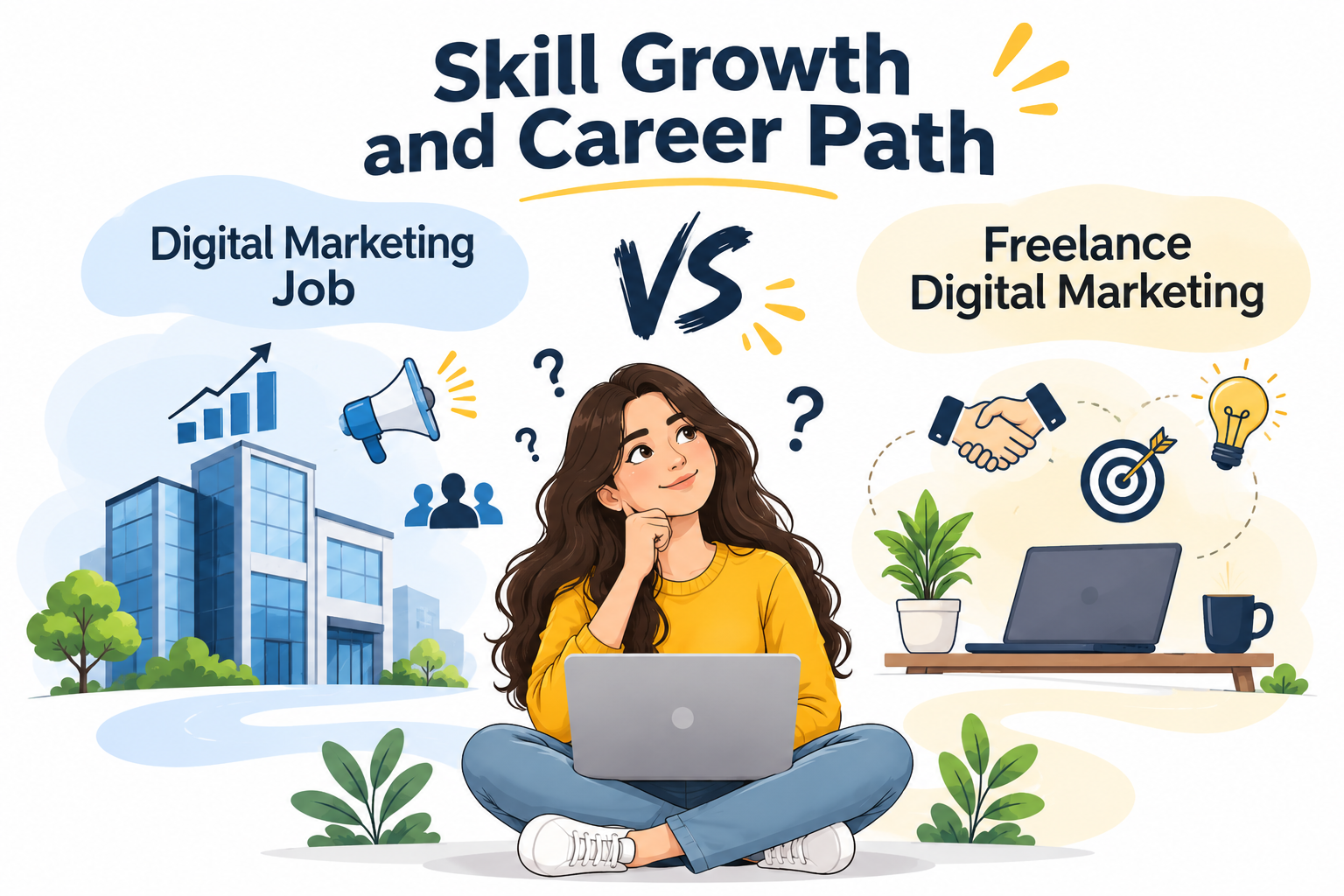
Both paths can build strong careers, but they build them differently.
Inside a company or agency, you learn from people ahead of you. You see how campaigns are planned, how budgets are managed, and how results are reported to leadership. You get access to premium tools, large ad budgets, and real data you might never touch as a solo operator.
An agency role is especially good for fast exposure. You may handle multiple accounts across industries within months, which compresses years of learning into a short time.
Freelancers learn quickly, but unevenly. You gain broad business skills: sales, negotiation, client communication, pricing, and project management. You are forced to deliver measurable results, which sharpens your thinking.
The risk is gaps. Without feedback from experienced colleagues, you can repeat mistakes for months without realizing it. Freelancers who grow fastest deliberately seek mentors, communities, and audits of their own work.
A digital marketing career in an organization follows a clear ladder: specialist, senior specialist, manager, head of marketing, and beyond. Leadership roles, team management, and strategy positions are easier to reach inside a company.
Freelancers have a different ladder: generalist, specialist, premium consultant, then agency owner or product creator. The upside is ownership and scalability. The downside is that nobody promotes you; you must create your own next step.
The market in 2026 rewards people who can show results, not just list tools.
AI has automated much of the routine work, including basic copy drafts, simple reporting, keyword grouping, and first-pass design. Companies now expect marketers to use these tools well and to add what machines cannot: strategy, judgment, brand sense, and accountability for outcomes. Entry-level tasks are shrinking, which makes it harder for beginners to land their first digital marketing job.
This cuts both ways:
The common thread is specialization. Whether you pursue freelancing or a salaried role, the people thriving in 2026 own a clear niche and can prove its impact.
Many people underestimate how much work it takes to start freelancing. Before you earn consistently, you need to build:
Expect the first few months to feel more like running a small business than doing marketing. Most freelancers spend a large portion of their early time on sales and admin, not billable work.
A digital marketing job asks far less upfront: a solid resume, a few relevant projects, and interview skills. If you are short on savings or experience, that lower barrier matters.
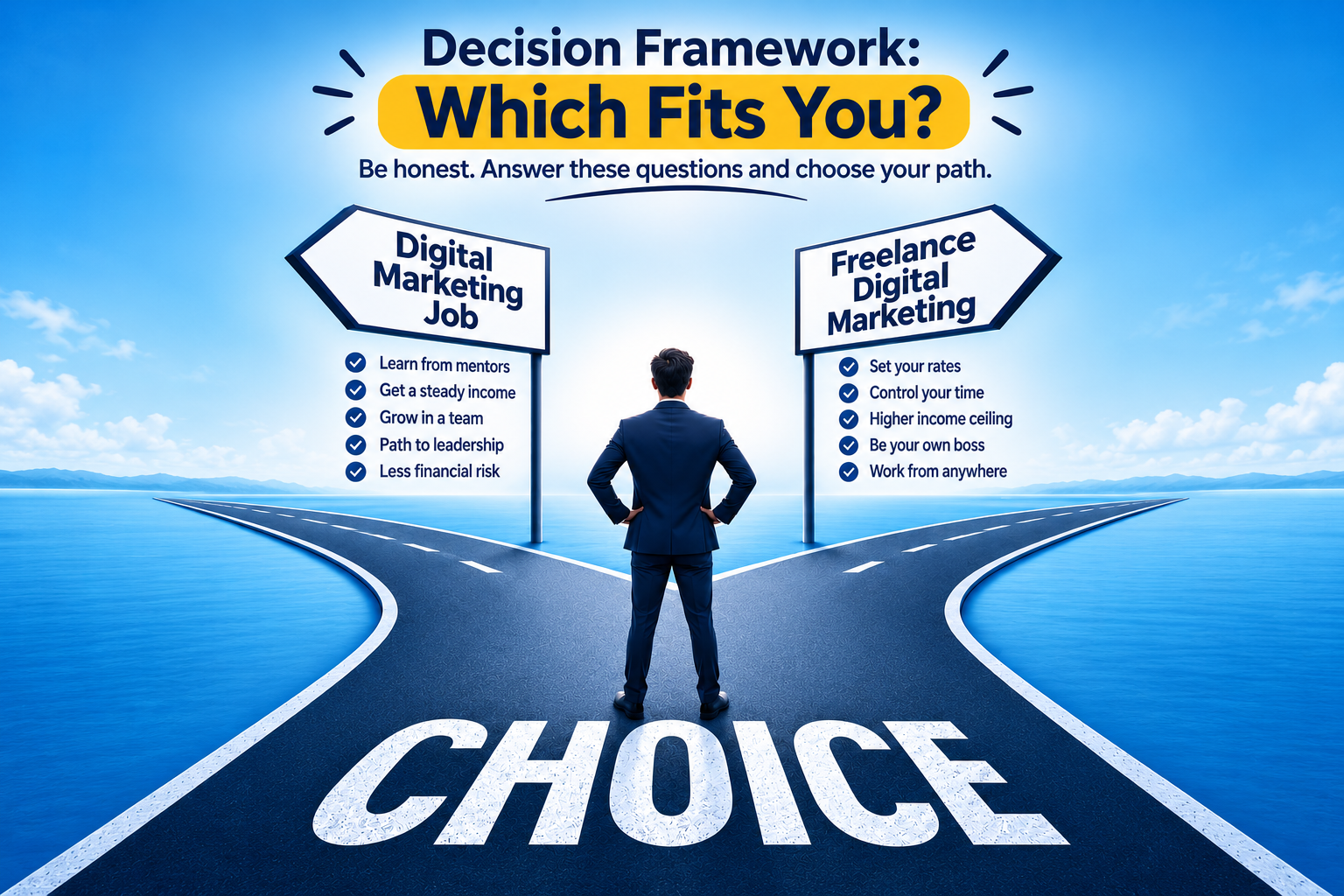
Use these questions to decide honestly.
A common, low-risk path is to keep your job while taking one or two freelance clients. Once freelance income reliably covers your expenses for several months, you can transition with far more confidence.
Before you decide, answer three questions:
If you answer “under three months,” “no,” and “not yet,” a job is the stronger choice right now. If you answer “six or more,” “yes,” and “yes,” freelancing deserves serious consideration.
A digital marketing job is usually the better starting point. It gives you paid learning, mentorship, and access to real campaigns and tools. Freelancing demands sales, pricing, and admin skills on top of marketing skills, and clients tend to hire proven specialists over beginners. Building two or more years of results in a job first makes the move to freelancing far less risky.
They can, but not automatically. Freelancers set their own rates, so the ceiling is higher, and specialists who sell results instead of hours can out-earn salaried peers within a few years. However, early-stage freelancers often earn less than they would in a job for the first six to twelve months. Taxes, insurance, software, unpaid pitching time, and gaps between projects also reduce take-home pay, so a freelancer needs to charge noticeably more per hour than a salaried equivalent just to break even.
Aim for a financial buffer that covers at least three to six months of living expenses. Client pipelines take time to build, and late payments or lost clients are common in the early years. If you have less than three months of savings, a job or a hybrid approach is the safer choice.
Yes, and it is one of the lowest-risk paths. Taking one or two freelance clients while employed lets you test demand, build a portfolio, and refine your offer without risking your income. Check your employment contract first for any restrictions on outside work or conflicts of interest. Once freelance income reliably covers your expenses for several months, you can transition with far more confidence.
AI has automated much of the routine work, such as basic copy drafts, simple reporting, keyword grouping, and first-pass design, which makes entry-level tasks harder to find. But it has not replaced strategy, judgment, brand sense, or accountability for results. Marketers who use AI tools well and specialize in a clear niche, whether as employees or freelancers, are the ones thriving.
The honest answer to the freelance vs digital marketing job question is that the better option depends on where you are, not just where you want to be.
If you are new, financially tight, or still building your skills, take a digital marketing job. It gives you paid learning, real experience, and a safety net while you work out your specialty. If you are experienced, specialized, and financially prepared, freelancing offers more control and more earning potential than any salary.
For most people, the strongest strategy is a sequence: start with a job, build proof of results, add freelance work on the side, and leave only when the numbers support it. That approach captures the best of both paths and avoids the biggest risks of each.
Pick the path that matches your current reality, commit to a specialty, and keep your results visible. In 2026, that combination wins no matter which route you choose.