
Choosing a digital marketing course for beginners may seem simple at first, but comparing different programmes can be confusing. Some courses are free, while others require a significant investment. Depending on the programme, students may receive certificates, practical training, job placement assistance, or a combination of these benefits. However, many digital marketing course descriptions sound similar, making it difficult to choose the right one.
This guide will help you understand digital marketing, explore the topics covered in a beginner-level course, and learn how to evaluate a programme before enrolling. You will also discover typical course fees in India and understand the importance of digital marketing certificates. By the end, you will have a clear plan to begin your digital marketing journey.
Digital marketing is a way for businesses to promote their products and services using online platforms. Companies can share product information, attract potential customers, and receive enquiries through websites, social media, email, and other digital channels.
Unlike traditional advertising methods such as newspapers, television, banners, and posters, online promotion allows businesses to reach people through platforms they regularly use. They can also monitor website visits, customer interactions, and sales to understand how their marketing activities are performing.
A digital marketing course for beginners helps learners understand these promotional methods and develop the skills needed to use different online marketing platforms.
The field is also crowded with hype. Nobody learns it in a weekend, and no course can promise you a particular salary. What it can give you is a solid foundation and a way to build real experience.
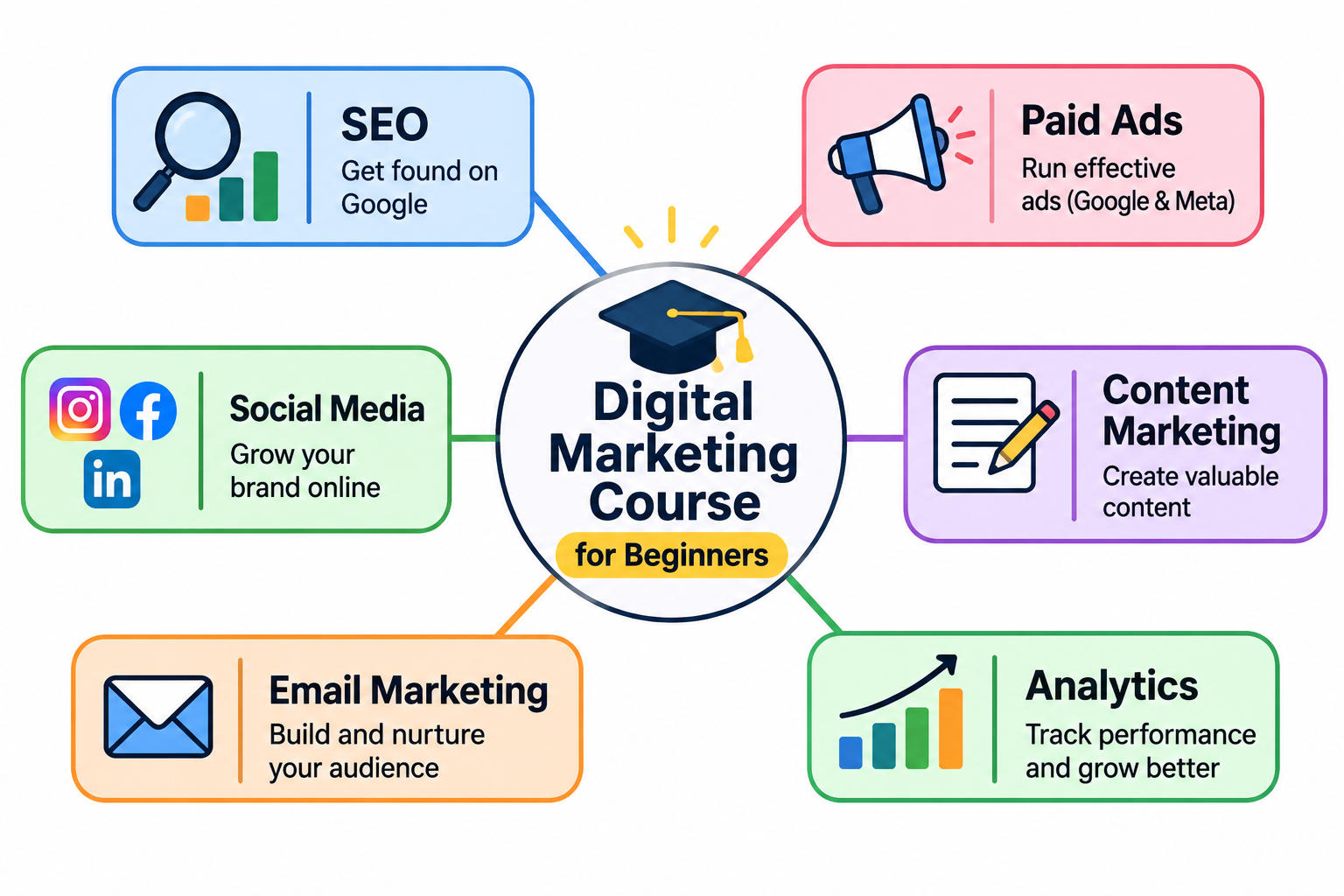 The six essential areas of digital marketing include SEO, paid advertising, social media, content marketing, email marketing and analytics.
Before you compare courses, you need a map of the territory. Most beginner programmes cover the six areas below. Knowing them will help you judge whether a syllabus is complete.
SEO involves improving different parts of a website so that it has a better chance of appearing in relevant Google search results. It helps people discover useful website content when they search for related information, products, or services.
Paid advertising is a method businesses use to promote their products or services by investing money in online campaigns. These promotions can be displayed on Google search pages, social media feeds, and different websites. In many advertising platforms, businesses pay when a user clicks on their advertisement. This is known as the Pay-Per-Click (PPC) model.
One benefit of paid campaigns is that they can bring visitors to a website within a short period. Advertisers can also set spending limits, monitor campaign expenses, and check how much they spend to attract potential customers.
Social media marketing focuses on using platforms like Instagram, Facebook, LinkedIn, YouTube, and X to promote a brand and interact with its audience. The work involves creating content, preparing captions, managing comments, sharing updates, and checking account performance.
Simply uploading pictures or videos is not enough to achieve good results. Marketers need to understand their target audience, identify the type of content people enjoy, and plan activities that encourage engagement, enquiries, or sales.
Content marketing uses useful material, such as blog posts, videos, podcasts, guides, and newsletters, to attract and keep an audience. Instead of interrupting people with an ad, you offer something worth their time. This area overlaps heavily with SEO. Good content gives search engines something to rank and gives readers a reason to stay.
A company can use email newsletters to share useful updates with people who have subscribed to receive them. These messages may contain product announcements, special deals, helpful tips, or information about upcoming services. Businesses can also divide their subscribers into different groups and send messages that match their interests. This makes email a useful tool for customer retention and repeat business.
Analytics helps marketers understand the results of their online campaigns. Platforms such as Google Analytics provide information about website visitors, their activities, traffic sources, and completed actions. For example, when a visitor purchases a product, registers for a service, or submits a form, it is known as a conversion.
Learning to understand these reports is an important part of digital marketing. By checking website performance regularly, marketers can identify changes in visitor behaviour, find areas that need improvement, and make better decisions for future campaigns.
The subjects covered in a digital marketing programme depend on the institute and its syllabus. However, most beginner-level programmes introduce students to important marketing concepts, online promotional methods, and practical activities. The aim is to help learners understand how digital platforms are used to promote businesses.
Before learning individual marketing tools, students need to understand the purpose behind an online campaign. This includes identifying the people a business wants to reach, understanding their needs, and deciding what the campaign should achieve.
For example, a business may want to increase website visitors, receive more customer enquiries, or gain new subscribers. Students learn how to set clear targets and plan marketing activities around those requirements.
Next come the channels covered above. A solid beginner curriculum usually includes:
The course does not need to make you an expert in each one. At this stage, the goal is literacy: understanding how each channel works and how they support each other.
Tool training varies, but beginners commonly work with:
Do not worry if a course uses different software. The concepts carry over, and tools change often.
This is the part that separates useful courses from passive ones. Look for assignments where you create something: a keyword plan for a real website, a mock ad campaign, a content calendar, or an email sequence. These become portfolio pieces later.
If a course consists only of videos and quizzes, you will finish knowing vocabulary but not how to use it.
Once you know what a good course covers, you can compare programmes with more confidence. Use the checks below.
Sales pages describe outcomes. Syllabi describe content. Look for a week-by-week or module-by-module outline and check it against the six core areas. Missing analytics is a warning sign, since it is the skill that proves your work is effective.
Also check how current the material is. Digital marketing changes quickly. Ask when the course was last updated, and be cautious if the examples reference platforms or features that no longer exist.
Who teaches the course? Ideal instructors have worked in the field and can show real campaigns or results. A polished presenter with no practical background is a weaker choice than a working marketer who explains things plainly.
Search for the instructor’s profile on LinkedIn. See what they have done outside of teaching.
Ask whether you will complete practical assignments and whether anyone reviews them. Feedback matters because beginners cannot always see their own mistakes. A mentor, instructor, or active community can fill that gap.
Testimonials on a course’s own website are curated. Look for reviews on third-party platforms, forums, and social media. Pay attention to specifics: what did students build, what did they find missing, and how did they use the course afterwards?
Be careful with job placement claims. Ask how the figure is calculated, who is counted, and over what period. A vague “90% of graduates get hired” is not much use without those details.
A trustworthy provider is comfortable answering questions before you pay.
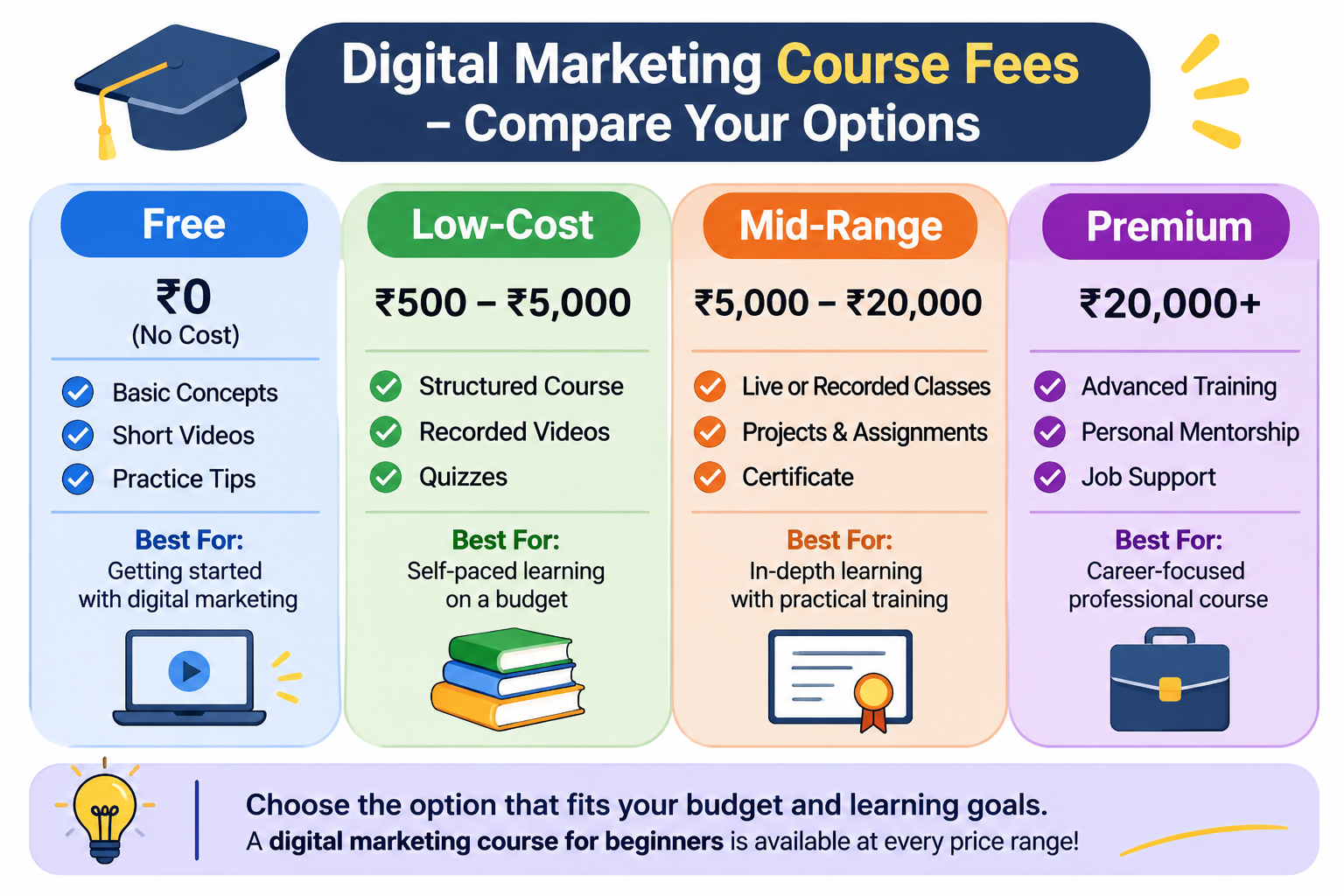 Comparison of free, low-cost, mid-range and premium digital marketing courses based on fees, features and learning benefits.
Cost is where many beginners get stuck, and it is reasonable to compare digital marketing course fees carefully. The range is wide, and a higher price does not always mean better teaching.
Fees vary by format and provider, so treat the figures below, shown in Indian rupees (₹), as rough orientations rather than quotes.
International platforms may list prices in dollars or adjust them for India, so check the current rupee price, including GST, before you pay. Local institutes can charge very differently from one another, so ask for a written fee breakdown.
Several factors explain why two similar-sounding courses can differ so much.
Ask what the fee covers. A higher price is only worth it if you will use the extras.
Beyond tuition, you may pay for:
Budget for a small practice project. Spending a modest amount on real ads or a simple website teaches more than any lecture.
A digital marketing certificate is a document that confirms you completed a course or passed an assessment. The term covers two quite different things, and the difference affects how much weight the certificate carries.
A certificate of completion shows you finished a course. It proves participation, not mastery, and it is usually awarded by the course provider.
An industry certification requires passing an exam. Examples include Google’s analytics and advertising certifications and HubSpot’s marketing certifications. Because you must demonstrate knowledge, these carry a little more weight, and many of them are free or low cost.
Some programmes also offer professional certificates through universities or large platforms. These bundle several courses and usually include projects, which makes them more substantial than a single-course completion certificate.
Here is the honest answer. A digital marketing certificate helps you get noticed, but it rarely decides a hiring decision on its own.
Hiring managers tend to care more about what you can show. A small portfolio with a keyword plan, a sample campaign, a blog you have grown, or results from a volunteer project is persuasive evidence. The certificate backs that up and signals that you took the learning seriously.
Where certificates help most:
Where they help the least: when a certificate is the only thing on your resume and you cannot explain what you learned.
Before paying for a certificate, ask whether the issuer is recognised in the industry, whether it expires, and whether you can find job postings that mention it.
Digital marketing classes come in several formats, and the best one depends on how you learn and what your schedule allows.
Online classes fall into two groups: self-paced (recorded lessons you complete whenever you like) and live online (scheduled sessions with an instructor and classmates).
Advantages:
Drawbacks:
Self-paced learning suits disciplined people with unpredictable schedules. Live online classes add structure and a sense of accountability.
In-person classes take place at an institute, college, or training centre.
Advantages:
Drawbacks:
In-person classes work well if you learn best with people around you, and a local network matters for your job search.
Some providers combine recorded lessons with live sessions or occasional meetups. This can offer the best of both.
To decide, ask yourself three questions:
If you are unsure, start online with a low-cost or free option. You can always move to a more structured format once you know the field suits you.
A digital marketing free course will not replace a full programme, but it can do something just as valuable: help you find out whether you like the work before you spend money.
Several well-known providers offer free material.
Availability and terms change, so check each provider’s current offer before you start.
Free courses are excellent for learning vocabulary, trying tools, and testing your interest. Many are also taught by the companies who build the platforms, so the information is accurate and current.
They have limits. Free courses are often tied to one company’s products, so the perspective can be narrow. They rarely include personal feedback. And with no money on the line, many people start and never finish.
Treat free courses as a trial period.
If you complete this and still want to learn more, a paid programme becomes a better investment because you know what you are buying.
Introductory courses can take a few weeks. Broader professional programmes usually run three to six months part-time. Becoming job-ready takes longer, because experience builds through practice.
No. Many marketers come from other fields. Comfort with computers and willingness to learn new tools are enough to begin.
It can be. Demand exists across industries, and entry-level roles such as marketing assistant, social media coordinator, and content writer are common starting points. Results depend on your effort, your portfolio, and your local job market.
Learn the basics across all areas first. Then pick one or two to deepen, such as SEO, paid ads, or email. Specialists are often easier to hire than generalists, but you need the wider view to choose well.
Yes, up to a point. You can build real foundations with free material. Paid programs add structure, feedback, and recognition, which many learners find worth the cost.
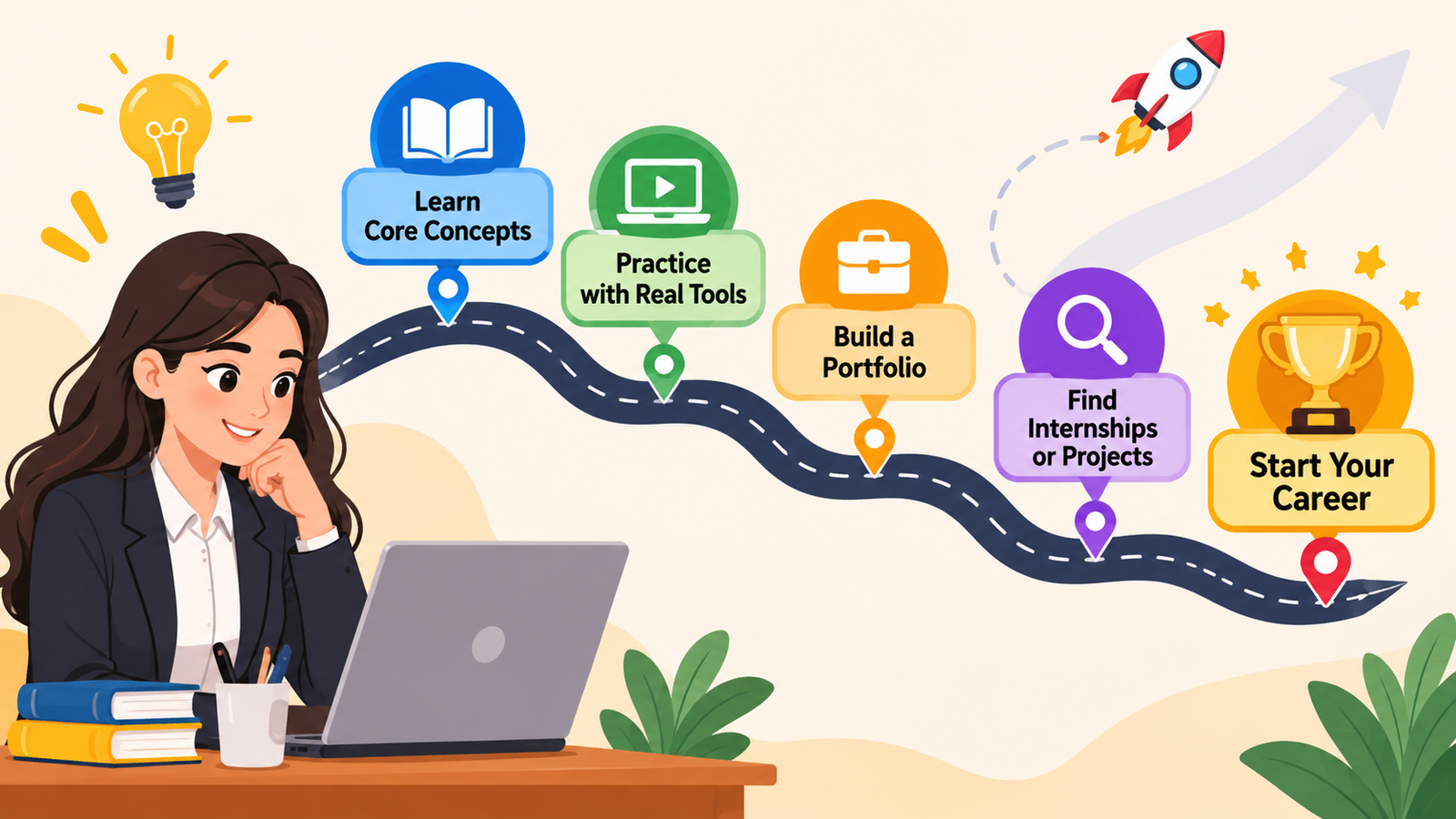 Take the next step towards a successful career with a Digital Marketing Course for Beginners: Complete Guide.
You now have what you need to choose with confidence. Here is a practical way to move forward.
Are you looking for a new career, a side income, or skills for your own business? Your answer shapes how much time and money to invest. A business owner may only need a focused course on search and social ads. A career changer may want a broader programme with projects.
Decide how much you can spend and how many hours per week you can study. Be realistic. Five consistent hours a week beat an ambitious plan that collapses in week two.
Complete one introductory digital marketing free course in the next two weeks. Take notes and keep a list of questions.
If you want more depth, compare programmes using the checks above: syllabus, instructor, hands-on work, reviews, fees, and certificate value. Contact each provider with a question and see how they respond.
Do not wait until you finish to create something. Start a simple website or blog, run a small email campaign, or manage social accounts for a local business or cause. Save your work and results.
At the end of a month, you will know more than most people who are still comparing options.
Choosing a digital marketing course for beginners does not require a perfect decision. It requires a clear idea of what you want, a realistic budget, and a willingness to practice. Start small, build something real, and let your results guide what you learn next.
(IMAGE 4)