Category: Digital Marketing

  • DigitalMarketing Career Guide: 5 Essential Tips for Long-Term Success

    DigitalMarketing Career Guide: 5 Essential Tips for Long-Term Success

    DigitalMarketing Career Guide: 5 Essential Tips for Long-Term Success

    In today’s digital-first world, businesses are increasingly relying on online platforms to connect with customers, promote products, and grow their brands. This shift has created enormous opportunities for professionals who want to build a career in Digital Marketing. Whether you’re a student exploring career options, a graduate looking for opportunities, or a working professional planning a career change, digitalmarketing offers a dynamic and rewarding path.

    The rise of social media, search engines, e-commerce, and mobile technology has transformed how companies communicate with their audiences. Traditional marketing methods are no longer sufficient on their own. Businesses now need skilled digitalmarketing professionals who can create effective online campaigns, attract customers, and generate measurable results.

    One of the biggest advantages of digitalmarketing is its versatility. It combines creativity, technology, communication, analytics, and strategy into a single profession. Professionals can specialize in various fields such as Search Engine Optimization (SEO), Social Media Marketing (SMM), Content Marketing, Email Marketing, Pay-Per-Click Advertising (PPC), Affiliate Marketing, and Marketing Analytics.

    The future of digitalmarketing looks brighter than ever. As technology continues to evolve, companies will continue investing in digital channels to stay competitive. This means the demand for talented digitalmarketing professionals is expected to grow steadily for years to come.

    However, building a successful career in digitalmarketing requires more than simply learning a few tools or completing a certification course. It requires continuous learning, practical experience, creativity, strategic thinking, and a strong understanding of customer behavior.

    If you are serious about building a successful career in digitalmarketing, the following five tips will help you establish a strong foundation and position yourself for long-term growth.

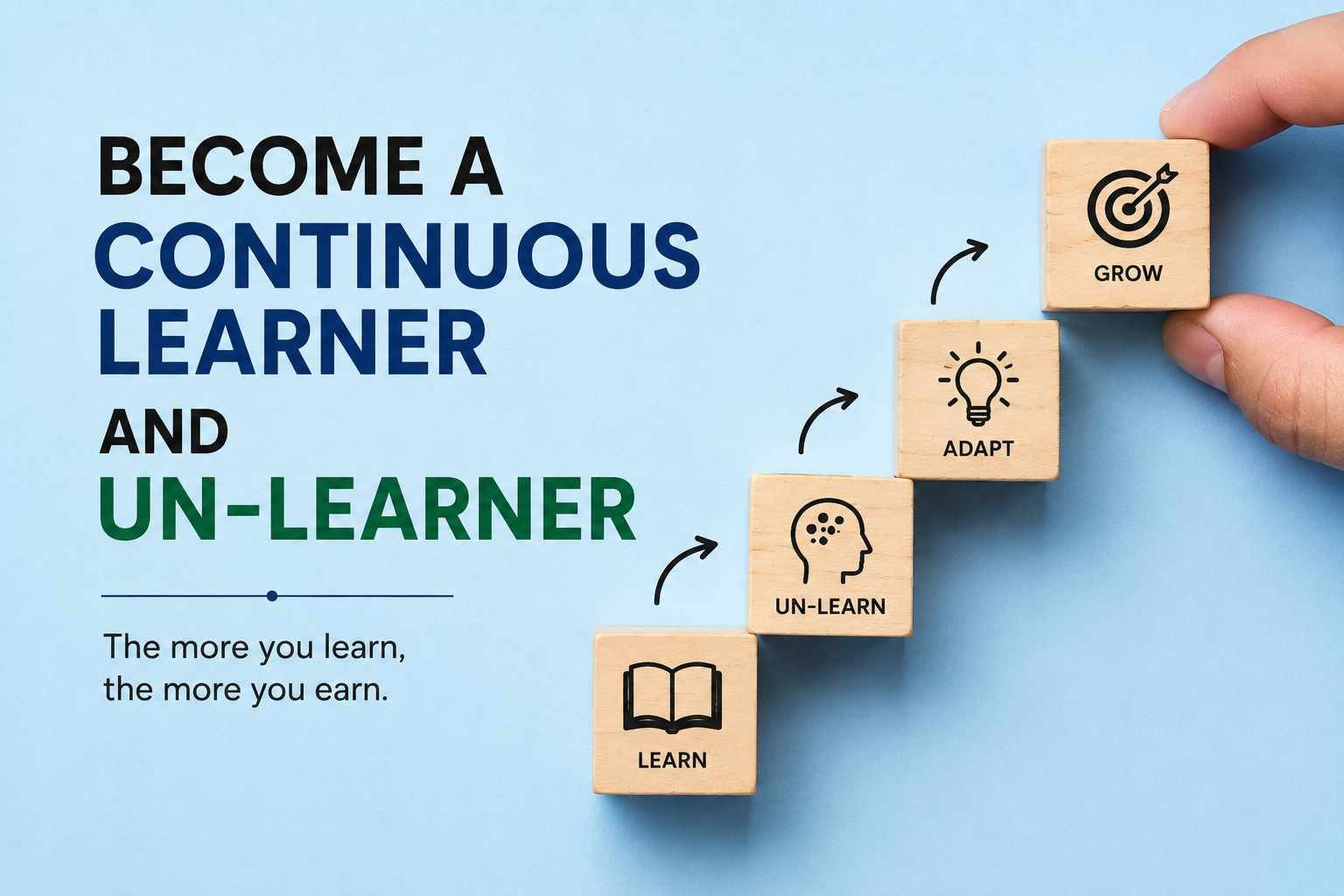
    1. Become a Continuous Learner and Un-Learner

    One of the most important characteristics of successful Digital Marketing professionals is their commitment to continuous learning.

    The digital landscape changes rapidly. Search engine algorithms are updated frequently, social media platforms introduce new features, consumer behavior evolves, and new technologies emerge every year. What worked six months ago may not be as effective today.

    Because of this constant change, Digital Marketing professionals must make learning a lifelong habit. Staying informed about industry trends allows marketers to adapt quickly and maintain their competitive edge.

    There are many ways to continue learning in Digital Marketing:

    • Follow industry-leading blogs and websites.
    • Attend webinars and online workshops.
    • Take professional certification courses.
    • Listen to marketing podcasts.
    • Join digitalmarketing communities and forums.
    • Follow successful marketers on social media.

    Learning alone is not enough. Successful professionals must also learn how to unlearn outdated methods. Some marketing techniques that were once effective may become obsolete due to changes in algorithms, technology, or consumer expectations.

    For example, search engine optimization strategies that worked years ago may no longer produce results because search engines continuously refine their ranking systems. Similarly, social media engagement tactics evolve as platforms update their algorithms and features.

    By embracing continuous learning and being willing to abandon ineffective practices, you can remain relevant and valuable in the digitalmarketing industry.

    The professionals who consistently invest in learning are often the ones who advance faster, secure better opportunities, and achieve long-term career success.


    Digital Marketing

    2. Study Competitors and Industry Leaders

    A powerful way to improve your Digital Marketing carefully observe successful brands and industry leaders.

    Every successful marketing campaign contains valuable lessons. By analyzing what established companies are doing, you can gain insights into customer engagement, content strategies, advertising techniques, and brand positioning.

    Competitor research helps you understand:

    • Market trends
    • Audience preferences
    • Content performance
    • Advertising strategies
    • Customer engagement techniques
    • Emerging opportunities

    Digital Marketing is highly competitive, and businesses constantly experiment with new approaches to attract customers. Studying competitors allows you to identify successful tactics while avoiding common mistakes.

    Pay attention to how leading brands:

    • Create social media content
    • Optimize websites for search engines
    • Run paid advertising campaigns
    • Use email marketing
    • Develop content marketing strategies
    • Build customer relationships

    You should also follow Digital Marketing experts who regularly share industry insights and practical advice. Learning from experienced professionals can help you understand challenges, avoid pitfalls, and develop a more strategic approach to marketing.

    However, competitor analysis should never involve copying someone else’s work. Instead, use your observations to inspire unique ideas and innovative strategies that align with your own goals.

    The most successful Digital Marketing professionals know how to learn from others while maintaining originality and creativity.

    3. Gain Hands-On Experience Through Real Projects

    Knowledge without practical application has limited value in digitalmarketing.

    Many beginners spend months studying theories but hesitate to implement what they have learned. While theoretical knowledge provides a strong foundation, real growth happens when you apply your skills to actual projects.

    Practical experience allows you to understand how marketing concepts work in real-world situations. It also helps you develop confidence and problem-solving abilities.

    Some ways to gain practical experience include:

    • Starting your own blog.
    • Creating a personal website.
    • Managing social media accounts.
    • Running small advertising campaigns.
    • Offering freelance services.
    • Assisting local businesses.
    • Creating content for online platforms.

    Working on real projects teaches you valuable skills such as:

    • Campaign planning
    • Audience targeting
    • Content creation
    • Search engine optimization
    • Data analysis
    • Performance tracking
    • Conversion optimization

    One of the greatest benefits of practical experience is portfolio development. Employers and clients often prioritize candidates who can demonstrate proven results rather than simply listing certifications.

    A portfolio showcasing successful projects, campaigns, and measurable outcomes can significantly improve your credibility and career prospects.

    Digital Marketing is ultimately a results-driven profession. The more experience you gain, the more capable you become at generating meaningful outcomes for businesses.


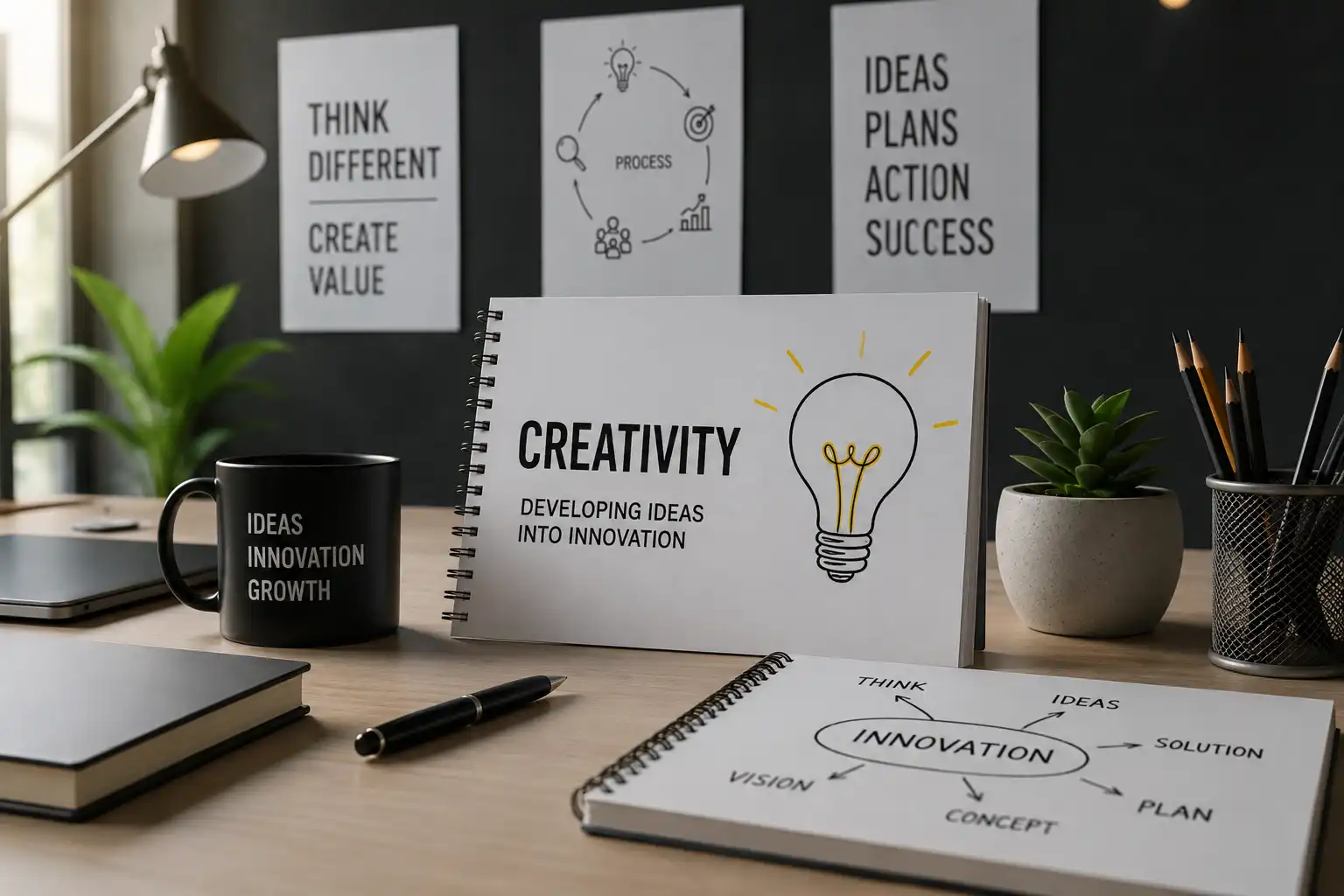
    4. Develop Creativity and Innovative Thinking

    Creativity is a critical component of successful Digital Marketing.

    Every day, consumers encounter thousands of advertisements, social media posts, emails, and promotional messages. To stand out in such a crowded environment, marketers must create content and campaigns that capture attention and leave a lasting impression.

    Creative thinking helps marketers:

    • Generate unique campaign ideas.
    • Create engaging content.
    • Build memorable brands.
    • Improve audience engagement.
    • Increase campaign effectiveness.

    Digital Marketing offers countless opportunities for creativity. Whether you are designing social media content, writing blog posts, creating videos, or developing advertising campaigns, innovative thinking can help you achieve better results.

    Beginners often have an advantage because they are not restricted by established routines. They can experiment with new ideas and test unconventional approaches.

    Some ways to strengthen creativity include:

    • Studying successful campaigns.
    • Reading books from different industries.
    • Following creative professionals.
    • Practicing brainstorming exercises.
    • Exploring new content formats.
    • Experimenting with storytelling techniques.

    Combining creativity with technical skills such as SEO, social media management, and analytics can create powerful marketing campaigns that resonate with audiences.

    In the world of Digital Marketing, creativity often becomes the factor that separates average marketers from exceptional ones.

    Digital Marketing

    5. Collect and Analyze Customer Feedback

    Customer feedback is one of the most valuable resources in digitalmarketing.

    Understanding your audience is essential for creating effective marketing strategies. Customer feedback provides direct insights into what people like, dislike, need, and expect from a brand.

    Businesses that actively listen to customers can improve their products, services, and marketing efforts more effectively than those that rely solely on assumptions.

    There are numerous ways to collect customer feedback:

    • Online surveys
    • Customer reviews
    • Social media comments
    • Website feedback forms
    • Email questionnaires
    • Customer interviews

    Modern Digital Marketing tools make it easier than ever to gather and analyze customer data. Analytics platforms, CRM systems, and email marketing tools provide valuable information about customer behavior and preferences.

    By analyzing feedback, businesses can:

    • Improve customer satisfaction.
    • Enhance user experience.
    • Identify market opportunities.
    • Optimize marketing campaigns.
    • Increase customer retention.
    • Build stronger customer relationships.

    Customer feedback also helps marketers understand long-term trends and evolving consumer expectations. This information can guide future marketing decisions and contribute to sustainable business growth.

    For aspiring Digital Marketing professionals, developing strong analytical skills and learning how to interpret customer data can significantly increase career opportunities and professional value.

    Conclusion

    The Digital Marketing industry continues to grow at an incredible pace, creating exciting opportunities for professionals around the world. Businesses of all sizes are investing heavily in digital channels, making digitalmarketing one of the most promising career paths in today’s economy.

    Success in Digital Marketing requires a combination of technical knowledge, practical experience, creativity, adaptability, and customer understanding. Professionals who continuously learn, analyze competitors, gain hands-on experience, think creatively, and leverage customer feedback are more likely to achieve long-term success.

    The journey may not always be easy. The industry is competitive and constantly evolving. However, for those who are willing to learn, adapt, and innovate, digitalmarketing offers endless possibilities for growth and achievement.

    If you’re considering a career in Digital Marketing, now is an excellent time to begin. Start building your skills, work on real projects, stay curious, and embrace continuous improvement. With dedication and persistence, you can establish yourself as a successful digitalmarketing professional and thrive in one of the world’s fastest-growing industries.

    Tags :
    digitdal marketing strategy
    Author : Swetha

    Freelance Digital Marketer passionate about helping businesses grow through SEO, content marketing, and data-driven digital strategies.

    Learner of DigiSkillz, Digital Marketing Institute in Kochi.

  • How Much is the Digital Marketing Salary for Freshers in India?

    How Much is the Digital Marketing Salary for Freshers in India?

    digital marketing salary for freshers

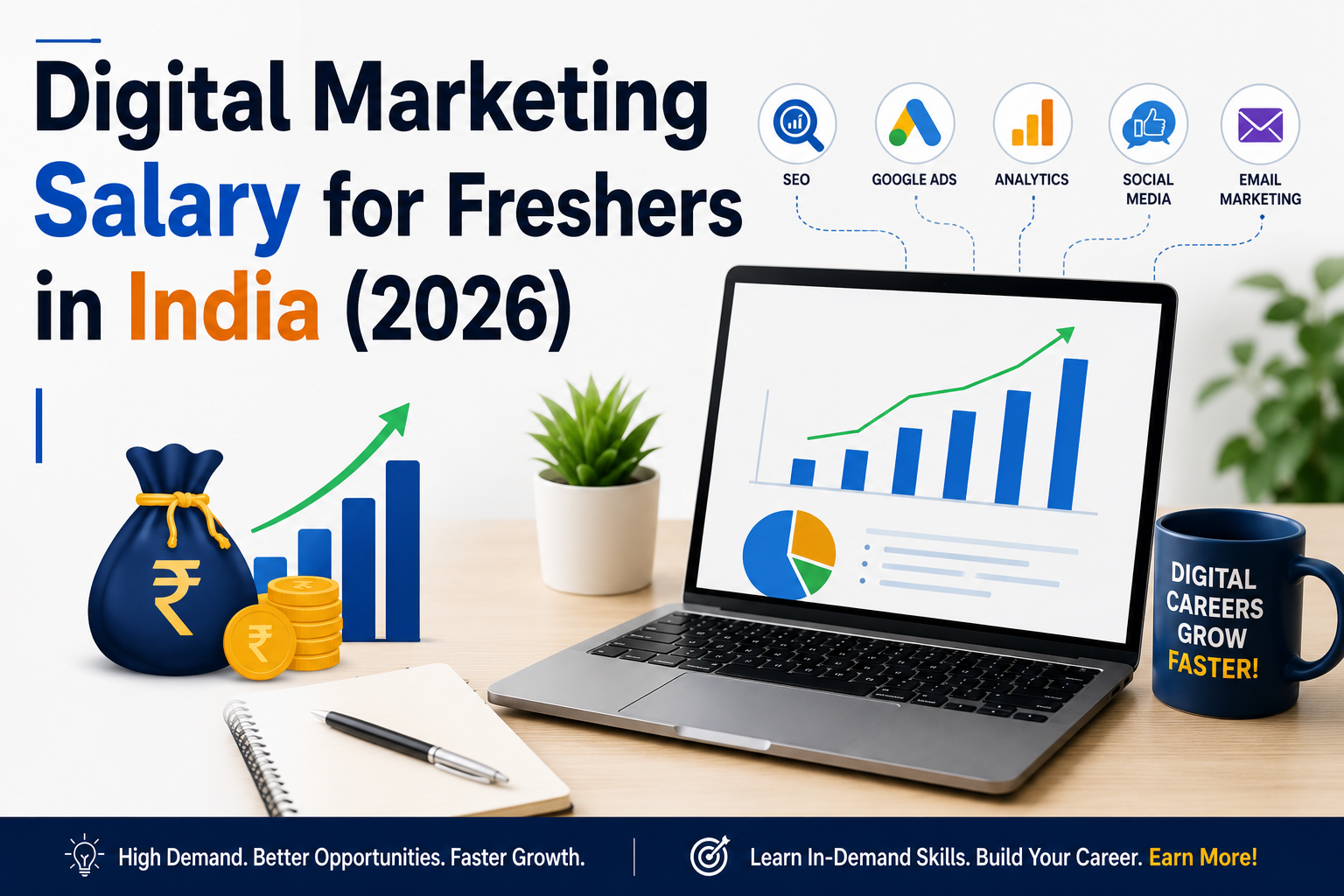
    How Much is the Digital Marketing Salary for Freshers in India?

    The digital marketing industry is one of the fastest-growing career sectors in India. As businesses continue shifting their operations online, the demand for skilled digital marketers is increasing every year. This has created thousands of opportunities for graduates, career switchers, and freshers looking for a stable and rewarding profession. One of the most common questions beginners ask is: What is the digital marketing salary for freshers? 

    However, the digital marketing salary for freshers isn’t the same for everyone. Two candidates with the same degree can receive very different salary offers based on their skills, certifications, internships, location, and the role they apply for. This is why it’s important to understand what influences your starting salary and how you can maximize your earning potential from day one. 

    Whether you’re a recent graduate, a career switcher, or someone exploring digital marketing for the first time, knowing what to expect financially can help you make smarter career decisions. In this article, we’ll explore digital marketing salary for freshers, the opportunities available in the industry, and how you can position yourself for higher-paying roles right from the start. 

    How much can a Fresher earn in Digital Marketing ?

    If you’re wondering about the average digital marketing salary for freshers, you’ll be pleased to know that entry-level salaries are competitive compared to many other professions.

    Most freshers in India can expect an annual salary ranging from ₹2.5 LPA to ₹4.5 LPA, depending on their qualifications and practical skills. On a monthly basis, this translates to approximately ₹18,000 to ₹35,000.

    Here’s a quick overview:

    Experience           

    Monthly Salary    

        Annual Salary

    Fresher

    (0–1 Year) 

              ₹18,000 – ₹35,000  

       ₹2.5 – ₹4.5 LPA

    1–2 Years

                 ₹30,000 – ₹50,000

        ₹4 – ₹6.5 LPA

    2–4 Years

                ₹50,000 – ₹80,000

         ₹6 – ₹10 LPA

    While these figures represent industry averages, your actual package may vary. Some freshers start with salaries above ₹5 LPA if they possess in-demand skills such as SEO, Google Ads, analytics, or performance marketing.

    Freshers with internship experience, industry certifications, or a strong portfolio often receive higher starting salaries than candidates with only theoretical knowledge. 

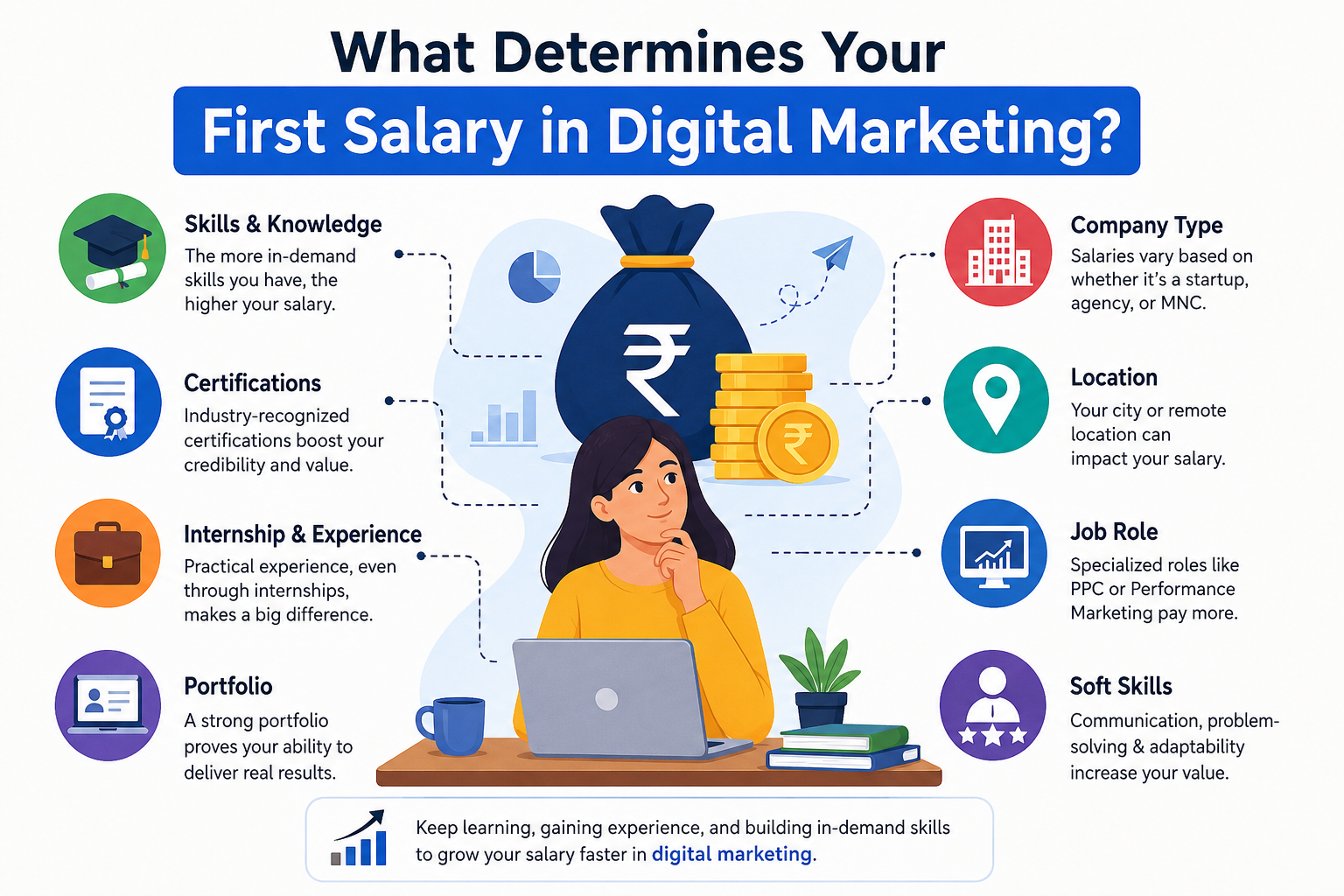
    What Determines your First Salary in Digital Marketing ?

    Visual guide explaining what affects digital marketing salary for freshers in India, including skills, certifications, internships, job role, company type, and location.

    Why do some graduates receive ₹20,000 per month while others start with ₹40,000 or more? The answer lies in the value they bring to employers.

    1. Skills Matter More Than Degrees

    Employers prioritize practical skills over academic qualifications.

    Candidates who know how to:

    • Perform keyword research
    • Run Google Ads
    • Create social media campaigns
    • Analyze website traffic
    • Optimize websites for SEO
    • Generate leads
    • Write engaging content

    usually receive better salary offers than those who possess only certifications.

    1. Internship Experience

    An internship gives you practical exposure to live projects, allowing you to apply what you’ve learned in real business situations.

    Even a three-month internship demonstrates that you’ve worked on live projects, understand deadlines, and can contribute from your first day on the job.

    Recruiters often prioritize candidates with internship experience over those who have only completed theoretical courses.

    1. Certifications

    Industry-recognized certifications strengthen your resume and showcase your commitment to continuous learning.

    Popular certifications include:

    • Google Ads Certification
    • Google Analytics Certification
    • HubSpot Content Marketing
    • Meta Blueprint
    • Semrush SEO Certification

    While certifications alone won’t guarantee a high salary, they can certainly improve your chances of receiving better offers.

    1. Company Size

    The size of the organization significantly impacts salary.

    Generally:

    Startups offer learning opportunities and faster growth.

    Mid-sized companies provide balanced salaries and responsibilities.

    Large corporations often offer structured career paths along with higher compensation and employee benefits.

    1. Location

    Your city also affects your salary.

    Digital marketing professionals working in metro cities generally earn more due to higher demand and living costs.

    Some of the highest-paying cities include:

    • Bengaluru
    • Mumbai
    • Delhi NCR
    • Hyderabad
    • Pune
    • Chennai

    However, with remote work becoming more common, location is becoming less of a deciding factor.

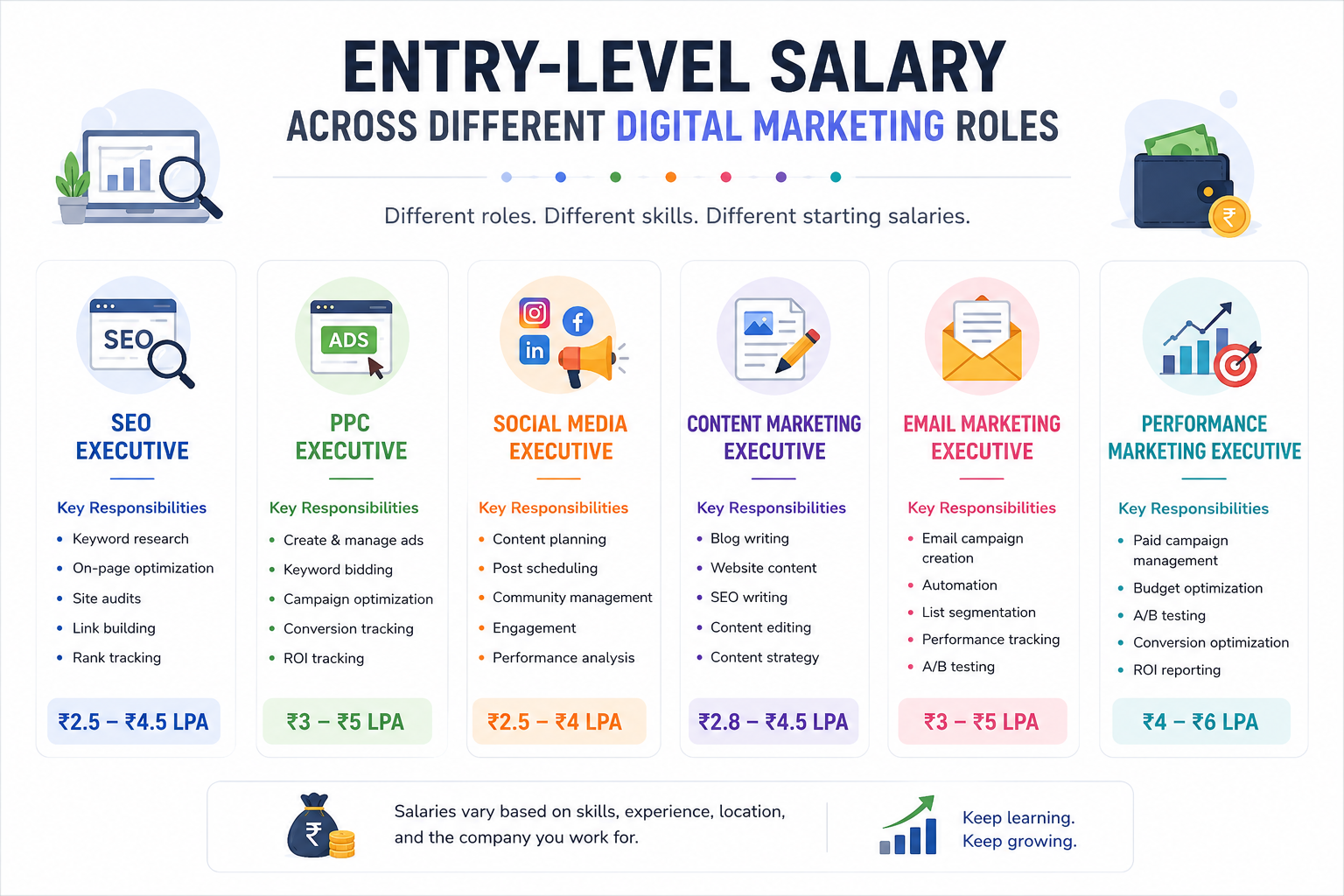
    Entry-Level Salary Across Different Digital Marketing Roles

    Not every digital marketing job offers the same starting salary. Some roles require specialized technical skills, while others focus on creativity, communication, or data analysis. Understanding the salary range for each role can help you choose a career path that matches both your interests and your income expectations.

    If your goal is to earn the highest digital marketing salary for freshers, it’s worth investing time in learning high-demand skills before applying for jobs.

    Infographic comparing entry-level digital marketing salaries for SEO Executive, PPC Executive, Social Media Executive, Content Marketing Executive, Email Marketing Executive, and Performance Marketing Executive in India.

       1)SEO Executive Salary for Freshers

    Search Engine Optimization (SEO) is one of the most popular entry-level career options in digital marketing. SEO executives help websites rank higher on search engines by optimizing content, improving website performance, conducting keyword research, and building quality backlinks.

    Since every business wants to attract organic traffic, SEO professionals are always in demand.

    Average Salary: ₹2.5 – ₹4.5 LPA

    Freshers with hands-on experience in tools like Google Search Console, Google Analytics, Ahrefs, Semrush, or Screaming Frog often receive better salary offers than candidates with only theoretical knowledge.

      2)PPC Executive Salary for Freshers

    Pay-Per-Click (PPC) specialists manage paid advertising campaigns on platforms such as Google Ads and Microsoft Ads. Their responsibilities include creating campaigns, selecting keywords, optimizing bids, tracking conversions, and improving return on investment (ROI).

    Because paid advertising directly impacts business revenue, PPC professionals usually earn a higher digital marketing salary for freshers than many other entry-level roles.

    Average Salary: ₹3 – ₹5 LPA

    Learning Google Ads and conversion tracking before applying can significantly improve your earning potential.

       3)Social Media Executive Salary for Freshers

    Brands rely on social media to engage customers, build communities, and increase brand awareness. A Social Media Executive plans content calendars, creates engaging posts, responds to followers, and analyzes campaign performance.

    Creativity, communication skills, and an understanding of platform algorithms are highly valued in this role.

    Average Salary: ₹2.5 – ₹4 LPA

    Candidates who know tools like Canva, Meta Ads Manager, Buffer, or Hootsuite often stand out during interviews.

       4)Content Marketing Executive Salary

    Content marketers create blogs, website copy, landing pages, email campaigns, and other forms of written content that attract and convert customers.

    If you enjoy writing and storytelling, this role offers excellent career growth.

    Average Salary: ₹2.8 – ₹4.5 LPA

    Writers with SEO knowledge typically earn more because they can create content that ranks well on search engines.

       5)Email Marketing Executive Salary

    Email marketing continues to deliver impressive results for businesses, making it one of the most valuable digital marketing skills to learn. Email marketing executives create newsletters, promotional campaigns, automated workflows, and customer engagement strategies.

    Average Salary: ₹3 – ₹5 LPA

    Knowledge of automation tools like Mailchimp, Brevo, or HubSpot can help freshers secure better packages.

       6)Performance Marketing Executive Salary

    Performance marketing focuses on measurable business outcomes such as leads, sales, app installs, or website conversions. Professionals in this field manage advertising budgets and optimize campaigns based on performance metrics.

    Since businesses closely monitor campaign results, performance marketers are among the highest-paid professionals at the entry level.

    Average Salary: ₹4 – ₹6 LPA

    Freshers with Google Ads certifications, Meta Ads experience, and analytical skills often receive excellent salary offers.

    Highest Paying Digital Marketing Skills for Freshers

    Your salary isn’t determined only by your job title—it also depends on the skills you bring to the organization.

    The following skills consistently help professionals earn a higher digital marketing salary for freshers.

    • Search Engine Optimization (SEO)SEO continues to be one of the most valuable digital marketing skills because every business wants higher visibility on Google. Understanding technical SEO, on-page optimization, keyword research, and link building can increase your market value.
    • Google AdsGoogle Ads specialists help companies generate leads and sales through paid advertising. Since businesses invest significant budgets in advertising, professionals who can deliver results are well compensated.
    • Google AnalyticsCompanies appreciate marketers who can interpret data and make informed marketing decisions. Knowing how to analyze website traffic, user behavior, and campaign performance can set you apart from other candidates.
    • Content WritingStrong writing skills are valuable across nearly every digital marketing role. Whether you’re creating blogs, landing pages, or ad copy, quality content remains a key driver of online success.
    • WordPressSince WordPress is widely used across different industries, knowing how to work with the platform can improve your employability as a digital marketing fresher. Understanding how to publish content, optimize pages, and implement basic SEO improvements makes you a more versatile candidate.
    • AI ToolsArtificial intelligence is transforming digital marketing. Employers increasingly look for candidates who know how to use AI tools for content creation, keyword research, campaign optimization, and productivity. Learning how to use AI responsibly can improve both your efficiency and your earning potential.

    How Does Internship Experience Affect Salary?

    Internships are one of the easiest ways to improve your starting package.

    During an internship, you learn how businesses actually run marketing campaigns, communicate with clients, meet deadlines, and solve real-world problems. This practical exposure gives employers confidence that you can contribute immediately after joining.

    For example:

    Fresher without internship: ₹2.5–3 LPA

    Fresher with internship: ₹3.5–5 LPA

    Although these figures vary between companies, internship experience almost always strengthens your position during salary negotiations.

    How to Increase Your Digital Marketing Salary for Freshers

    Starting with a good salary isn’t just about luck—it depends on how well you prepare before entering the job market. Many candidates apply for digital marketing jobs with similar educational qualifications, but employers are willing to pay more to those who demonstrate practical skills and a willingness to learn.

    If you want to earn a higher digital marketing salary for freshers, focus on becoming a candidate who can deliver results rather than simply listing certifications on a resume.

    Here are some proven ways to increase your starting package.

     1) Build a Strong PortfolioA well-organized portfolio can make a huge difference during interviews. Instead of telling recruiters what you know, show them what you’ve done.

    Your portfolio can include:

    • SEO audit reports
    • Keyword research projects
    • Blog articles
    • Google Ads campaign samples
    • Social media content calendars
    • Website optimization projects
    • Google Analytics reports

    Even personal projects or mock campaigns demonstrate initiative and practical knowledge. Recruiters are more likely to offer a better digital marketing salary for freshers when they can see evidence of your skills.

     2) Earn Industry-Recognized CertificationsCertifications won’t replace experience, but they can strengthen your profile and help you stand out from other applicants.

    Some valuable certifications include:

    • Google Ads Certification
    • Google Analytics Certification
    • Meta Blueprint Certification
    • HubSpot Content Marketing Certification
    • Semrush SEO Certification

    These certifications show employers that you’ve invested time in learning industry-standard tools and practices.

     3) Learn Multiple Digital Marketing SkillsCompanies increasingly look for professionals who can contribute across different marketing channels. Expanding your skill set makes you more valuable and can lead to better salary offers.

    Some high-value skill combinations include:

    • SEO + Content Writing
    • SEO + WordPress
    • Google Ads + Google Analytics
    • Social Media Marketing + Canva
    • Email Marketing + Marketing Automation

    The more responsibilities you can handle, the stronger your negotiating position becomes.

     4) Gain Practical Experience Through Freelancing – Freelancing is one of the fastest ways to build confidence and real-world experience before applying for full-time jobs.

    You can offer services such as:

    • SEO optimization
    • Blog writing
    • Social media management
    • Google Ads management
    • Website audits
    • Content marketing

    Even a few successful freelance projects can significantly improve your resume and increase your chances of securing a higher digital marketing salary for freshers.

    How to Negotiate a Better Starting Salary

    Many freshers accept the first salary offered because they feel they have little room to negotiate. While it’s important to remain realistic, professional negotiation can sometimes result in a better package.

    Before discussing salary : Before discussing your salary expectations, take time to understand the typical pay range for similar digital marketing roles in your city or industry.

    Highlight internships, certifications, and portfolio projects.

    Show the interviewer how your practical knowledge and problem-solving abilities can support the company’s digital marketing efforts.

    Be confident but respectful during the conversation.

    If a company cannot increase the salary immediately, you can ask about:

    • Performance-based salary reviews
    • Learning opportunities
    • Certification sponsorships
    • Bonuses or incentives
    • Flexible work options

    Even if the starting salary remains the same, these additional perks can make the overall job offer far more rewarding.

    Future Scope of Digital Marketing Salaries

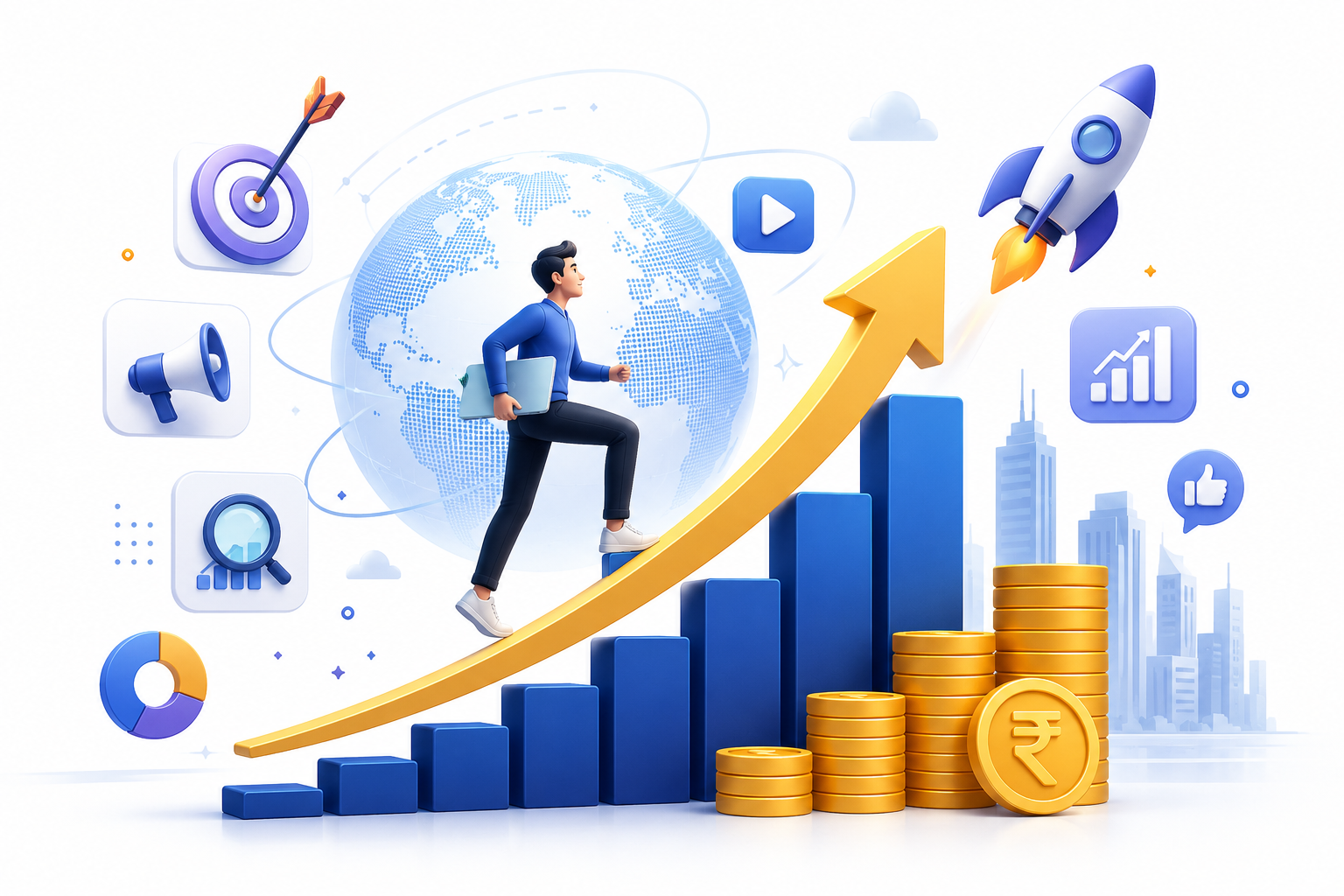
    Visual representing the future scope of digital marketing salaries with a rising graph, digital marketer, coins, rocket, analytics, and global digital marketing growth.

    The future of digital marketing looks promising. As more businesses shift their marketing budgets toward online channels, the demand for skilled professionals is expected to continue rising.

    Technologies such as artificial intelligence, marketing automation, voice search, data analytics, and personalization are changing how businesses connect with customers. Professionals who adapt to these trends will have access to better job opportunities and higher salaries.

    The digital marketing salary for freshers is also expected to improve as companies compete for qualified talent with practical experience and specialized skills.

    Is Digital Marketing the Right Career Path for Beginners?

    Without a doubt, yes. Digital marketing offers several advantages that make it an attractive career choice for beginners:

    • High demand across industries
    • Competitive starting salaries
    •  Fast career progression
    • Opportunities to work remotely
    • Freelancing and consulting options
    • Continuous learning and skill development
    • Global career opportunities

    Unlike many professions that rely heavily on years of experience, digital marketing rewards people who consistently improve their skills and deliver measurable business results.

    Final Thoughts

    If you’re considering a career in digital marketing, now is an excellent time to begin. The demand for skilled professionals continues to grow, and businesses are actively looking for candidates who can help them build a strong online presence.

    The average digital marketing salary for freshers in India typically ranges from ₹2.5 LPA to ₹4.5 LPA, but your actual salary will depend on factors such as your skills, certifications, internship experience, location, and the type of company you join.

    Instead of focusing only on finding a job, invest your time in building practical expertise, creating a strong portfolio, earning recognized certifications, and staying updated with the latest industry trends. These efforts will not only help you secure a better digital marketing salary for freshers but also lay the foundation for long-term career growth.

    Remember, your first salary is just the starting point. With continuous learning and hands-on experience, digital marketing can become one of the most rewarding and future-proof careers available today.

    Author : Sandeep A S

    Freelance Digital Marketer passionate about helping businesses grow through SEO, content marketing, and data-driven digital strategies.

    Learner of DigiSkillz, Digital Marketing Institute in Kochi.

  • 10 Reasons Why Educators Should Invest In Digital Marketing Courses

    10 Reasons Why Educators Should Invest In Digital Marketing Courses

    Digital marketing courses

    Digital Marketing Courses: 10 Reasons Why Educators Should Invest

    The education industry has undergone a remarkable transformation in recent years. Traditional classroom teaching has expanded into online learning, virtual classrooms, webinars, coaching programs, and self-paced courses. Today, students rely heavily on search engines, social media platforms, and educational websites to discover learning opportunities before enrolling in a course.

    For educators, having subject expertise is no longer enough. To reach more learners and establish a strong professional presence, they must also know how to market their knowledge online. This is where digital marketing courses play a crucial role.

    By enrolling in digital marketing courses, educators can learn valuable skills such as Search Engine Optimization (SEO), content marketing, social media marketing, email marketing, paid advertising, and website optimization. These skills help educators attract more students, build trust, increase visibility, and remain competitive in today’s digital-first education landscape.

    Whether you’re a teacher, professor, tutor, trainer, education consultant, or online course creator, investing in digital marketing education is a smart decision for long-term career growth. Here are the top 10 reasons why educators should invest in digital marketing courses.

    1. The Digital World Is Here to Stay

    The digital revolution has transformed almost every industry, and education is no exception. Today, students and parents use search engines, social media platforms, and educational websites to research schools, colleges, coaching centers, certification programs, and online courses before making enrollment decisions. This shift means educators must establish a strong online presence to remain visible and relevant in an increasingly competitive education market.

    Investing in digital marketing courses equips educators with essential skills to promote their expertise effectively. These courses cover important topics such as Search Engine Optimization (SEO), content marketing, social media marketing, email marketing, Google Ads, and website analytics. By understanding these strategies, educators can reach the right audience, build credibility, and increase student enrollments.

    Rather than relying solely on traditional referrals or offline advertising, educators can use digital marketing techniques to consistently attract prospective students, grow their reputation, and build long-term success in the digital education landscape.


    2. Online Digital Marketing Courses Offer Greater Flexibility

    One of the biggest advantages of digital marketing courses is the flexibility they provide. Unlike traditional classroom programs, online courses allow educators to learn from anywhere and at any time. This makes it easier for teachers, professors, tutors, and trainers to upgrade their skills without disrupting their professional responsibilities.

    Most online courses are self-paced, allowing learners to revisit recorded lectures, complete assignments at their convenience, and learn according to their own schedule. Whether you teach full-time or manage multiple responsibilities, online learning offers the convenience needed to continue your professional development.

    Additionally, many digital marketing courses provide lifetime access to study materials, regular updates, and practical projects. This enables educators to continuously improve their knowledge while staying current with the latest digital marketing trends.

    3. Digital Marketing Skills Are in High Demand

    The demand for digital marketing professionals continues to grow across every industry, including education. Schools, universities, coaching institutes, and EdTech companies increasingly seek educators who understand digital marketing strategies to promote courses, engage learners, and build their online presence.

    By enrolling in digital marketing courses, educators gain practical skills in website optimization, search engine marketing, content creation, social media management, lead generation, and online branding. These abilities not only enhance their teaching careers but also make them valuable contributors to educational institutions looking to expand digitally.

    Beyond traditional teaching roles, digital marketing skills create opportunities in educational consulting, online coaching, course creation, and corporate training. As digital learning continues to grow, educators with marketing expertise will have a significant competitive advantage.

    dmc

    4. Learn at Your Own Pace

    Every educator has unique responsibilities and learning preferences. One of the most attractive features of digital marketing courses is the freedom to learn at your own pace. Unlike fixed classroom schedules, online courses allow learners to progress according to their availability and comfort level.

    Educators can revisit recorded lessons whenever needed, complete assignments gradually, and spend extra time mastering topics that require additional practice. This personalized learning approach helps improve knowledge retention and reduces the pressure associated with traditional classroom environments.

    Learning at your own pace also encourages continuous skill development. Educators can steadily build confidence while applying newly acquired marketing techniques directly to their educational websites, courses, or institutions.

    5. Stay Ahead of the Competition

    The online education industry has become increasingly competitive as more educators launch coaching programs, online courses, webinars, and digital learning platforms. Simply having subject expertise is no longer enough to attract students. Educators must also know how to market their knowledge effectively.

    Digital marketing courses teach educators how to optimize websites for search engines, create engaging educational content, improve social media engagement, and build authority through blogging and video marketing. These strategies help educators increase their visibility and reach larger audiences.

    By applying these marketing techniques consistently, educators can differentiate themselves from competitors, establish stronger credibility, and attract more students while building a sustainable online education business.

    6. Learn the Latest Digital Marketing Trends

    Digital marketing evolves rapidly, with search engine algorithms, social media platforms, and consumer behavior constantly changing. Staying updated with these developments is essential for educators who want to maintain a strong online presence and continue attracting new learners.

    Enrolling in digital marketing courses allows educators to stay informed about emerging trends such as Artificial Intelligence (AI), voice search optimization, video marketing, marketing automation, short-form content strategies, and advanced analytics. Understanding these innovations enables educators to adapt quickly to changing digital environments.

    Keeping pace with industry trends not only improves marketing performance but also ensures educators remain relevant in an increasingly technology-driven education sector.


    7. Strengthen Your Resume and Career Opportunities

    Professional development plays an important role in career advancement. Completing digital marketing courses demonstrates a commitment to continuous learning and equips educators with practical skills that employers highly value.

    Adding digital marketing certifications to a resume showcases expertise in SEO, content marketing, analytics, social media management, and online advertising. These qualifications make candidates more attractive to educational institutions, corporate training organizations, and EdTech companies.

    In addition to improving employability, digital marketing knowledge opens doors to careers such as Digital Marketing Trainer, Educational Consultant, Online Course Creator, SEO Specialist, Content Strategist, and Corporate Trainer.

    8. Enhance Your Knowledge of Digital Marketing

    Digital marketing is much more than creating social media posts. It is a comprehensive strategy that combines multiple techniques to increase visibility, engage audiences, and generate measurable results.

    Through digital marketing courses, educators gain a deeper understanding of Search Engine Optimization (SEO), content marketing, email marketing, pay-per-click advertising, conversion rate optimization, Google Analytics, and website performance optimization. These skills allow educators to create more effective marketing campaigns and improve student engagement.

    A strong understanding of digital marketing enables educators to promote courses confidently while making informed decisions based on performance data and user behavior.


    9. Stay Updated with Industry Changes

    Both education and digital marketing are constantly evolving. Search engines regularly update their algorithms, social media platforms introduce new features, and marketing technologies continue to advance. Educators who fail to adapt risk falling behind competitors.Regularly investing in digital marketing courses helps educators remain informed about the latest tools, strategies, and industry best practices. This knowledge enables them to adjust their marketing campaigns, improve student engagement, and maintain effective communication with their target audience.Continuous learning not only improves marketing performance but also ensures long-term career success in the fast-changing digital education environment.

     10. Build a Strong Professional Network

    Networking is another significant advantage of enrolling in digital marketing courses. Many training programs bring together educators, business owners, marketers, entrepreneurs, and industry experts from diverse backgrounds.

    Building professional relationships allows educators to exchange ideas, share experiences, collaborate on projects, and discover new career opportunities. Networking can also lead to guest speaking engagements, strategic partnerships, and valuable mentorship opportunities.

    A strong professional network helps educators stay informed about industry developments while creating opportunities for long-term personal and professional growth.


    dmc

    Additional Benefits of Digital Marketing Courses

    Beyond the reasons discussed above, digital marketing courses offer several long-term benefits for educators. They help improve online visibility, generate qualified student leads, build a strong personal brand, increase website traffic, and strengthen communication with prospective learners.

    These courses also teach educators how to grow social media communities, improve email marketing campaigns, understand audience behavior through analytics, and develop sustainable marketing strategies. Whether working independently or within educational institutions, these skills contribute to long-term professional growth and increased student engagement.


    How to Choose the Right Digital Marketing Course

    With numerous training programs available, choosing the right digital marketing course is essential. Educators should look for comprehensive courses that include practical training in SEO, content marketing, social media marketing, email marketing, Google Ads, Google Analytics, AI-powered marketing tools, and website optimization.

    A high-quality course should also provide live projects, industry-recognized certifications, experienced instructors, and placement or internship support. Hands-on experience helps learners apply theoretical concepts to real-world marketing campaigns.

    Selecting the right digital marketing course ensures educators develop practical skills, gain confidence, and successfully apply modern marketing strategies to grow their careers and educational institutions.

    Conclusion

    As education continues to evolve in the digital era, educators must develop skills beyond traditional teaching methods. Investing in digital marketing courses enables teachers, trainers, professors, and education professionals to build a strong online presence, attract more students, enhance their professional reputation, and create new career opportunities.

    From mastering SEO and social media marketing to understanding analytics and content creation, digital marketing courses equip educators with the practical skills needed to thrive in today’s competitive education landscape. Whether you want to promote your institution, launch an online course, or grow your personal brand, enrolling in digital marketing courses is a valuable investment that delivers long-term benefits.

    By staying updated with the latest digital marketing trends and continuously improving your skills through digital marketing courses, you can expand your reach, inspire more learners, and build a successful future in the ever-growing digital education industry. Choosing the right digital marketing courses can help you stay ahead of the competition and unlock new opportunities for career growth and professional success.


    Tags :
    digitdal marketing strategy
    Author : Sonappan

    Consectetur sollicitudin cubilia facilisis lobortis lacus a ac phasellus. Mus pulvinar enim suspendisse pharetra id commodo platea nunc aliquet.

    Learner of DigiSkillz, Digital Marketing Institute in Kochi.

  • 7 Ways AI Can Transform Your Digital Marketing Strategy

    7 Ways AI Can Transform Your Digital Marketing Strategy

    Digital Marketing Strategy

    7 Ways AI Can Transform Your Digital Marketing Strategy

    The digital marketing landscape is evolving faster than ever before. As customer expectations continue to rise and competition becomes increasingly intense, businesses must find smarter ways to connect with their target audience. This is where Artificial Intelligence (AI) is making a significant impact.

    AI is no longer a futuristic concept reserved for large corporations. Today, businesses of all sizes are using AI-powered tools to improve customer experiences, automate repetitive tasks, analyze massive amounts of data, and make better marketing decisions. Whether it’s personalizing content, predicting customer behavior, or optimizing advertising campaigns, AI is reshaping every aspect of a successful Digital Marketing Strategy.

    Traditional marketing methods often rely on assumptions and manual processes. AI, on the other hand, uses data-driven insights to help marketers understand customers more accurately and deliver highly relevant experiences at scale. This results in improved engagement, higher conversion rates, and better returns on marketing investments.

    In this article, we’ll explore seven powerful ways AI can transform your Digital Marketing Strategy and help your business achieve sustainable growth in the digital era.

    1. Automated Customer Segmentation

    Digital Marketing Strategy

    One of the biggest challenges marketers face is understanding their audience. Every customer has unique interests, behaviors, preferences, and purchasing patterns. Manually segmenting customers can be time-consuming and often lacks precision.

    AI solves this challenge through automated customer segmentation.

    Using machine learning algorithms, AI analyzes customer data from multiple sources, including:

    • Website visits
    • Purchase history
    • Social media engagement
    • Email interactions
    • Demographic information
    • Online behavior

    AI then groups customers into highly targeted segments based on shared characteristics and behaviors.

    For example, an eCommerce business can identify customers who frequently purchase premium products and create specialized campaigns specifically for them. Similarly, marketers can target customers who abandoned their shopping carts with personalized offers.

    Benefits of AI-Powered Segmentation

    • More accurate audience targeting
    • Increased campaign relevance
    • Better customer engagement
    • Improved conversion rates
    • Higher marketing ROI

    Customer segmentation forms the foundation of a successful Digital Marketing Strategy, and AI makes this process faster and more effective than ever.

    2. Optimized Ad Targeting

    Digital advertising consumes a significant portion of most marketing budgets. However, even the most creative advertisements can fail if they reach the wrong audience.

    AI helps businesses optimize ad targeting by identifying users most likely to engage with their products or services.

    AI-powered advertising platforms analyze:

    • Browsing behavior
    • Search history
    • Purchase intent
    • Social media activity
    • Demographic data
    • Previous interactions

    Based on this information, AI determines which audience segments are most likely to convert.

    Additionally, AI continuously learns from campaign performance and automatically adjusts targeting strategies in real time.

    How AI Improves Advertising

    • Reduces wasted ad spend
    • Improves click-through rates
    • Increases conversion rates
    • Enhances customer acquisition
    • Maximizes advertising ROI

    By incorporating AI into your Digital Marketing Strategy, you can ensure your advertising budget is spent more efficiently and effectively.

    3. Enhanced Personalization

    digital marketing strategy

    Today’s consumers expect personalized experiences. Generic marketing messages no longer generate the same level of engagement they once did.

    AI enables businesses to deliver personalized experiences at scale.

    By analyzing customer preferences, browsing history, and behavioral patterns, AI can automatically customize:

    • Website content
    • Product recommendations
    • Email campaigns
    • Promotional offers
    • Social media content

    For example, streaming platforms recommend content based on viewing history, while online retailers suggest products based on previous purchases.

    This level of personalization creates stronger customer relationships and increases brand loyalty.

    Benefits of AI Personalization

    • Improved customer satisfaction
    • Higher engagement rates
    • Increased customer retention
    • More conversions
    • Enhanced user experience

    Personalization has become an essential element of every modern Digital Marketing Strategy, and AI makes it easier to implement effectively.

    4. Automated Insights and Reporting

    Data is one of the most valuable assets in digital marketing. However, collecting, analyzing, and interpreting large amounts of data can be overwhelming.

    AI simplifies this process by automating insights and reporting.

    Instead of spending hours creating reports manually, marketers can use AI-powered analytics tools to gain real-time insights into:

    • Campaign performance
    • Customer behavior
    • Traffic sources
    • Conversion rates
    • Audience demographics
    • Revenue attribution

    AI can also identify trends and opportunities that may otherwise go unnoticed.

    Advantages of AI Reporting

    • Faster decision-making
    • Real-time performance tracking
    • Reduced manual effort
    • Improved campaign optimization
    • Better strategic planning

    A data-driven Digital Marketing Strategy is critical for success, and AI makes data analysis significantly more accessible and actionable.

    Digital Marketing Strategy

    5. Smarter Lead Scoring

    Not every lead has the same potential value. Identifying high-quality leads is essential for maximizing sales and marketing efficiency.

    AI-powered lead scoring helps businesses prioritize leads based on their likelihood to convert.

    AI evaluates multiple factors, including:

    • Website activity
    • Email engagement
    • Demographics
    • Purchase history
    • Content interactions
    • Customer intent signals

    The system then assigns scores to each lead, allowing sales teams to focus on prospects with the highest probability of making a purchase.

    Benefits of AI Lead Scoring

    • Better lead qualification
    • Improved sales productivity
    • Faster conversion cycles
    • Increased revenue opportunities
    • More efficient marketing efforts

    Integrating AI lead scoring into your Digital Marketing Strategy can dramatically improve lead management and overall business performance.

    6. Predictive Analytics

    digital marketing strategy

    Predictive analytics is one of the most powerful applications of AI in marketing.

    Rather than reacting to customer behavior after it occurs, predictive analytics enables businesses to anticipate future actions and trends.

    AI analyzes historical data to predict:

    • Customer purchasing behavior
    • Product demand
    • Campaign performance
    • Churn risk
    • Seasonal trends
    • Market opportunities

    This allows marketers to make proactive decisions instead of reactive ones.

    For example, businesses can identify customers who are likely to stop purchasing and launch retention campaigns before losing them.

    Advantages of Predictive Analytics

    • Improved forecasting
    • Better customer retention
    • Enhanced campaign planning
    • Increased competitive advantage
    • Smarter decision-making

    Predictive analytics strengthens any Digital Marketing Strategy by helping businesses stay ahead of customer needs and market changes.

    7. Increased ROI Through Automation

    One of the primary goals of every Digital Marketing Strategy is maximizing return on investment (ROI).

    AI contributes directly to higher ROI by automating repetitive and time-consuming tasks such as:

    • Email marketing
    • Social media scheduling
    • Customer support
    • Data analysis
    • Campaign optimization
    • Lead nurturing

    Automation reduces operational costs while improving efficiency and productivity.

    AI also continuously monitors campaign performance and recommends improvements that maximize results.

    How AI Improves ROI

    • Reduced marketing costs
    • Increased operational efficiency
    • Higher conversion rates
    • Better resource allocation
    • Improved campaign effectiveness

    Businesses that leverage AI effectively often achieve better results with fewer resources compared to traditional marketing approaches.

    digital marketing strategy

    The Future of AI in Digital Marketing

    As AI technology continues to evolve, its role in marketing will become even more significant.

    Emerging AI capabilities include:

    • Conversational AI chatbots
    • Voice search optimization
    • Hyper-personalized customer experiences
    • Advanced predictive modeling
    • AI-generated content creation
    • Real-time customer journey optimization

    Businesses that embrace these innovations will gain a competitive advantage and build stronger relationships with their audiences.

    AI is no longer just a helpful tool—it is becoming a core component of every successful Digital Marketing Strategy.

    Conclusion

    Artificial Intelligence is transforming the way businesses approach digital marketing. From automated customer segmentation and optimized ad targeting to predictive analytics and personalized customer experiences, AI enables marketers to make smarter decisions and achieve better results.

    Organizations that integrate AI into their Digital Marketing Strategy can improve efficiency, enhance customer engagement, generate higher-quality leads, and maximize return on investment.

    As technology continues to advance, adopting AI-driven marketing solutions will become increasingly important for businesses that want to remain competitive and grow in the digital age. The future of marketing is intelligent, data-driven, and powered by AI—and the time to embrace it is now.

    Tags :
    digitdal marketing strategy
    Author : Akash

    Consectetur sollicitudin cubilia facilisis lobortis lacus a ac phasellus. Mus pulvinar enim suspendisse pharetra id commodo platea nunc aliquet.

    Learner of DigiSkillz, Digital Marketing Institute in Kochi.

  • Marketing vs Branding: Key Differences Every Business Should Know

    Marketing vs Branding: Key Differences Every Business Should Know

    Digital marketing course in kochi marketing vs branding

    In today’s competitive business world, many people use the terms marketing and branding interchangeably. Although they work together to help businesses grow, they are not the same. Understanding marketing vs branding is essential for entrepreneurs, business owners, marketers, and students who want to build successful businesses and strong customer relationships.

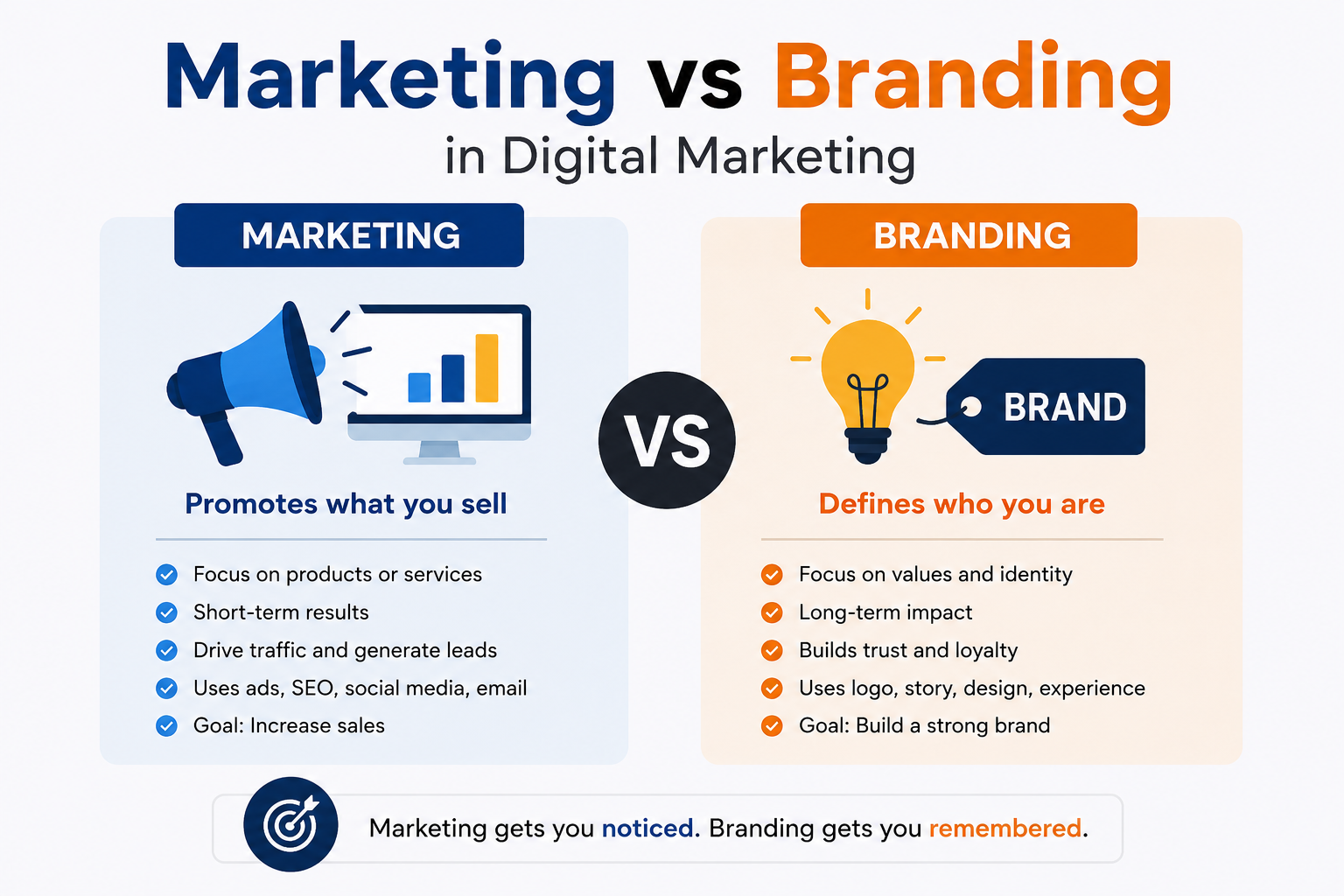
    Marketing focuses on promoting products or services to generate leads and increase sales. Branding, on the other hand, is about creating a unique identity and building trust that keeps customers coming back. A business may run excellent marketing campaigns, but without strong branding, it can struggle to create lasting customer loyalty.

    This guide explains the major differences between marketing and branding, their goals, strategies, benefits, and why businesses need both for long-term success.

    What is Marketing?  

    When discussing marketing vs branding, marketing represents the promotional side of a business. It includes advertising, SEO, social media marketing, content marketing, and paid campaigns that help attract potential customers and increase conversions.

    The primary objective of marketing is to increase awareness, generate leads, and boost revenue. Marketing campaigns are often designed for short-term goals and can be adjusted quickly based on customer behavior and market trends.

    Some common marketing strategies include:

    • Search Engine Optimization (SEO)
    • Pay-Per-Click (PPC) Advertising
    • Social Media Marketing
    • Email Marketing
    • Content Marketing
    • Influencer Marketing
    • Video Marketing
    • Affiliate Marketing

    Successful marketing helps businesses reach the right audience at the right time while maximizing return on investment (ROI).Before exploring each concept individually, it’s important to understand how marketing vs branding contributes to overall business growth.

    What is Branding?

    Branding is the process of creating a unique identity that differentiates a business from its competitors. It shapes how customers perceive a company and influences their emotional connection with the brand.

    A strong brand includes more than just a logo or color scheme. It represents the company’s values, mission, personality, customer experience, and reputation.

    Branding helps businesses:

    • Build trust with customers
    • Increase brand recognition
    • Create emotional connections
    • Encourage customer loyalty
    • Stand out in competitive markets

    Unlike marketing, branding is a long-term investment. While marketing attracts customers, branding ensures they remember and return to your business.

    Marketing vs Branding: Understanding the Difference

    The comparison between marketing vs branding becomes easier when you understand that marketing drives customer acquisition, while branding strengthens customer retention. Both are essential for sustainable business growth.

    Marketing focuses on driving immediate sales through promotional activities. Branding focuses on building a lasting reputation that influences purchasing decisions over time.

    Think of branding as the personality of your business and marketing as the communication strategy that introduces that personality to the world.

    For example, a digital marketing campaign may attract visitors to your website, but a strong brand convinces them to trust your company and become loyal customers.

    digital marketing course in kochi marketing vs branding

    Key Differences Between Marketing and Branding

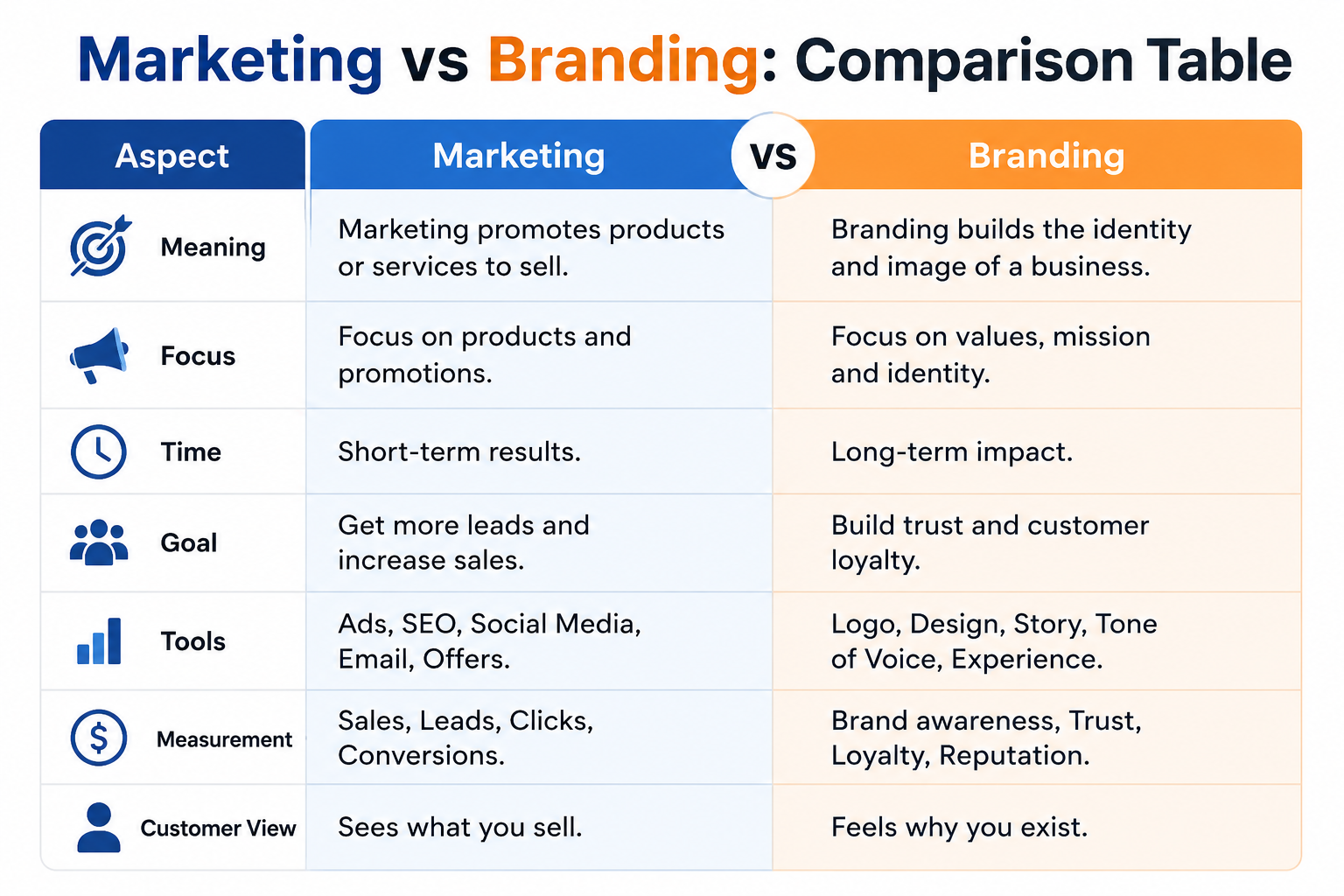
    Comparing marketing vs branding helps businesses understand how promotional activities and brand identity work together.

    1. Purpose

    Marketing aims to generate leads, increase sales, and grow revenue through promotional activities.

    Branding aims to create trust, credibility, and long-term customer relationships by establishing a memorable business identity.

    2. Timeframe

    Marketing campaigns usually have short-term objectives. They may run for a few weeks or months depending on business goals.

    Branding is a continuous process that develops over many years through consistent customer experiences and communication.

    3. Focus

    Marketing focuses on products, services, pricing, promotions, and customer acquisition.

    Branding focuses on company values, mission, identity, customer perception, and emotional connection.

    4. Success Metrics

    Marketing performance is measured using data such as:

    • Website traffic
    • Conversion rates
    • Lead generation
    • Click-through rates
    • Return on investment (ROI)
    • Sales revenue

    Branding success is measured through:

    • Brand awareness
    • Customer loyalty
    • Brand recognition
    • Customer trust
    • Reputation
    • Customer retention

    Why Marketing and Branding Work Together

    Many businesses mistakenly believe they only need marketing to succeed. In reality, marketing and branding are most effective when they work together.

    Imagine spending thousands of dollars on advertisements. Your campaigns may attract visitors, but if your business lacks credibility, customers are unlikely to make a purchase.

    Similarly, a business with an excellent brand but no marketing strategy may struggle to reach new customers.

    Marketing creates visibility.

    Branding builds trust.

    Together, they create sustainable business growth.

    Marketing vs Branding in Digital Marketing

    Digital marketing has made the relationship between marketing and branding even more important.

    Businesses now interact with customers through websites, search engines, social media platforms, email campaigns, YouTube, and online advertisements. Every interaction contributes to both marketing performance and brand perception.

    For example:

    • SEO improves website visibility.
    • Content marketing builds authority.
    • Social media strengthens brand personality.
    • Email marketing nurtures customer relationships.
    • PPC advertising generates immediate leads.
    • Online reviews improve brand trust.

    A successful digital strategy combines these elements to create both short-term results and long-term brand value.

    Common Marketing Channels

    Businesses today use multiple channels to reach their audience, including:

    • Google Search
    • Facebook and Instagram Ads
    • LinkedIn Marketing
    • YouTube Marketing
    • Email Campaigns
    • Content Marketing
    • Search Engine Optimization (SEO)
    • Influencer Marketing
    • Affiliate Marketing
    • Mobile Marketing

    Choosing the right channels depends on your target audience, business goals, and budget.

    How to Build a Strong Branding Strategy

    A successful branding strategy helps businesses create a memorable identity and establish long-term relationships with customers. Here are the key steps to building a strong brand:

    1. Define Your Brand Identity

    Start by identifying your mission, vision, values, and unique selling proposition (USP). These elements form the foundation of your brand and communicate what your business stands for.

    2. Know Your Target Audience

    Understanding your audience is essential for both marketing and branding. Research their demographics, interests, challenges, and purchasing behavior to create messaging that resonates with them.

    3. Create a Consistent Brand Voice

    Your communication style should remain consistent across your website, social media, advertisements, emails, and customer support. A consistent tone strengthens brand recognition and builds trust.

    4. Design a Memorable Visual Identity

    Your logo, typography, color palette, and website design should reflect your brand personality. A professional and consistent visual identity makes your business instantly recognizable.

    5. Deliver Excellent Customer Experience

    Every customer interaction shapes your brand. Providing exceptional products, services, and support encourages positive reviews, repeat business, and word-of-mouth referrals.

    Marketing vs Branding: Comparison Table

    Digital marketing course in kochi marketing vs branding

    Real-World Example of Marketing vs Branding

    Imagine two coffee shops opening in the same neighborhood.

    The first coffee shop spends heavily on social media ads and promotional offers. Customers visit because of the discounts, but many don’t return once the offers end.

    The second coffee shop invests in creating a welcoming atmosphere, consistent branding, friendly service, quality products, and an engaging online presence. Customers remember the experience, recommend it to friends, and become loyal visitors.

    The first business relied mainly on marketing.

    The second combined effective marketing with strong branding.

    This example highlights why marketing vs branding is not a competition. The most successful businesses integrate both strategies to achieve sustainable growth.

    This example clearly demonstrates why marketing vs branding should be treated as complementary strategies rather than competing concepts.

    Common Mistakes Businesses Make Digital marketing course in kochi marketing vs branding

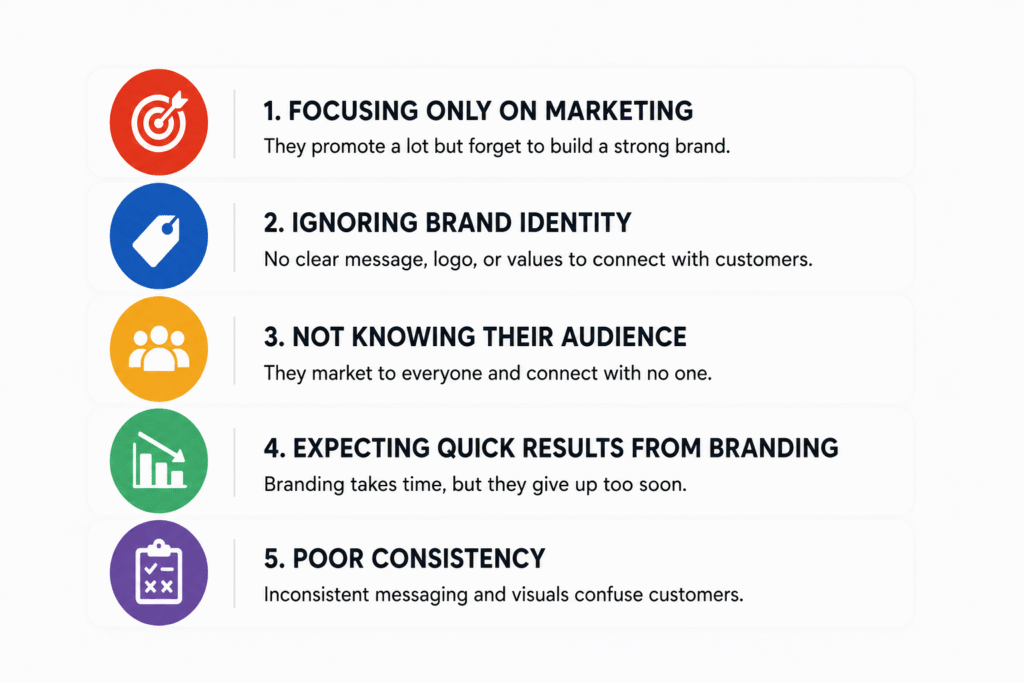
    Many businesses struggle because they misunderstand the relationship between marketing and branding. Some common mistakes include:

    • Running advertising campaigns without a clear brand identity.
    • Frequently changing logos, colors, or messaging.
    • Focusing only on sales instead of customer relationships.
    • Ignoring customer feedback and online reviews.
    • Creating inconsistent content across different platforms.
    • Investing in branding but neglecting marketing efforts.

    Avoiding these mistakes helps businesses build credibility and maximize the impact of their marketing campaigns.Many businesses fail because they misunderstand marketing vs branding and focus on one while ignoring the other.

    Best Practices for Combining Marketing and Branding

    To achieve long-term success, businesses should integrate marketing and branding into a single strategy.

    Some best practices include:

    • Maintain consistent messaging across all marketing channels.
    • Create valuable, informative content that reflects your brand values.
    • Invest in SEO to increase organic visibility.
    • Use social media to engage with your audience and strengthen relationships.
    • Monitor marketing performance using analytics.
    • Collect customer feedback to improve both your marketing and branding efforts.
    • Continuously adapt your marketing strategies while maintaining a consistent brand identity.

    Why Both Marketing and Branding Matter

    Businesses often ask whether marketing or branding is more important. The truth is that both are essential.

    Marketing helps businesses reach new audiences, generate leads, and increase revenue.

    Branding transforms first-time buyers into loyal customers by creating trust, credibility, and emotional connections.

    Without marketing, potential customers may never discover your business.

    Without branding, customers may forget your business after making a purchase.

    The most successful companies combine strategic marketing with strong branding to create sustainable growth and long-term customer loyalty.

    Frequently Asked Questions

    Is marketing the same as branding?

    No. Marketing promotes products and services to generate sales, while branding builds a company’s identity, reputation, and customer trust.

    Which comes first: marketing or branding?

    Branding should come first. A strong brand identity provides the foundation for effective marketing campaigns and consistent communication.
    Can a business succeed with marketing alone?

    Marketing can generate short-term sales, but long-term success requires strong branding to build customer loyalty and brand recognition.

    Why is branding important in digital marketing?

    Branding creates consistency across websites, social media, email campaigns, and online advertisements. It improves trust, recognition, and customer engagement.

    Conclusion

    Understanding marketing vs branding is essential for building a successful business. Whether you are a student, entrepreneur, or business owner, understanding marketing vs branding gives you a competitive advantage. Although they serve different purposes, they complement each other and work best when combined.

    Marketing helps attract potential customers through promotional strategies, advertising, SEO, content marketing, and digital campaigns. Branding builds the trust, credibility, and emotional connection that encourages customers to stay loyal and recommend your business to others.

    Whether you’re launching a startup, managing an established company, or learning digital marketing, investing in both marketing and branding will create stronger customer relationships, improve business visibility, and support long-term growth.

    By developing a consistent brand identity and implementing effective marketing strategies, businesses can stand out in competitive markets and achieve lasting success. Mastering marketing vs branding allows businesses to create effective campaigns while building a strong and memorable brand. 

    Tags :
    digitdal marketing strategy
    Author : Sneha

    Freelance Digital Marketer passionate about helping businesses grow through SEO, content marketing, and data-driven digital strategies.

    Learner of DigiSkillz, Digital Marketing Institute in Kochi.

  • Google Bard AI: Features, Benefits, Use Cases, and Its Impact on SEO & Digital Marketing

    Google Bard AI: Features, Benefits, Use Cases, and Its Impact on SEO & Digital Marketing

    Google Bard AI

    Google Bard AI: Features, Benefits, Use Cases, and Its Impact on SEO & Digital Marketing

    Artificial Intelligence has transformed the way people search for information, create content, and interact online. One of Google’s biggest innovations in AI is Google Bard AI, an intelligent conversational chatbot designed to provide fast, accurate, and helpful responses to users.

    Initially launched as Google’s answer to ChatGPT, Google Bard AI was built using Google’s advanced language models to make searching for information more conversational and efficient. Although Bard has now evolved into Google Gemini, the term Google Bard AI remains widely searched and is still important for understanding Google’s AI journey.

    What is Google Bard AI?

    Google AI updates: Bard and its new features 2023

    Google Bard AI is Google’s AI-powered chatbot that helps users answer questions, generate content, summarize information, and complete various tasks using natural language. Unlike traditional search engines that display a list of links, Google Bard AI provides conversational, human-like responses. It was initially powered by LaMDA (Language Model for Dialogue Applications) before evolving into more advanced Gemini models for improved accuracy and performance.

    Key Features of Google Bard AI

    Google Bard AI offers powerful features that make it a valuable AI assistant for students, professionals, developers, and digital marketers. Its conversational AI provides natural, human-like responses, while real-time web access delivers up-to-date information. It also helps users create blog posts, social media content, emails, and marketing copy quickly.

    In addition, Google Bard AI supports coding by generating code, debugging errors, and explaining programming concepts. Its summarization feature condenses lengthy articles and documents, while its creative writing capabilities help generate stories, business ideas, video scripts, and marketing content, making it an effective tool for boosting productivity and creativity.

    What is LaMDA?

     Google AI updates: google Bard and its new features 2023

    LaMDA stands for Language Model for Dialogue Applications.

    It is Google’s conversational AI model designed specifically for dialogue. Unlike traditional search algorithms, LaMDA understands context, allowing conversations to flow naturally from one topic to another.

    Its key strengths include:

    • Context awareness
    • Human-like conversations
    • Better understanding of user intent
    • Improved language generation

    LaMDA laid the foundation for Google Bard AI before Google transitioned to more advanced AI models.

    How to Use Google Bard AI

    1. Visit the Google AI platform.
    2. Sign in with your Google account.
    3. Enter your question or prompt.
    4. Receive AI-generated responses.
    5. Continue the conversation by asking follow-up questions.

    The interface is designed to feel like chatting with a knowledgeable assistant.

    Google Bard AI Use Cases

    Google Bard AI is a versatile AI tool that can be used across various industries and everyday tasks. It helps users create blogs, articles, website content, and social media posts, making content creation faster and more efficient. Students and researchers can use AI to summarize complex topics, understand difficult concepts, and gather information quickly. Businesses benefit from its ability to draft emails, create marketing campaigns, write product descriptions, and improve customer communication. Developers can generate code, debug programs, and learn programming concepts, while travelers can use AI to discover destinations, plan itineraries, and receive personalized travel recommendations.

    Benefits of Google Bard AI

    One of the biggest advantages of Google Bard AI is its ability to improve productivity by providing quick, accurate, and real-time information. It supports content creation, creative brainstorming, coding assistance, and task automation, helping users save time and work more efficiently. Whether you’re a student, professional, or business owner,  AI enhances learning, creativity, and decision-making.

    Google Bard AI in Digital Marketing

    For digital marketers, Google Bard AI simplifies many daily tasks, including generating blog outlines, SEO-friendly content, email campaigns, PPC ad copy, social media captions, product descriptions, and customer support responses. By combining the capabilities of  AI with human creativity and SEO expertise, businesses can improve content quality, increase productivity, and strengthen their digital marketing strategies.

    Conclusion

    Google Bard AI has transformed content creation, SEO, and digital marketing by making information more accessible and improving productivity. Although it has evolved into Google Gemini, understanding Google Bard AI remains valuable for businesses, marketers, and professionals embracing AI technology.

    Tags :
    digitdal marketing strategy
    Author : Dilshad

    Consectetur sollicitudin cubilia facilisis lobortis lacus a ac phasellus. Mus pulvinar enim suspendisse pharetra id commodo platea nunc aliquet.

    Learner of DigiSkillz, Digital Marketing Institute in Kochi.

  • The Future of SEO: Constantly Evolving and Adapting to Change

    The Future of SEO: Constantly Evolving and Adapting to Change

    future of SEO

    Ultimate Future of SEO: Constantly Evolving and Adapting to Change

    The future of SEO is an ever-changing landscape. As technology and consumer behaviour continue to evolve, it’s important for businesses and marketers to keep up with the latest trends in order to stay ahead of the competition. In this blog post, we’ll be taking a closer look at how the future of SEO is constantly evolving and adapting to the ever-changing digital environment.future-of-seo

    SEO is Constantly Evolving

    Search engine optimization (SEO) is constantly evolving in order to keep up with the ever-changing digital landscape. It is important for SEO experts and marketers to be aware of the latest trends and strategies in order to remain competitive. As search engine algorithms and user expectations evolve, it is essential to stay up to date on the most recent SEO best practices.

    One of the top SEO future trends that marketers must be aware of is local search optimization. With the increasing popularity of mobile devices, local searches have become increasingly important for businesses that want to attract nearby customers. Therefore, optimizing for local search results has become an essential component of a comprehensive SEO strategy.

    Additionally, voice search is also a trend that is gaining traction as more consumers are using voice-activated devices to find information. For this reason, it is important to optimize content for conversational search queries so that they can be easily discovered by voice search.

    Furthermore, artificial intelligence (AI) is also a major factor in the future of SEO. AI technologies are being used to analyze vast amounts of data quickly and accurately, enabling companies to better target potential customers and optimize their content for higher rankings. All of these emerging trends underscore the importance of keeping up with the latest SEO best practices.

    future-of-seo

    Changes in Technology

    As the world becomes increasingly more digital, so too does the way businesses conduct their marketing and search engine optimization. Technology is constantly improving and advancing, and the future of SEO will have to adjust to keep up with these changes. For example, the increasing popularity of mobile devices has changed the way we access the internet and search for information, meaning that companies must now focus on optimizing their content for mobile users.

    Additionally, voice search technology is rapidly developing, with more and more people now using voice-activated virtual assistants like Alexa or Google Home to search for content online. This means that businesses must optimize their websites for conversational searches, making sure that they are providing accurate answers to relevant questions. In order to stay ahead of the curve, it’s important to be aware of current trends in technology and how they may affect the future of SEO.

    Changes in Consumer Behavior

    The future of SEO is closely tied to changes in consumer behaviour. Consumers today are increasingly using mobile devices, spending more time online, and expecting tailored content. Companies must respond to these changes in order to stay ahead of the competition. To do so, they must understand how their target audience uses the web and optimize their SEO strategies accordingly.

    One of the most important changes to keep an eye on is how users search for information. As people become more comfortable with voice search, for example, companies will need to adjust their SEO strategies to target long-tail keywords that better match the way people talk. 

    The future of SEO will also require companies to provide a better user experience, which includes faster page load times, mobile optimization, and quick response times.

    Additionally, companies must create content that appeals to users by being engaging and helpful. Finally, as social media continues to be a major influence in the world of search engine optimization, companies should prioritize developing a strong presence on platforms such as Facebook, Twitter, and Instagram. 

    By keeping an eye on changes in consumer behaviour, companies can stay one step ahead of the competition and position themselves well for success in the ever-evolving world of SEO.

    future-of-seo

    The Future of SEO

    As SEO continues to evolve, it is important to stay on top of the latest trends in order to stay ahead of the competition. It is essential to recognize and understand the changes in technology and consumer behaviour that can affect SEO in order to develop an effective strategy for success.

    Technology is always changing, and it is no different when it comes to SEO. As new technologies become available, they can have a significant impact on how search engines rank websites. For example, Google’s algorithm is constantly being updated and improved to better understand user queries and deliver more relevant results. Therefore, keeping up with the latest updates and changes in technology is critical for any website trying to stay ahead of the competition.

    Consumer behaviour is also changing, as more people are using mobile devices and voice assistants to search for information online. As a result, businesses must ensure that their websites are optimized for these new technologies in order to appear higher in search engine rankings.

    Additionally, SEO must be tailored to meet the needs of these consumers, such as using relevant keywords in content and optimizing for local searches.

    The future of SEO will continue to include the importance of staying up-to-date with the latest technologies and trends in order to remain competitive.

    Additionally, businesses should focus on providing valuable content that meets the needs of their target audiences, as well as optimizing their websites for both desktop and mobile devices. Taking advantage of SEO future trends such as voice search optimization, artificial intelligence (AI), and structured data will also be important to maintain high rankings in the future.

    Conclusion

    In conclusion, the future of SEO is constantly evolving and adapting to changes in technology and consumer behaviour. As search engines become more advanced and user behaviour shifts, SEO professionals will need to stay informed and adapt their strategies to stay ahead of the curve. From the increasing importance of artificial intelligence and machine learning to the growing importance of mobile optimization and local SEO, the future of SEO is filled with exciting opportunities and challenges. By staying informed and staying ahead of the curve, SEO professionals can continue to deliver the best possible results for their clients and help their businesses stay ahead of the competition in the digital marketplace.

    Tags :
    digitdal marketing strategy
    Author : Anjana

    Consectetur sollicitudin cubilia facilisis lobortis lacus a ac phasellus. Mus pulvinar enim suspendisse pharetra id commodo platea nunc aliquet.

    Learner of DigiSkillz, Digital Marketing Institute in Kochi.

  • The 5 Reasons To Enroll in a Best Digital Marketing Course in India 2023

    The 5 Reasons To Enroll in a Best Digital Marketing Course in India 2023

    Reasons to Enroll in a Digital Marketing Course in 2026

    The digital world is growing faster than ever, and businesses are constantly looking for skilled professionals who can help them succeed online. Whether you’re a student, entrepreneur, freelancer, or working professional, enrolling in a digital marketing course is one of the smartest investments you can make.

    A quality digital marketing course helps you master the latest marketing strategies, build practical skills, and unlock exciting career opportunities. In this guide, we’ll explore five compelling reasons why joining a digital marketing course can transform your future.

    Learn the Latest Digital Marketing Trends

    Digital marketing is constantly evolving. Search engine algorithms, social media platforms, and AI-powered marketing tools are changing every year.

    A modern digital marketing course helps you stay updated with:

    • Search Engine Optimization (SEO)
    • Google Ads (PPC)
    • Social Media Marketing
    • Content Marketing
    • Email Marketing
    • AI-powered Marketing Tools
    • Analytics and Performance Tracking

    Learning these skills keeps you ahead of industry changes.

    Stay Ahead of the Competition

    Best digital marketing course in india

    Businesses that use effective digital marketing strategies attract more customers and generate higher revenue. By completing a digital marketing course, you’ll gain the skills to create high-performing campaigns that outperform competitors.

    You’ll learn how to:

    • Build successful marketing strategies
    • Increase website traffic
    • Generate quality leads
    • Improve conversion rates
    • Measure campaign performance

    These practical skills can give both individuals and businesses a significant competitive advantage

    Develop In-Demand Skills

    best digital marketing course in india

    A good digital marketing course focuses on hands-on learning instead of theory.

    You’ll gain experience with tools such as:

    • Google Analytics
    • Google Search Console
    • Meta Ads Manager
    • Canva
    • WordPress
    • Keyword Research Tools
    • Email Marketing Platforms

    Working on live projects builds confidence and prepares you for real business challenges.

    Boost Your Career Opportunities

    best digital marketing course in india

    Digital marketing offers a wide range of career paths.

    After completing a digital marketing course, you can work as:

    • Digital Marketing Executive
    • SEO Specialist
    • Social Media Manager
    • PPC Expert
    • Content Marketer
    • Email Marketing Specialist
    • Digital Marketing Consultant
    • Freelancer

    You can also start your own digital marketing agency or promote your own business online.

    Affordable Learning with High ROI

    Compared to many professional courses, a digital marketing course is affordable while offering excellent career opportunities.

    The skills you gain can help you:

    • Earn a higher salary
    • Start freelancing
    • Build your own business
    • Work remotely
    • Generate passive income through online businesses

    It’s an investment that continues to deliver long-term value.

    Final Thoughts

    A digital marketing course is more than just a certification—it’s a gateway to exciting career opportunities and business growth. Whether you’re beginning your career or looking to upgrade your skills, learning digital marketing can help you stay competitive in today’s digital economy.

    Choose a course that offers practical training, experienced mentors, and industry-recognized certification. The sooner you start learning, the sooner you’ll be ready to build a successful future in digital marketing.

    Tags :
    digitdal marketing strategy
    Author : anshif

    Consectetur sollicitudin cubilia facilisis lobortis lacus a ac phasellus. Mus pulvinar enim suspendisse pharetra id commodo platea nunc aliquet.

    Learner of DigiSkillz, Digital Marketing Institute in Kochi.

  • A Practical Guide to Building a Successful Career in Digital Marketing

    A Practical Guide to Building a Successful Career in Digital Marketing

    Digital Marketing

    A Practical Guide to Building a Successful Career in Digital Marketing

    Digital Marketing has become one of the most exciting and rewarding career options in today’s digital-first world. As businesses increasingly rely on online platforms to reach customers, the demand for skilled Digital Marketing professionals continues to grow. Whether you are a student, graduate, entrepreneur, or someone looking for a career change, learning Digital Marketing can open the door to numerous job opportunities across industries.

    Unlike traditional marketing, Digital Marketing focuses on promoting products and services through online channels such as search engines, social media, websites, email, and paid advertising. It combines creativity, data analysis, and technology, making it an ideal career for individuals who enjoy learning and solving problems. If you are planning to build a successful career in Digital Marketing, here are five practical tips to help you get started.

    1. Keep Learning and Stay Updated

    The world of Digital Marketing evolves rapidly. Search engine algorithms, social media platforms, AI tools, and customer preferences change frequently, making continuous learning essential. Successful digital marketers invest time in learning new strategies, testing new tools, and staying informed about industry updates.

    Follow trusted marketing blogs, attend webinars, complete online certifications, and practice with real projects. At the same time, be willing to unlearn outdated techniques that no longer produce results. The ability to adapt is one of the most valuable skills in Digital Marketing and will help you stay competitive throughout your career.

    start-a-career-in-digital-marketing

    2. Learn from Competitors and Industry Leaders

    One of the fastest ways to improve your Digital Marketing skills is by studying successful brands and experienced marketers. Observe how leading companies create engaging content, optimize their websites, run advertising campaigns, and communicate with their audience.

    Analyze their SEO strategies, social media presence, email marketing campaigns, and website design. Understanding what works in your industry can inspire new ideas and help you build better marketing strategies. Instead of copying competitors, use their success as motivation to create unique campaigns that reflect your own creativity and expertise.

    3. Build Practical Skills Through Hands-on Experience

    Practical experience is more valuable than theoretical knowledge in Digital Marketing. Employers prefer candidates who can demonstrate real-world skills rather than simply listing certifications on a resume.

    Start your own blog, build a website, manage social media pages, or work on freelance projects to gain experience. Learn essential areas such as Search Engine Optimization (SEO), Google Ads, Meta Ads, content marketing, email marketing, Google Analytics, and social media marketing. These skills will help you build a strong portfolio and increase your confidence when applying for jobs or working with clients.

    The more projects you complete, the stronger your understanding of Digital Marketing becomes.

    4. Develop Creativity and Problem-Solving Skills

    Creativity plays a major role in Digital Marketing. Every business wants to stand out online, and creative campaigns often attract more attention than ordinary ones. Successful marketers combine creativity with data to produce content that engages audiences and drives results.

    Experiment with blog writing, video marketing, graphic design, storytelling, and social media campaigns. Don’t be afraid to test new ideas and learn from your mistakes. Every campaign teaches valuable lessons that improve your skills.

    In addition to creativity, problem-solving is equally important. Every marketing campaign presents new challenges, and the ability to analyze data, identify issues, and find effective solutions will make you a more valuable Digital Marketing professional.

    start-a-career-in-digital-marketing

    5. Listen to Customer Feedback

    Understanding your audience is the foundation of successful Digital Marketing. Customer feedback provides valuable insights into what people like, dislike, and expect from a brand. Collecting feedback helps businesses improve products, services, and marketing campaigns.

    Use online surveys, social media comments, Google Reviews, email questionnaires, and website feedback forms to gather customer opinions. Analyze this information to understand customer behavior and improve future marketing strategies.

    Listening to your audience helps build trust, strengthen customer relationships, and create marketing campaigns that deliver better results.

    Build Your Personal Brand

    Build a strong online presence by creating a professional LinkedIn profile, sharing valuable content, and showcasing your Digital Marketing projects. A personal portfolio can help demonstrate your skills and attract employers or clients.

    Network with Industry Professionals

    Connect with Digital Marketing professionals through webinars, events, and online communities. Networking helps you learn new skills, stay updated with industry trends, and discover career opportunities.

    Career Opportunities in Digital Marketing

    A career in Digital Marketing offers various roles, including SEO Specialist, Social Media Manager, Content Marketer, Google Ads Expert, Content Writer, and Digital Marketing Manager. You can also work as a freelancer or start your own agency.

    Conclusion

    Digital Marketing offers excellent career opportunities for those willing to learn and grow. By building practical skills, staying updated, and gaining real-world experience, you can build a successful and rewarding career in this fast-growing industry.

    Tags :
    digitdal marketing strategy
    Author : Swetha

    Consectetur sollicitudin cubilia facilisis lobortis lacus a ac phasellus. Mus pulvinar enim suspendisse pharetra id commodo platea nunc aliquet.

    Learner of DigiSkillz, Digital Marketing Institute in Kochi.

  • Chatbot Marketing: Transforming Customer Engagement in the Digital Age

    Chatbot Marketing: Transforming Customer Engagement in the Digital Age

    chatbot marketing

    Chatbot Marketing: Transforming Customer Engagement in the Digital Age

    What is Chatbot Marketing?

    Chatbot Marketing: Transforming Customer Engagement in the Digital Age

    Chatbot marketing is the use of AI-powered conversational tools to engage with customers, streamline interactions, and drive conversions. These automated agents simulate human conversations on platforms like websites, messaging apps, and social media. Chatbots can answer customer inquiries, recommend products, collect leads, and even process transactions, making them a powerful tool for businesses.

    Unlike traditional communication methods, chatbots operate 24/7, providing instant support and personalized experiences. They range from simple rule-based systems, which follow predefined scripts, to advanced AI-driven models that leverage machine learning and natural language processing (NLP) to understand and respond to complex queries.

    This technology enhances customer engagement, reduces operational costs, and scales effortlessly to handle multiple conversations simultaneously. By integrating chatbots into marketing strategies, businesses can improve customer satisfaction, boost retention, and increase sales, making chatbot marketing an essential component of modern digital marketing.

    Types of Chatbots

    Chatbot Marketing: Transforming Customer Engagement in the Digital Age

    Based on their capabilities and underlying technology, chatbots are divided into several categories:

    1. Rule-Based Chatbots: To respond, these adhere to pre-programmed guidelines and scripts.They are ideal for handling simple queries like FAQs or guiding users through basic processes. While limited in scope, rule-based chatbots are reliable for predictable interactions.

    2. AI-Powered Chatbots: AI-powered chatbots use natural language processing and machine learning to understand user intent and context.Unlike rule-based bots, they learn from past interactions, improving their ability to deliver personalized and accurate responses 

    3. Hybrid Chatbots: A combination of rule-based and AI-powered systems, hybrid chatbots offer the best of both worlds. They automate routine tasks while seamlessly transferring complex queries to human agents, ensuring a smooth customer experience.

    Benefits of Chatbot Marketing

    hatbot markeChatbot Marketing: Transforming Customer Engagement in the Digital Age

    Cting offers a multitude of advantages for businesses and customers alike:

    1. 24/7 Availability: Chatbots provide round-the-clock support, ensuring that customers receive assistance regardless of time zones or working hours.

    2. Instant Responses: By eliminating wait times, chatbots enhance customer satisfaction and reduce bounce rates, particularly on websites.

    3. Cost Efficiency: Automating repetitive tasks reduces the need for extensive human support teams, resulting in significant cost savings.

    4. Enhanced Engagement: Interactive conversations captivate users, fostering stronger connections and higher retention rates.

    5. Scalability: Chatbots are perfect for companies with expanding clientele since they can manage several chats at once.

    How Chatbots Work

    Chatbot Marketing: Transforming Customer Engagement in the Digital Age

    Chatbots rely on a blend of technologies to simulate human-like conversations:

    1. Natural Language Processing (NLP): NLP enables chatbots to interpret and process human language. By breaking down user input into smaller components, chatbots understand context and intent, facilitating accurate responses.

    2. Machine Learning (ML): Machine learning models help chatbots learn from past interactions, improving their ability to handle diverse queries and deliver personalized solutions.

    3. Automation: Chatbots automate repetitive processes like order confirmations, appointment scheduling, and FAQ responses, freeing up human agents for more complex tasks.

    Chatbot Platforms and Tools

    Chatbot Marketing: Transforming Customer Engagement in the Digital Age

    Chatbot platforms and tools have become essential for businesses to implement conversational marketing strategies effectively. These tools enable the creation, deployment, and management of chatbots across various channels like websites, social media, and messaging apps.

    1. Drift: Drift specializes in conversational marketing, helping businesses engage website visitors, qualify leads, and book meetings in real time.It is popular for B2B marketing and sales automation.

    2. HubSpot: HubSpot’s chatbot builder integrates seamlessly with its CRM, enabling businesses to create personalized customer experiences, automate support, and streamline sales processes.

    3. ManyChat: Designed for Facebook Messenger and Instagram, ManyChat allows businesses to create bots for social media engagement, lead generation, and customer support with an easy-to-use interface.

    4. WhatsApp Business API: Ideal for global businesses, this tool enables customer interaction on WhatsApp, offering features like notifications, customer support, and transactional updates.

    5. Intercom: Known for its versatility, Intercom supports customer service, sales, and marketing with AI-driven chatbots that integrate with various platforms.

    Because every platform has different characteristics, it’s critical to select one that complements your company’s objectives. Implementing the right chatbot tool can enhance customer interactions, improve efficiency, and drive measurable results.

    Chatbot Marketing Use Cases

    Chatbot Marketing: Transforming Customer Engagement in the Digital Age

    Chatbots can be used in many different industries:

    1. E-commerce: Provide instant product recommendations based on user preferences.Assist customers during checkout by addressing queries.Send updates on order status, shipping, and delivery.

    2. Lead Generation: Qualify leads by gathering information through interactive conversations.Send quality leads to the sales department so they may be followed up upon.Engage website visitors in real-time to convert them into prospects.

    3. Customer Support: Offer instant responses to frequently asked questions.Handle refund requests, cancellations, and troubleshooting issues.Reduce support team workload by resolving routine queries.

    4. Upselling and Cross-Selling: Make recommendations for related goods or services while the customer is making a purchase.Use data insights to recommend upgrades or premium versions of products.

    5.Event Marketing: Register attendees, provide event details, and answer logistical questions.Send reminders and updates about schedules or last-minute changes.

    Integrating Chatbots with Marketing Channels

    Chatbots can seamlessly integrate into various marketing channels to enhance overall effectiveness:

    1. Email CampaignsEmbed chatbots into email campaigns to provide direct interaction options. For instance, a chatbot can address common customer concerns highlighted in emails, driving engagement.

    2. Social Media: Deploy chatbots on platforms like Facebook Messenger, Instagram Direct, or Twitter to manage inquiries, promote products, and interact with followers.

    3. Landing Pages: Add chatbots to landing pages to guide visitors, answer questions, and improve conversion rates.

    4. PPC Campaigns: Use chatbots to engage users who click on paid ads, capturing leads and providing relevant information instantly.

    Best Practices for Chatbot Marketing

    Chatbot Marketing: Transforming Customer Engagement in the Digital Age

    To ensure successful chatbot marketing campaigns, consider these best practices:

    1. Chatbot marketing: Craft Natural and Engaging Scripts: Conversations should feel authentic and human-like.Avoid using too formal or robotic language as this could turn off users.

    2. Chatbot marketing: Focus on Personalization: Tailor chatbot responses based on user preferences, browsing history, and past interactions.

    3. Chatbot marketing: Ensure a Seamless Conversational Flow: Design intuitive conversation pathways that guide users effortlessly toward their goals.

    4. Chatbot marketing: Offer Escalation Options: Always provide the option to connect with a human agent for complex queries or unresolved issues.

    5. Chatbot marketing: Regularly Test and Optimize: Monitor chatbot performance and update scripts or workflows to address emerging customer needs and trends.

    Challenges in Chatbot Marketing

    While chatbot marketing offers immense potential, it comes with its own set of challenges:

    1. Miscommunication: Chatbots may occasionally misinterpret user intent, leading to frustration.

    Solution: Regularly update and train chatbots using real customer interactions.

    2. Data Privacy Concerns:Consumers are increasingly cautious about sharing personal data.

    Solution: Be transparent about data collection practices and comply with regulations like GDPR or CCPA.

    3. Over-Automation:Excessive reliance on chatbots can make customer interactions feel impersonal.

    Solution: Strike a balance between automation and human intervention for a more personalized experience.

    The Future of Chatbot Marketing

    Chatbot Marketing: Transforming Customer Engagement in the Digital Age

    1. Multichannel Integration: Chatbots will expand beyond websites and social media platforms like Facebook Messenger and WhatsApp, integrating seamlessly with voice assistants, IoT devices, and mobile apps. This will enable businesses to engage with customers across multiple touchpoints, offering personalized, real-time interactions wherever the customer is.

    2. Enhanced AI and NLP Capabilities: As AI and natural language processing (NLP) technologies continue to advance, chatbots will become better at understanding and responding to user intent. They will be able to recognize emotions, tone, and context in conversations, leading to more accurate and relevant responses tailored to individual customer needs.

    3. Personalized Customer Experiences: Future chatbots will provide highly personalized experiences by learning from every interaction. By analyzing user data, chatbots will proactively offer recommendations, reminders, and targeted information, making interactions more relevant and valuable to the user.

    4. Integration with Marketing Automation Tools: Chatbots will increasingly work in tandem with marketing automation systems to collect customer data, nurture leads, and execute targeted campaigns. This integration will improve lead generation and conversion rates by guiding customers through the sales funnel in an automated yet personalized manner.

    5. Post-Purchase Engagement: Businesses will use chatbots for post-purchase interactions, such as collecting feedback, offering loyalty rewards, and providing personalized product recommendations. One-time consumers will become repeat customers as a result of this ongoing involvement, which will improve brand loyalty and customer relationships.

    6. Proactive Customer Support and Assistance: Chatbots will not only respond to queries but will also anticipate customer needs, offering proactive support and assistance. This can include reminders for service renewals, troubleshooting, or helping customers navigate products and services.

    7. Improved Lead Qualification and Conversion: As chatbots become smarter, they will be able to more effectively qualify leads by asking the right questions, assessing customer interest, and directing them to relevant products or services. This will result in more efficient lead conversion and higher ROI for marketing campaigns.

    8. Human-like Interactions: The ultimate goal for chatbot marketing is to create human-like interactions that feel authentic and engaging. With continuous improvements in AI, chatbots will become capable of having conversations that closely resemble those with human agents, ensuring a more enjoyable and seamless customer experience.

    Conclusion

    Chatbot marketing is redefining customer engagement, making it more dynamic, personalized, and efficient. From automating routine interactions to delivering tailored experiences, chatbots empower businesses to build stronger relationships with their customers.

    By leveraging the right tools, best practices, and strategies, businesses can harness the full potential of chatbot marketing to drive growth and enhance customer satisfaction. The future belongs to brands that embrace this technology to stay ahead in the competitive digital landscape.

    Ready to take the leap? Start integrating chatbots into your marketing strategy today and unlock new possibilities for customer engagement and business growth.

    Tags :
    digitdal marketing strategy
    Author : MOHAMMED SAVAD

    Consectetur sollicitudin cubilia facilisis lobortis lacus a ac phasellus. Mus pulvinar enim suspendisse pharetra id commodo platea nunc aliquet.

    Learner of DigiSkillz, Digital Marketing Institute in Kochi.

Call Now Button