
Artificial Intelligence (AI) is changing the way we live, work, and communicate. What once seemed like science fiction is now a part of our everyday lives. From voice assistants like Siri and Google Assistant to self-driving cars and personalized shopping recommendations, AI is everywhere.
Businesses, healthcare providers, educational institutions, and governments are using AI to improve efficiency, automate repetitive tasks, and make better decisions. As AI technology continues to evolve, it is creating new opportunities while also raising important ethical and social questions.
In this blog, you’ll learn what Artificial Intelligence is, the technologies behind it, its real-world applications, benefits, challenges, and what the future of AI looks like.
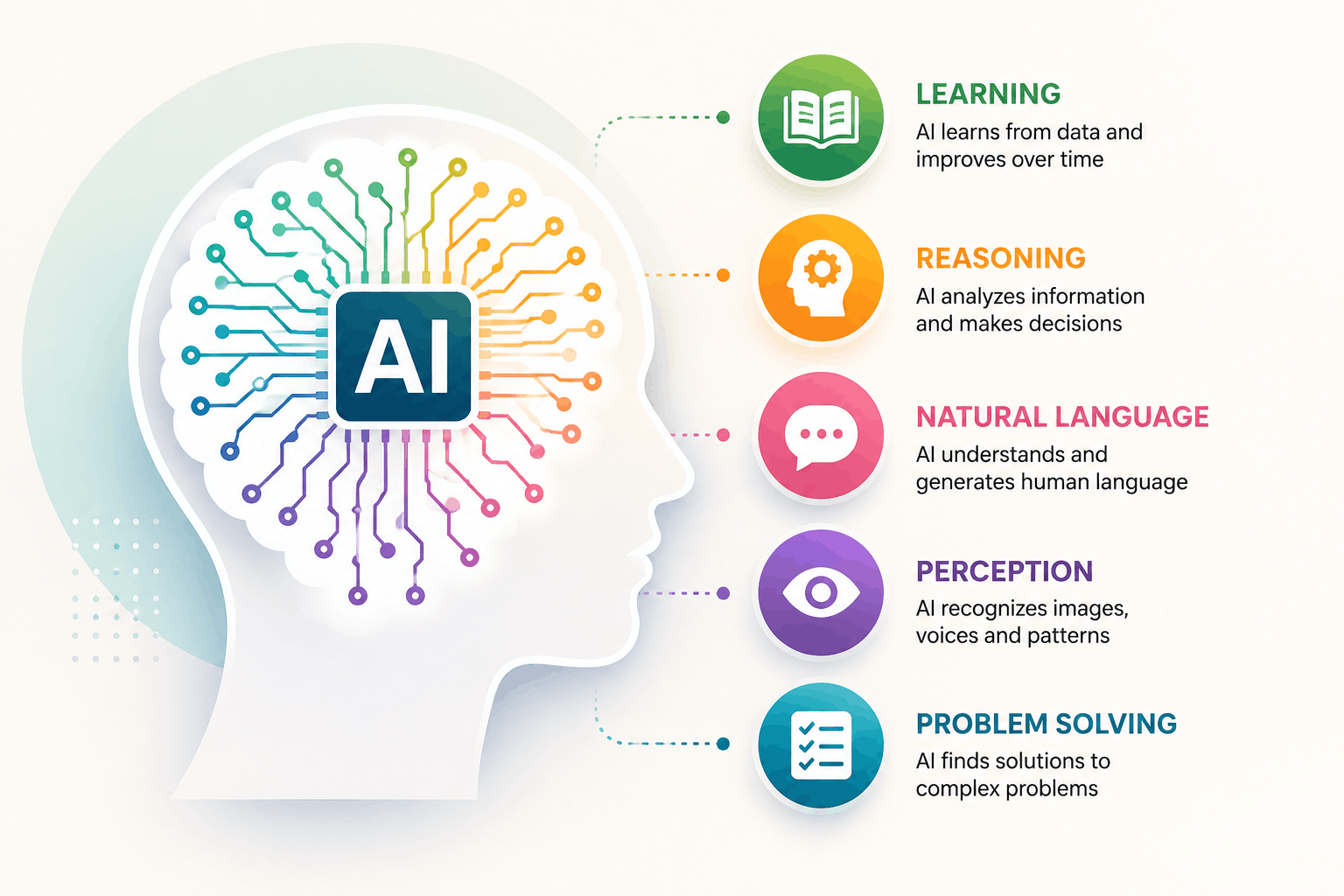
Artificial Intelligence (AI) refers to the ability of machines and computer systems to perform tasks that normally require human intelligence. These tasks include learning, reasoning, problem-solving, understanding language, recognizing images, and making decisions.
Unlike traditional software that follows fixed instructions, Artificial Intelligence systems learn from data, recognize patterns, and improve their performance over time without constant human intervention. This ability makes Artificial Intelligence a powerful technology for solving complex problems across a wide range of industries.
Today, Artificial Intelligence powers many of the digital tools we use every day, including search engines, virtual assistants, online shopping recommendations, fraud detection systems, medical diagnosis tools, and smart automation solutions. As Artificial Intelligence continues to evolve, it is transforming businesses, improving customer experiences, and driving innovation across healthcare, education, finance, manufacturing, and many other sectors.
Modern AI is built on several important technologies that work together to create intelligent systems.
Machine Learning is one of the most important branches of AI. It enables computers to learn from data without being directly programmed for every task.
Machine Learning is divided into three main types:
Machine learning is widely used in recommendation systems, spam filtering, fraud detection, and predictive analytics.
Deep Learning is a specialized form of machine learning that uses artificial neural networks with multiple layers.
It is highly effective for processing complex data such as:
Applications include facial recognition, speech recognition, medical image analysis, and autonomous vehicles.
Popular frameworks include TensorFlow and PyTorch.
Natural Language Processing enables computers to understand, interpret, and generate human language.
Common NLP applications include:
This technology helps businesses improve customer service and communication.
Computer Vision allows machines to interpret visual information from images and videos.
It is commonly used in:
Robotics combines AI with engineering to create intelligent machines capable of performing physical tasks.
AI-powered robots are used in:
Expert systems use predefined rules and knowledge to solve specific problems.
They are commonly used in:
AI can be divided into different categories based on its capabilities.
These AI systems only react to current information and cannot learn from previous experiences.
Example:
IBM Deep Blue chess computer.
Most modern AI systems belong to this category. They learn from historical data to improve future decisions.
Examples include:
This type of AI aims to understand human emotions, beliefs, and social interactions.
Although researchers are making progress, this technology is still under development.
Self-aware AI is a theoretical concept where machines possess consciousness and emotions similar to humans.
At present, this remains a future possibility rather than a reality.
Artificial Intelligence is transforming almost every industry.
AI is improving healthcare through:
Doctors use AI to detect diseases earlier and improve patient care.
AI plays an important role in the automotive industry by enabling:
These technologies improve road safety and driving experiences.
Banks and financial institutions use AI for:
AI helps reduce risks while improving financial services.
Online businesses use AI to deliver personalized shopping experiences.
Applications include:
These features improve customer satisfaction and increase sales.
Streaming platforms and gaming companies use AI to recommend personalized content.
Examples include:
AI helps users discover content based on their interests.
AI is making education more personalized and accessible.
Applications include:
Teachers can use AI to provide better learning experiences for students.
Artificial Intelligence is driving innovation across many industries.
Manufacturers use AI for:
This reduces downtime and improves productivity.
AI helps farmers improve crop production through:
These technologies increase agricultural efficiency while reducing waste.
AI improves logistics through:
Businesses can reduce costs and improve delivery times.
HR departments use AI for:
AI helps recruiters make faster and more informed hiring decisions.
AI offers numerous advantages for businesses and individuals.
AI automates repetitive tasks, allowing employees to focus on more valuable work.
AI analyzes large amounts of data quickly, helping organizations make smarter business decisions.
Unlike humans, AI systems can work continuously without breaks or fatigue.
AI delivers customized recommendations based on user preferences, improving customer experiences.
Automation reduces operational costs and increases business efficiency.
AI minimizes human errors and delivers consistent results in many applications.
AI enables the development of new products, services, and business models that drive economic growth.
Despite its many benefits, AI also presents several challenges.
Automation may replace some jobs, especially those involving repetitive tasks. However, it also creates demand for new skills and careers.
AI systems can inherit bias from the data used for training, leading to unfair decisions.
Developers must ensure datasets are diverse and unbiased.
AI relies heavily on data collection, raising concerns about user privacy and data security.
Organizations must handle personal information responsibly.
Many AI systems are difficult to understand because their decision-making process is not fully transparent.
This is often called the “black box” problem.
AI can be misused for:
Strong cybersecurity measures are essential.
The future of AI is exciting and full of possibilities.
Researchers are working toward Artificial General Intelligence (AGI), where machines can perform a wide variety of intellectual tasks similar to humans.
Other emerging trends include:
As AI technology advances, it will become an even more important part of our personal and professional lives.
To maximize the benefits of AI while reducing its risks, responsible development is essential.
Organizations should focus on:
Governments, businesses, researchers, and society must work together to ensure AI benefits everyone.
Artificial Intelligence has become one of the most powerful technologies of the digital age. From healthcare and education to finance, manufacturing, and entertainment, Artificial Intelligence is transforming industries and improving the way people live and work. Its ability to automate tasks, analyze data, and support better decision-making is creating new opportunities for businesses and individuals alike.
While Artificial Intelligence offers tremendous benefits, it also presents challenges related to privacy, ethics, transparency, and employment. Addressing these concerns through responsible Artificial Intelligence development, strong regulations, and ethical practices will help create a future where AI is used safely, fairly, and responsibly.
As Artificial Intelligence continues to evolve, it is expected to play an even greater role in solving global challenges, driving innovation, and enhancing human capabilities. Individuals and businesses that understand and embrace Artificial Intelligence today will be better prepared for the opportunities and advancements of tomorrow.