

In today’s competitive world, digital marketing for small business is no longer a luxury—it’s a necessity. Customers are searching online before they buy, comparing brands on social media, and trusting businesses with a strong digital presence. If your small business is not visible online, you are losing potential customers every single day.
This guide will walk you through everything you need to know about digital marketing for small business, even if you have no experience, a small budget, or limited time. By the end of this blog, you’ll understand how to build a simple, effective digital marketing plan that actually brings results.
Table of Contents
What Is Digital Marketing for Small Business?
Digital marketing for small business means promoting your products or services using online platforms such as:
- Google (Search & Maps)
- Social media (Facebook, Instagram, LinkedIn)
- Websites and blogs
- Online advertising
Unlike traditional marketing, digital marketing allows small businesses to compete with bigger brands using smart strategies instead of big budgets.
Why Digital Marketing Is Important for Small Businesses
Small businesses often rely on word-of-mouth or local customers. While that’s important, it’s not enough in today’s digital-first world.
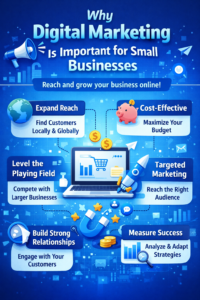
Here’s why digital marketing for small business is critical:
- Customers search online before buying
- It’s cost-effective compared to traditional ads
- You can target the right audience
- Results are measurable
- Helps build trust and brand awareness
With the right digital marketing strategy, even a small business can grow faster than expected.
Step 1: Set Clear Business Goals
Every successful digital marketing for small business plan starts with clear goals.
Ask yourself:
- Do I want more website traffic?
- Do I want more phone calls or inquiries?
- Do I want online sales?
- Do I want local customers?
Examples of Small Business Goals:
- Get 50 leads per month
- Increase local visibility on Google
- Grow Instagram followers to 5,000
- Increase monthly sales by 20%
Your digital marketing efforts should always support these goals.
Step 2: Understand Your Target Audience

One of the biggest mistakes in digital marketing for small business is trying to market to everyone.
Instead, define your ideal customer:
- Age
- Location
- Interests
- Problems
- Buying behavior
Example:
A local bakery’s audience might be:
- People aged 20–45
- Living within 5–10 km
- Interested in cakes, desserts, celebrations
When you know your audience, your digital marketing becomes more effective.
Step 3: Build a Professional Website
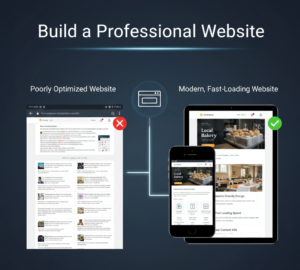
A website is the foundation of digital marketing for small business.
Your website should:
- Load fast
- Work on mobile devices
- Clearly explain your services
- Have contact details
- Build trust
Must-Have Pages:
- Home
- About Us
- Services / Products
- Blog
- Contact
Your website acts as a 24/7 salesperson for your small business.
Step 4: Search Engine Optimization (SEO) for Small Business
SEO helps your website appear on Google when people search for your services.
Digital marketing for small business heavily depends on SEO because it brings free, long-term traffic.
Basic SEO Tips:
- Use keywords like digital marketing for small business
- Optimize page titles and descriptions
- Add location-based keywords
- Write helpful blog content
- Get listed on Google Business Profile
Local SEO is especially powerful for small businesses.
Step 5: Content Marketing That Builds Trust
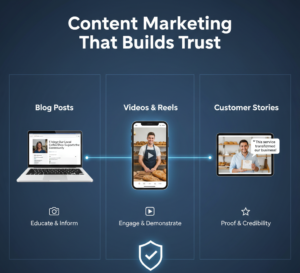
Content marketing is a key part of digital marketing for small business.
Content helps you:
- Educate customers
- Answer questions
- Build authority
- Improve SEO
Types of Content Small Businesses Can Create:
- Blog posts
- How-to guides
- Videos
- Reels and shorts
- Customer success stories
Example blog topics:
- “How Our Service Helps Small Businesses Save Money”
- “Best Tips for Small Business Owners in 2026”
Step 6: Social Media Marketing for Small Business
Social media is one of the most powerful tools in digital marketing for small business.
Best Platforms for Small Businesses:
- Facebook (local reach & groups)
- Instagram (visual products & services)
- LinkedIn (B2B businesses)
- YouTube (education & trust)
Social Media Tips:
- Post consistently (3–5 times per week)
- Share behind-the-scenes content
- Show customer reviews
- Educate, don’t just sell
You don’t need to be on every platform—just choose where your audience is.
Step 7: Email Marketing for Small Business Growth
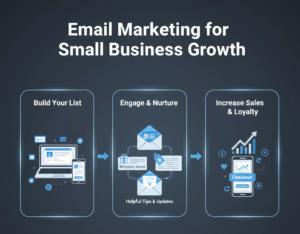
Email marketing offers one of the highest returns in digital marketing for small business.
With email, you can:
- Stay in touch with customers
- Promote offers
- Share updates
- Increase repeat sales
Email Ideas:
- Welcome emails
- Discounts and offers
- Product updates
- Helpful tips
Build an email list using your website or social media.
Step 8: Paid Advertising on a Small Budget
Paid ads can speed up results in digital marketing for small business.
Popular Advertising Platforms:
- Google Ads
- Facebook Ads
- Instagram Ads
Tips for Beginners:
- Start with a small budget
- Target local audiences
- Promote best-selling products
- Track performance
Paid ads work best when combined with SEO and content marketing.
Step 9: Use Free & Low-Cost Tools
You don’t need expensive tools to succeed in digital marketing for small business.
Useful Tools:
- Google Analytics
- Google Search Console
- Canva
- Mailchimp
- ChatGPT
- Meta Business Suite
These tools help manage, track, and improve your marketing efforts.
Step 10: Track Performance and Optimize
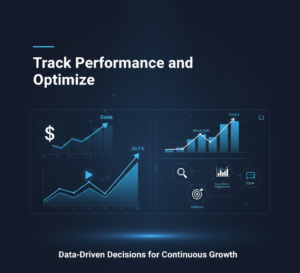
Tracking results is essential in digital marketing for small business.
Monitor:
- Website traffic
- Leads and inquiries
- Sales
- Social media engagement
- Email open rates
Use this data to improve what works and stop what doesn’t.
Common Digital Marketing Mistakes Small Businesses Make
Avoid these mistakes:
- No clear strategy
- Ignoring SEO
- Posting randomly on social media
- Not tracking results
- Giving up too early
Consistency is the secret to success in digital marketing.
Example Digital Marketing Plan for Small Business
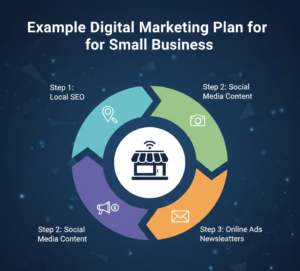
Business Type: Local service
Goal: Get more leads
Strategy:
- SEO blog posts
- Google Business Profile
- Instagram reels
- Email follow-ups
Keyword Focus: digital marketing for small business
This simple plan can outperform complex strategies if executed consistently.
How Long Does Digital Marketing Take to Show Results?
- SEO: 3–6 months
- Social media: 1–2 months
- Paid ads: Immediate
- Email marketing: Immediate
Digital marketing for small business is a long-term investment, not a quick fix.
Benefits of Digital Marketing for Small Business
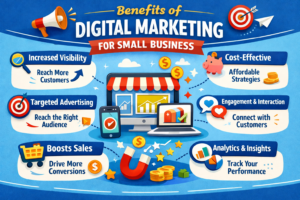
Digital marketing for small business provides opportunities that were once only available to large corporations with huge advertising budgets. In the past, small businesses struggled to compete with well-known brands, but digital platforms have changed the rules. Today, even a small business with limited resources can build a strong online presence, reach the right audience, and grow consistently by using smart digital marketing strategies.
Digital marketing is flexible, measurable, and scalable, making it one of the most effective growth tools for small businesses in any industry.
Increased Visibility
One of the most important benefits of digital marketing for small business is increased visibility. Customers now search online before making buying decisions. They use Google to find services, scroll through social media to discover brands, and watch videos to learn about products.
Digital marketing helps your business appear exactly where your customers are looking. Through search engine optimization (SEO), social media marketing, online directories, and local search results, your business can stay visible 24/7. Unlike traditional marketing, digital marketing does not depend on store location or operating hours.
When your small business consistently appears in search results and social feeds, it builds awareness and keeps your brand top of mind for potential customers.
Better Customer Engagement
Another major advantage of digital marketing for small business is improved customer engagement. Digital platforms allow businesses to communicate directly with their audience in real time.
Through social media comments, emails, website chat, reviews, and messages, small businesses can interact with customers personally. This two-way communication helps businesses understand customer needs, answer questions quickly, and solve problems efficiently.
Better engagement also allows businesses to share valuable content, such as tips, updates, and offers, which strengthens relationships over time. When customers feel heard and valued, they are more likely to trust your brand and remain loyal.
Higher Conversions and Sales
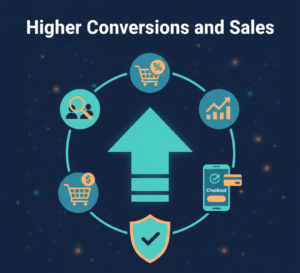
Digital marketing for small business is designed to attract targeted audiences, which leads to higher conversion rates. Unlike traditional advertising that reaches a broad and often uninterested audience, digital marketing focuses on people who are already searching for or interested in your products or services.
Whether it’s a well-optimized website, a targeted email campaign, or a social media advertisement, digital marketing delivers the right message to the right audience at the right time. This approach improves lead quality and increases the chances of turning visitors into paying customers.
As a result, small businesses can generate more sales while spending less compared to traditional marketing methods.
Strong Brand Trust and Credibility
Trust plays a critical role in small business success, and digital marketing for small business helps build that trust over time. Customers are more likely to choose businesses that appear professional, consistent, and helpful online.
Regular content creation, positive customer reviews, informative blog posts, and an active social media presence all contribute to a strong brand image. When customers see your business providing value and responding to feedback, they feel more confident choosing your services.
Over time, digital marketing strengthens brand credibility and positions your business as a trusted authority in your industry.
Cost-Effective Marketing Solution
One of the biggest advantages of digital marketing for small business is affordability. Compared to traditional advertising methods like TV, radio, or print ads, digital marketing is much more cost-effective.
Many strategies, such as SEO, content marketing, and social media, require more time and effort than money. Even paid advertising allows businesses to control budgets, target specific audiences, and track results in real time.
This makes digital marketing ideal for small businesses that need maximum impact with minimal spending.
Sustainable and Long-Term Growth
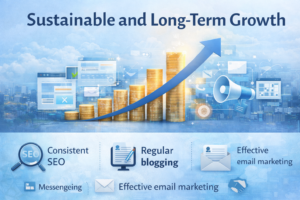
Digital marketing for small business supports long-term and sustainable growth. Unlike traditional ads that stop working once the budget ends, digital strategies such as SEO, blogging, and email marketing continue to generate results over time.
By tracking performance data, small businesses can improve strategies, focus on what works, and eliminate what doesn’t. This data-driven approach leads to smarter decisions and steady growth.
Digital marketing also grows with your business. You can start small and scale your efforts as your audience and revenue increase.
Levels the Playing Field
With the right approach, digital marketing truly levels the playing field. Small businesses no longer need to compete based on budget alone. Creativity, consistency, and strategy matter more than size.
A well-executed digital marketing plan allows small businesses to compete with larger brands, reach niche audiences, and build loyal customer bases.
Final Thoughts
Digital marketing for small business is one of the most powerful tools available in today’s digital economy. It offers visibility, engagement, trust, and growth—all without requiring a massive budget or large marketing team.
With patience, effort, and the right digital marketing approach, small businesses can increase visibility, attract loyal customers, and achieve long-term success in an increasingly competitive market.
Conclusion
Digital marketing for small business is no longer optional—it is essential for survival and growth in today’s digital-first marketplace. From improving online visibility and building customer trust to generating consistent leads and sales, digital marketing empowers small businesses to compete effectively with larger brands. With the right strategy, even businesses with limited budgets and resources can achieve sustainable growth and long-term success.
By setting clear goals, understanding your audience, building a strong online presence, and consistently applying SEO, content, social media, and email marketing strategies, small businesses can create measurable and lasting impact. The key is consistency, patience, and continuous optimization based on data and customer behavior.
In the modern business landscape, digital marketing is not just about promotion—it is about connection, credibility, and customer experience. Small businesses that embrace digital marketing today will be the ones that thrive tomorrow.
Author: Shahilshan
Learner of : Digiskillzz , Digital Marketing Institute in Kochi






Leave A Comment