Tag: Digital Marketing

  • Performance Marketing in 2026: Powerful Strategies, Benefits & Complete Guide

    Performance Marketing in 2026: Powerful Strategies, Benefits & Complete Guide


    Performance Marketing in 2026: A Complete Guide to Driving Measurable Growth


    performence marketing In today’s competitive digital world, businesses need marketing strategies that produce measurable and meaningful results.. Unlike traditional advertising, where success can be difficult to track, performance marketing focuses on outcomes such as clicks, leads, sales, app installs, and conversions. Every campaign is optimized using real-time data, helping businesses maximize their return on investment (ROI).

    Whether you’re a small business owner, e-commerce brand, startup, or marketing professional, performance marketing allows you to spend your advertising budget more efficiently and achieve sustainable growth.

    In this guide, you’ll learn what performance marketing is, how it works, its benefits, the best channels, and proven strategies for success in 2026.

    What Is Performance Marketing?

    Performance marketing is a digital marketing strategy in which businesses pay only when a specific action, such as a click, lead, or sale, is completed. These actions may include:


    • Website clicks
    • Lead generation
    • Product purchases
    • App installs
    • Form submissions
    • Newsletter sign-ups

    Because every campaign is measurable, businesses can continuously improve performance and reduce wasted advertising spend.

    How Performance Marketing Works

    Performance marketing follows a data-driven process:


    • Define business goals.
    • Identify your target audience.
    • Launch advertising campaigns.
    • Track campaign performance.
    • Analyze user behavior.
    • Optimize campaigns based on real-time data.
    • Scale successful campaigns.

    This cycle of testing and optimization is what makes performance marketing highly effective.ย ย ย ย ย ย ย ย ย ย ย 

    Benefits of Performance Marketing

    Performance marketing provides several advantages:

    • Measurable campaign results
    • Higher return on investment (ROI)
    • Better budget control
    • Accurate audience targeting
    • Faster business growth
    • Real-time campaign optimization
    • Improved lead quality
    • Scalable advertising strategies

    Since businesses only pay for meaningful actions, performance marketing is often more cost-effective than traditional advertising.

    Popular Performance Marketing Channels

    Google Ads

    Google Ads enables businesses to connect with potential customers who are actively searching for their products or services online. Search, Display, Shopping, and Performance Max campaigns can all support different business goals.Performance Marketing in 2026

    Social Media Advertising

    Platforms like Facebook, Instagram, LinkedIn, TikTok, and Pinterest allow businesses to target users based on interests, demographics, behaviors, and online activity.

    Search Engine Optimization(SEO)

    SEO supports performance marketing by generating long-term organic traffic. A strong SEO strategy reduces dependence on paid advertising over time.

    Affiliate Marketing

    Businesses partner with affiliates who promote products in exchange for commissions based on successful sales or leads.

    Email Marketing

    Email campaigns nurture leads, recover abandoned carts, promote offers, and encourage repeat purchases.

    Influencer Marketing

    Working with trusted creators can increase brand awareness and drive measurable conversions when campaigns are tracked effectively.

    Key Performance Marketing Metrics

    Tracking the right metrics helps improve campaign performance.

    Important metrics include:


    • Click-Through Rate (CTR)
    • Cost Per Click (CPC)
    • Cost Per Acquisition (CPA)
    • Conversion Rate
    • Return on Ad Spend (ROAS)
    • Return on Investment (ROI)
    • Customer Lifetime Value (CLV)
    • Cost Per Lead (CPL)
    • Bounce Rate


    These metrics help marketers understand what is working and where improvements are needed.

    Best Performance Marketing Strategies

    Know Your Audience

    Understand your customers’ interests, needs, and online behavior before launching campaigns.

    Create High-Converting Landing Pages

    Your landing page should have:


    • Clear headlines
    • Strong calls to action
    • Fast loading speed
    • Mobile-friendly design
    • Trust signals such as reviews or testimonials
    • Test Multiple Ad Creatives

    Run A/B tests on headlines, images, videos, and calls to action to discover what performs best.

    Optimize Campaigns Regularly

    Review campaign data frequently and adjust:


    • Keywords
    • Audience targeting
    • Bids
    • Ad copy
    • Landing pages

    Continuous optimization improves campaign efficiency.

    Use Remarketing

    Remarketing allows you to reconnect with people who have already visited your website but didn’t convert, increasing the likelihood of future sales .One major advantage of Performance Marketing is that businesses can clearly understand where their advertising budget is being spent.

    Common Performance Marketing Mistakes

    Avoid these mistakes:


    • Ignoring campaign data
    • Poor audience targeting
    • Weak landing pages
    • Not testing ad creatives
    • Tracking the wrong metrics
    • Overspending without optimization
    • Forgetting mobile users


    Fixing these issues can significantly improve your campaign’s overall performance and results.

    AI and the Future of Performance Marketing

    Artificial intelligence is transforming digital advertising by helping marketers:


    • Automate bidding strategies
    • Improve audience targeting
    • Predict customer behavior
    • Generate ad copy
    • Analyze campaign performance
    • Personalize customer experiences

    Businesses that combine AI with human strategy can improve efficiency and achieve better marketing results.

    Why Performance Marketing Matters

    Performance marketing allows businesses to make informed decisions based on real data instead of guesswork. Every campaign can be measured, optimized, and scaled, making it one of the most effective approaches to digital advertising.

    Whether your goal is to generate leads, increase online sales, or grow brand awareness, performance marketing provides the tools to achieve measurable success. Performance Marketing in 2026

    Conclusion

    Performance marketing has become a key strategy for businesses looking to achieve measurable growth and maximize their advertising return on investment (ROI). By using the right channels, tracking meaningful metrics, creating high-quality landing pages, and continuously optimizing campaigns, businesses can reach the right audience and achieve long-term success.

    As digital marketing continues to evolve in 2026, organizations that embrace data-driven decision-making and ongoing optimization will be well-positioned to outperform their competitors and build sustainable growth.


    author: ansif muhammed

  • How to Improve Google Search Ranking

    How to Improve Google Search Ranking

    Tags :

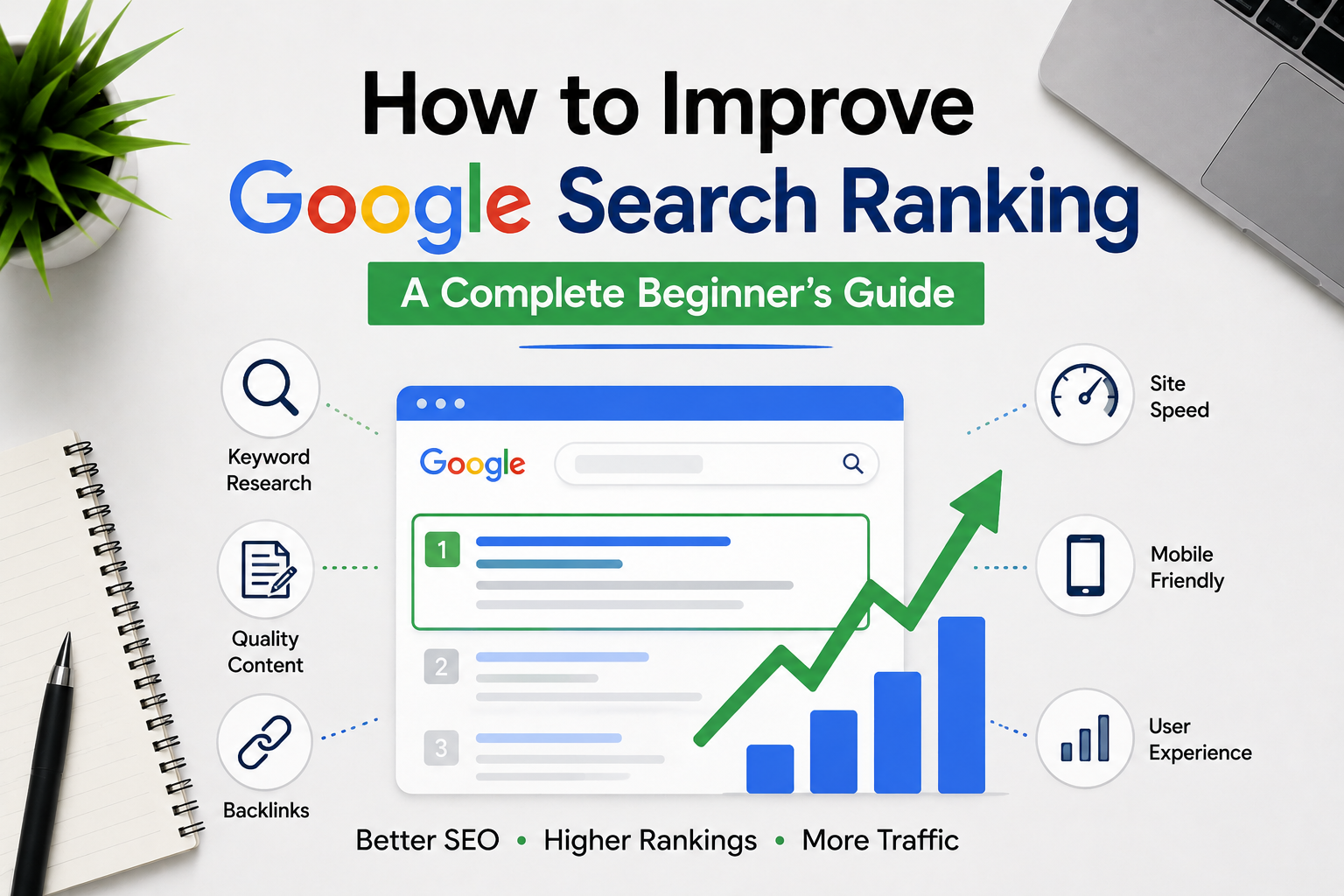
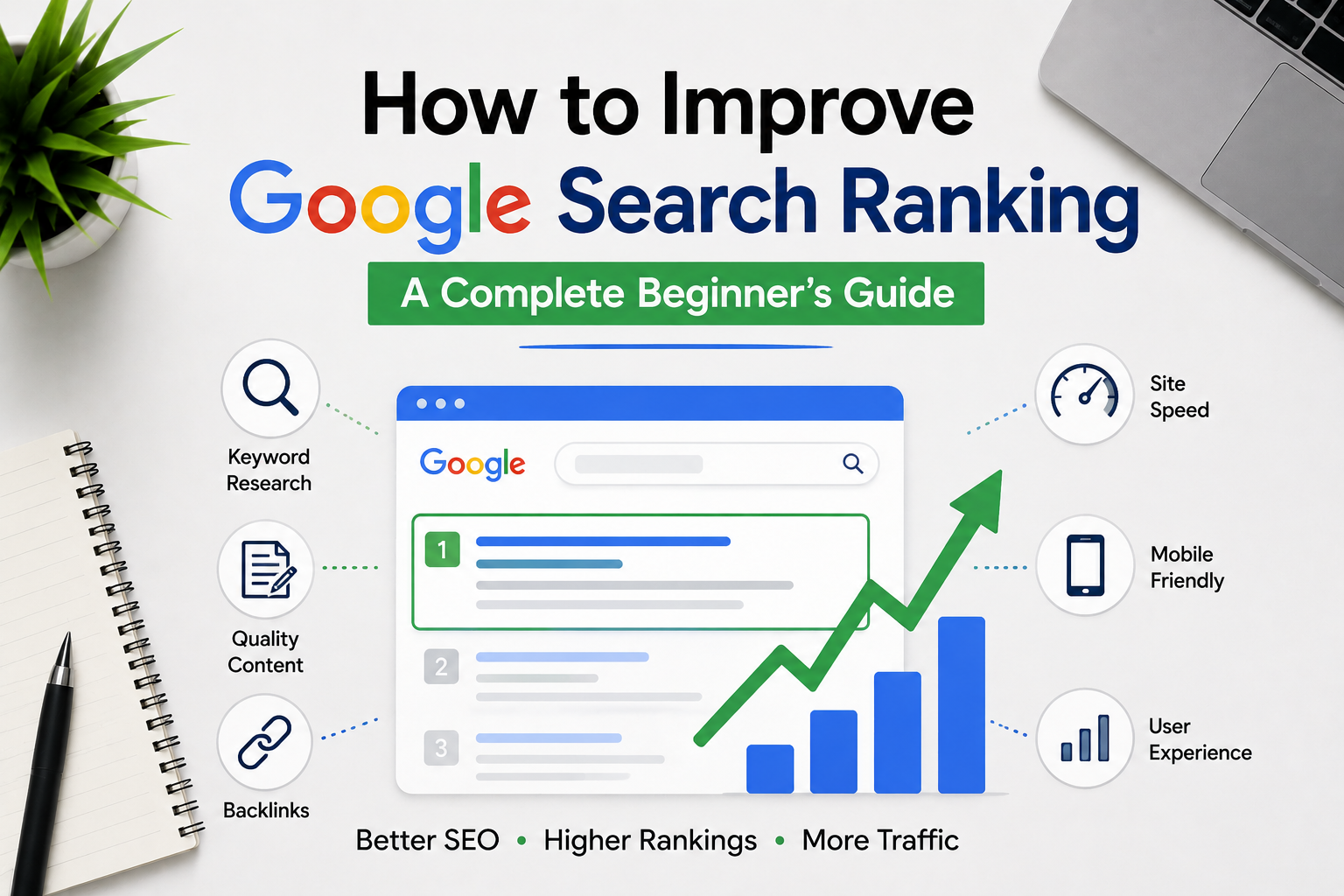
    How to Improve Google Search Ranking: A Complete Beginner’s Guide

    Every website owner wants more people to discover their content through Google. Whether you run a personal blog, a business website, or an online store, appearing higher in search results can increase traffic, build trust, and create more opportunities for growth. That is why so many people search for *how to improve Google search ranking*.

    The good news is that you do not need shortcuts or expensive SEO software to achieve better rankings. Google mainly rewards websites that offer useful information, provide a great user experience, and answer visitors’ questions clearly.

    This guide explains *how to improve Google search ranking* using practical SEO strategies that continue to work in 2026. These methods are beginner-friendly, easy to understand, and focused on long-term success rather than quick fixes.

    What Is Google Search Ranking?

    How to Improve google search rankingGoogle search ranking refers to the position of a webpage in Google’s search results for a particular keyword or phrase. When someone searches online, Google’s algorithm evaluates millions of pages and displays the most useful and relevant results first.
    ย 

    For example, a website that appears in the top three search results is much more likely to receive clicks than a website listed on the second page. Better rankings usually lead to more visitors, which can increase enquiries, sales, and brand awareness.

    Understanding *how to improve Google search ranking* is important because organic traffic is one of the most valuable sources of website visitors.

    Why Is Google Ranking Important?

    How to Improve Google Search Ranking

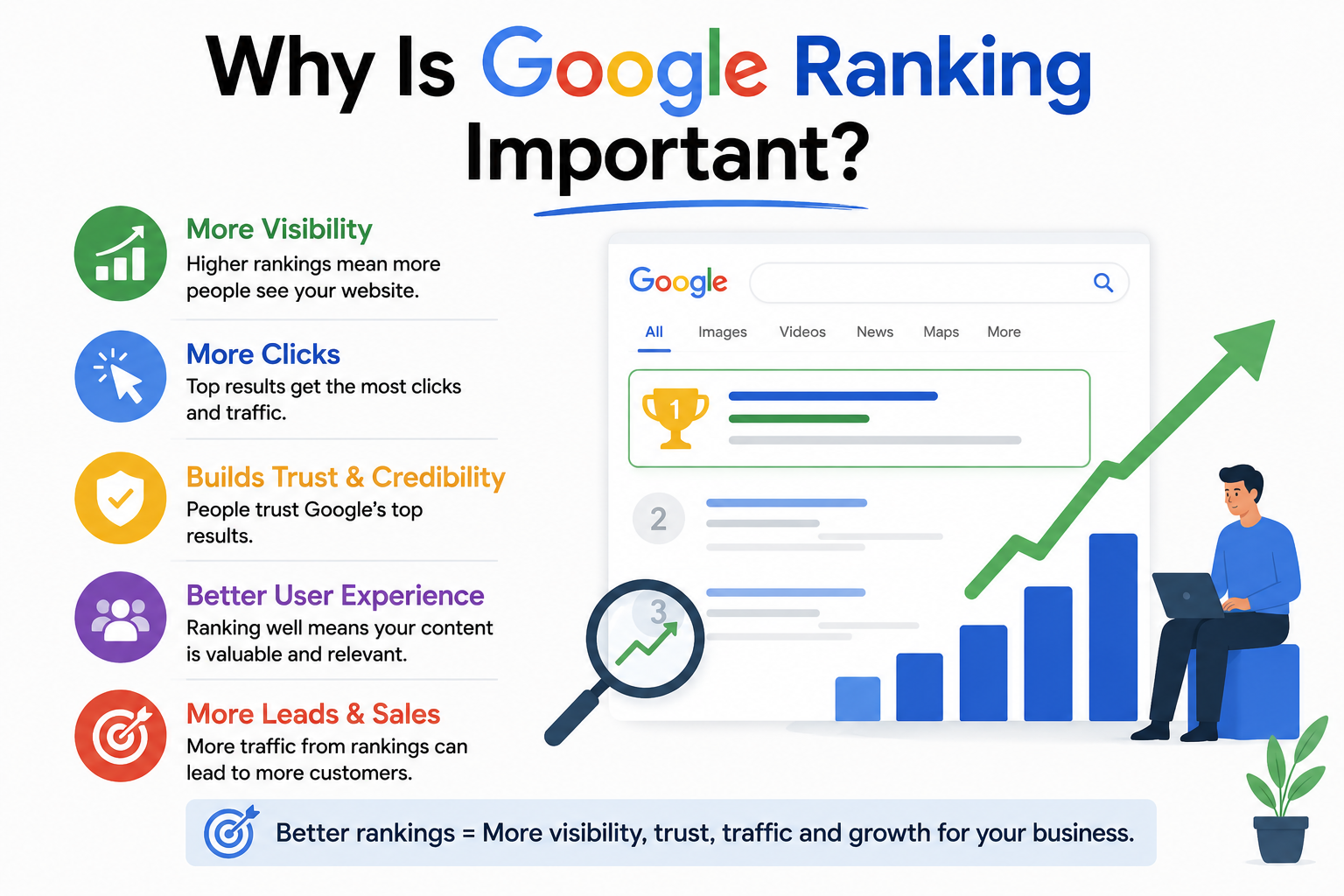
    A higher position in Google search results offers several advantages for businesses and content creators.

    Some of the biggest benefits include:

    * More organic visitors
    * Greater online visibility
    * Increased customer trust
    * Better lead generation
    * Improved brand recognition
    * Long-term marketing results without paying for every click

    These advantages explain why learning *how to improve Google search ranking* has become a priority for businesses of every size.

    1. Create Helpful and Original Content

    The foundation of successful SEO is creating content that genuinely helps your audience. If you want to learn how to improve Google search ranking, start by creating content that answers users’ questions and provides real value. Google’s goal is to recommend pages that solve problems accurately and deliver a great user experience.

    Instead of writing only to rank for keywords, focus on solving problems. Think about the information your readers are looking for and explain it in simple language. This approach not only builds trust with your audience but also helps improve your Google search ranking over time.

    Helpful content should:

    * Answer common questions
    * Be accurate and easy to understand
    * Offer practical solutions
    * Include updated information

    When readers spend more time on your page because your content is useful, Google receives positive signals that can improve your rankings.

    If you want to learn *how to improve Google search ranking*, publishing valuable and original content should always be your first step.

    2. Choose the Right Keywords

    Keywords help Google understand the topic of your webpage. If you want to know how to improve Google search ranking, choosing the right keywords is one of the most important steps. Selecting relevant keywords makes it easier for your content to reach the right audience and increases the chances of your pages appearing in relevant search results.

    Before writing, spend some time researching the words and phrases your potential visitors actually search for.

    Focus on:

    * Primary keywords
    * Long-tail keywords
    * Related search terms
    * User intent

    Use your main keyword naturally throughout your article instead of repeating it unnecessarily. A well-written article should sound natural while still making the topic clear to both readers and search engines.

    For example, if your target keyword is *how to improve Google search ranking*, include it where it fits naturally, such as in the introduction, headings, and conclusion.

    3. Write SEO-Friendly Titles

    Your page title is one of the first things people notice in Google search results. If you’re learning how to improve Google search ranking, creating a clear, relevant, and engaging page title is essential. A well-written title encourages users to click on your page instead of someone else’s, which can improve your visibility and attract more organic traffic.

    An effective SEO title should:

    * Include the primary keyword
    * Clearly explain the topic
    * Stay concise
    * Encourage curiosity without being misleading

    Example:

    *How to Improve Google Search Ranking: 12 Proven SEO Tips for Beginners*

    A well-written title can improve your click-through rate, which may also help your overall search performance.

    4. Improve Website Speed

    Visitors expect websites to load quickly. If you’re looking for how to improve Google search ranking, improving your website’s loading speed should be a top priority. When a webpage loads slowly, many visitors lose interest and leave before they have a chance to explore your content. A faster website provides a better user experience and can help improve your rankings in Google Search.

    A fast website creates a better experience for visitors and can positively influence your search rankings.

    Here are some practical ways to improve loading speed:

    * Compress large images
    * Remove unnecessary plugins
    * Choose reliable web hosting
    * Enable browser caching
    * Reduce unused CSS and JavaScript files

    Even small improvements in speed can make your website feel more responsive and enjoyable for users.

    5. Make Your Website Mobile-Friendly

    Today, most internet users browse websites on smartphones or tablets. If you want to learn how to improve Google search ranking, making your website mobile-friendly is essential. Google mainly evaluates the mobile version of a website when determining search rankings, so a responsive design that works well on all screen sizes can improve both user experience and search visibility.

    Your website should provide a smooth experience across all devices.

    Make sure it:

    * Adjusts automatically to different screen sizes
    * Uses readable fonts
    * Loads quickly on mobile networks
    * Uses buttons that are large enough for comfortable touch navigation.
    * Offers simple navigation

    A responsive design not only improves user satisfaction but also supports *how to improve Google search ranking* by meeting Google’s mobile-friendly expectations.

    6. Optimize Your Images

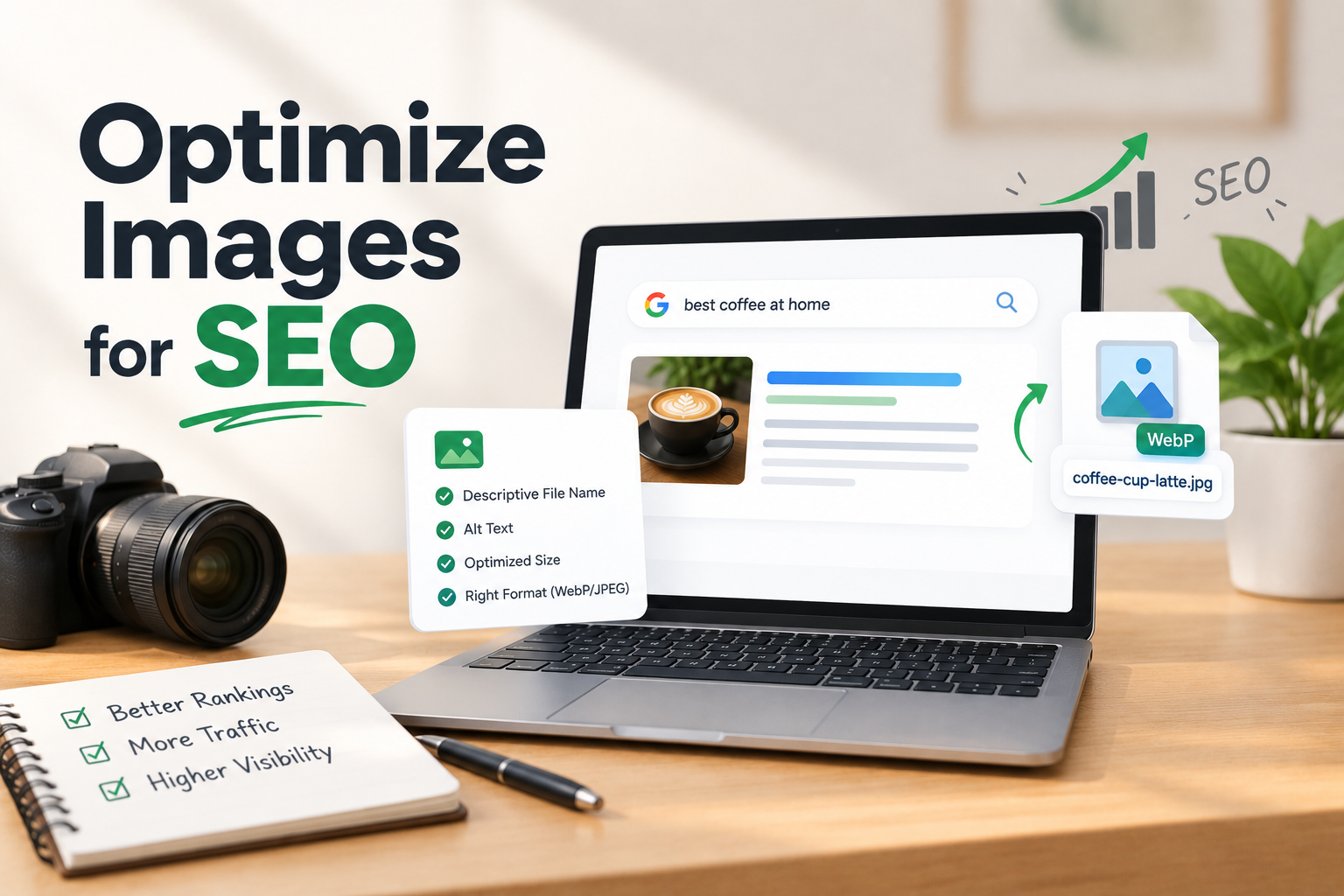
    Images make your articles more attractive and easier to understand. If you’re learning how to improve Google search ranking, optimizing your images is an important step that should not be overlooked. Using large or unoptimized images can slow down your website, which may affect both user experience and search rankings.

    Before uploading images, reduce their file size without losing quality. Give each image a meaningful file name instead of generic names like “IMG001.jpg.” Adding descriptive alt text also helps search engines understand what the image represents while improving accessibility for users who rely on screen readers.

    Modern image formats such as WebP can reduce loading time even further. Well-optimized images contribute to a faster website, and faster websites often perform better in Google Search, helping improve your overall search visibility.

    7. Use Proper Headings

    A well-organized article is easier for both readers and search engines to understand. If you want to know how to improve Google search ranking, using a clear heading structure is an important SEO practice. Headings divide your content into logical sections, making it easier to read and navigate.

    Use one H1 heading for the page title, H2 headings for the main topics, and H3 headings whenever you need to explain smaller points under each section.

    A logical heading structure helps visitors quickly find the information they need while making it easier for Google to understand the main topics covered on your page, which can improve your chances of ranking higher in search results.

    8. Build High-Quality Backlinks

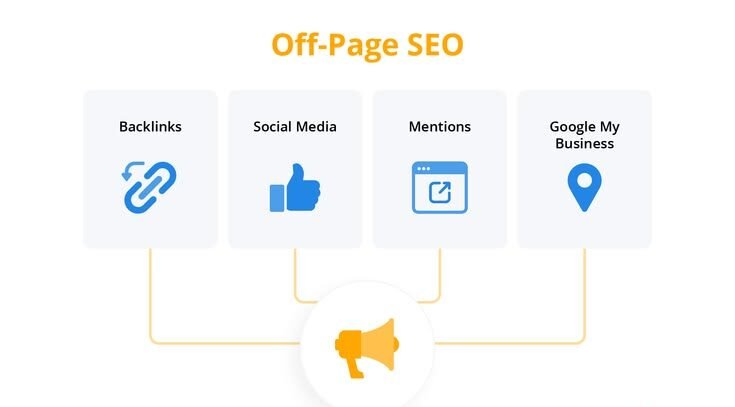
    Backlinks are links from other websites that point to your content. If you’re wondering how to improve Google search ranking, earning high-quality backlinks should be part of your SEO strategy. These links act as recommendations, showing Google that your website provides valuable and trustworthy information.

    Instead of trying to collect hundreds of low-quality links, focus on earning backlinks from trusted and relevant websites. A few high-quality backlinks are often more valuable than many low-quality ones and can have a positive impact on your search rankings.

    Some effective ways to earn quality backlinks include:

    * Publishing detailed guides
    * Creating original research or case studies
    * Writing guest articles for reputable websites
    * Producing useful resources that others naturally want to share

    Avoid purchasing backlinks or using spammy link-building methods. These practices can hurt your website instead of helping it.

    9. Improve User Experience

    Google wants to recommend websites that visitors enjoy using. If you’re looking for how to improve Google search ranking, providing an excellent user experience should be a priority. If users leave your site immediately because it is confusing or difficult to navigate, your rankings may suffer over time.

    Create a clean, easy-to-use website with clear navigation, readable fonts, and well-organized content. When visitors can quickly find the information they need and enjoy browsing your website, they are more likely to stay longer, which can positively influence your search rankings.

    Creating a positive user experience does not require a complicated design. Sometimes the simplest improvements have the biggest impact.

    Consider these tips:

    * Keep menus simple and organized.
    * Use readable fonts and enough spacing.
    * Break long paragraphs into shorter ones.
    * Include bullet points where appropriate.
    * Avoid excessive pop-ups that interrupt visitors.

    When users stay longer, explore more pages, and easily find what they need, your website sends positive quality signals to Google.

    10. Update Old Content Regularly

    SEO is an ongoing process rather than a one-time project. If you’re learning how to improve Google search ranking, remember that regularly updating your website is just as important as creating new content. Information changes over time, and outdated content may gradually lose its ranking.

    Review your pages regularly, update outdated information, improve your content with fresh insights, and fix broken links when needed. Keeping your website accurate and up to date helps maintain its relevance and can improve your Google search rankings over the long term.

    Review your older articles every few months and look for opportunities to improve them.

    You can update:

    * Statistics and data
    * Examples
    * Images or screenshots
    * Broken links
    * Newly available information

    Refreshing existing content is often easier than creating a completely new article, and it can help your pages remain competitive in search results.

    Updating old articles is also an effective way to improve *how to improve Google search ranking* over the long term.

    11. Use Internal Links

    Internal links create connections between different pages on your website. If you want to understand how to improve Google search ranking, using internal links is an effective SEO strategy. They help visitors discover additional useful content while guiding search engines to crawl, understand, and explore your site’s structure more efficiently.

    By linking to relevant pages within your website, you improve navigation, keep visitors engaged for longer, and help distribute SEO value across your content. A strong internal linking strategy can improve both user experience and your website’s visibility in Google Search.

    For example, if you publish an article about keyword research, you can naturally link it to another article discussing on-page SEO or content optimization.

    Good internal linking offers several advantages:

    * Helps search engines discover more pages
    * Keeps visitors on your website longer
    * Improves navigation
    * Distributes authority across important pages

    A well-planned internal linking strategy creates a stronger website structure and improves the overall user experience.

    12. Write Better Meta Descriptions

    A meta description is the short summary displayed below your page title in Google search results. If you’re looking for how to improve Google search ranking, writing clear and compelling meta descriptions can help attract more visitors to your website.

    Although Google does not use meta descriptions as a direct ranking factor, an engaging description can encourage more people to click on your page. Higher click-through rates can increase your organic traffic and improve your website’s overall visibility in search results.

    A good meta description should:

    * Clearly explain the content
    * Include the primary keyword naturally
    * Stay within approximately 150โ€“160 characters
    * Encourage users to learn more

    Writing compelling descriptions can improve your click-through rate and bring more visitors to your website.

    13. Use Google Search Console

    Google Search Console is a free tool that provides valuable information about your website’s performance in Google Search.

    It allows you to monitor how your pages appear in search results and identify areas that need improvement.

    With Google Search Console, you can:

    * Check whether pages are indexed
    * Monitor search performance
    * Submit XML sitemaps
    * Identify crawling issues
    * Discover the keywords people use to find your website

    Reviewing this data regularly helps you make informed SEO decisions and improve your site’s visibility.

    14. Understand Search Intent

    One of the most important aspects of modern SEO is understanding why someone performs a particular search.

    Before creating content, think about the user’s goal.

    Ask yourself questions such as:

    * Are they searching for information?
    * Do they want to compare products?
    * Are they ready to buy a product or service?
    * Do they need step-by-step instructions?

    When your content closely matches what users expect to find, Google is more likely to rank it higher because it provides a better search experience.

    15. Be Patient and Stay Consistent

    Many beginners expect SEO results within a few days or weeks. In reality, improving rankings usually takes time.

    Depending on your industry and competition, noticeable improvements may take several months.

    The key is consistency.

    Continue publishing useful content, improving your website, updating older pages, and following SEO best practices. Making steady improvements over time is usually more effective than looking for quick SEO tricks.

    If your goal is *how to improve Google search ranking*, patience and continuous improvement are two of the most important qualities you can have.

    Common SEO Mistakes to Avoid

    How to Improve Google Search Ranking

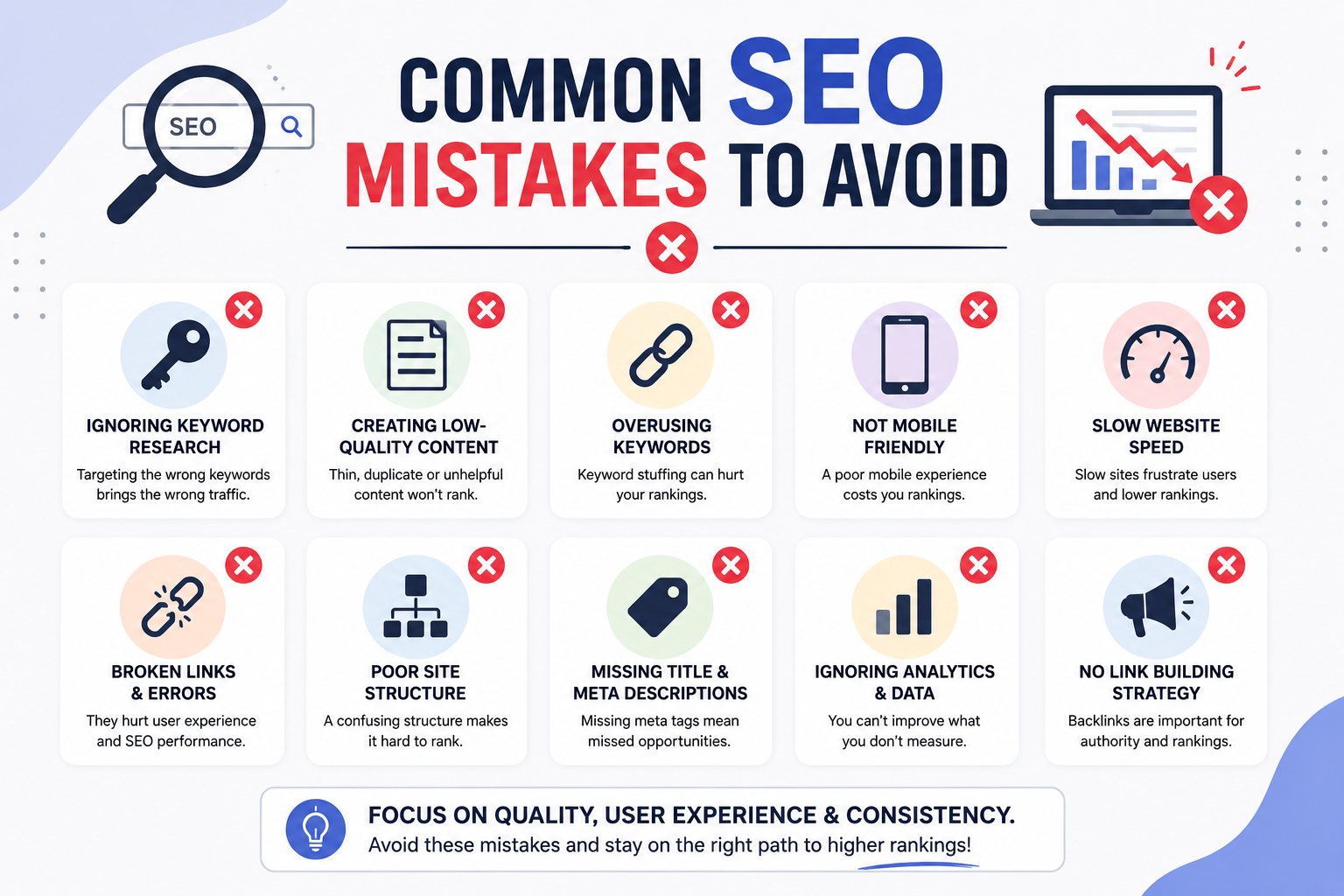
    Even a well-designed website can lose rankings if common SEO mistakes are ignored.

    Some of the most frequent mistakes include:

    *Publishing duplicate or copied content
    * Buying low-quality backlinks
    * Ignoring mobile optimization
    * Creating very short pages with little value
    * Allowing pages to load slowly
    * Leaving broken links unfixed
    * Forgetting image alt text
    * Complicated website navigation
    * Failing to update outdated content

    Avoiding these mistakes helps create a healthier website that is easier for both users and search engines to trust.

    Final Thoughts

    How to Improve Google Search Ranking

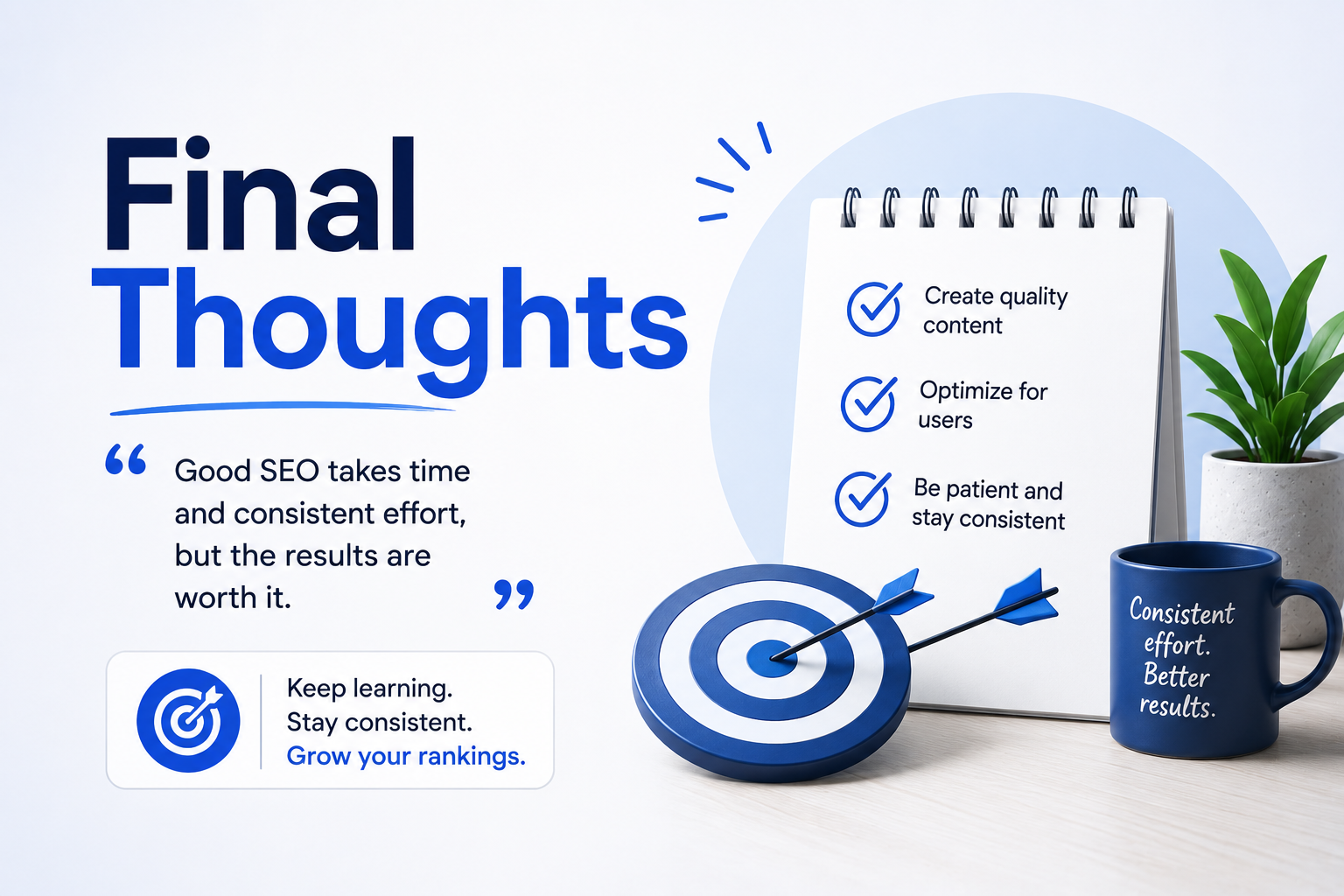
    Learning *how to improve Google search ranking* is an ongoing journey that requires planning, consistency, and a focus on providing value. Google rewards websites that answer users’ questions clearly, offer reliable information, and deliver a smooth browsing experience.

    Rather than looking for quick SEO tricks, invest your time in creating original content, choosing the right keywords, improving website speed, optimizing images, and building a website that visitors genuinely enjoy using.

    As your content library grows, continue updating older articles, strengthening internal links, and monitoring your site’s performance through Google Search Console. These simple habits can gradually improve your visibility and attract more organic traffic.

    Remember that SEO success rarely happens overnight. With patience and consistent effort, your website can earn higher rankings, attract the right audience, and achieve sustainable growth. Following the strategies in this guide will help you understand *how to improve Google search ranking* while building a website that both users and search engines trust.

    Author : ATHUL KRISHNA P.S

    Digital Marketing Freelancer dedicated to boosting brands with SEO, engaging content, and performance-focused online marketing strategies.

    Learner ofย DigiSkillz, Digital Marketing Course in Kochi.

    Freelance Digital Marketer in Vaduthala

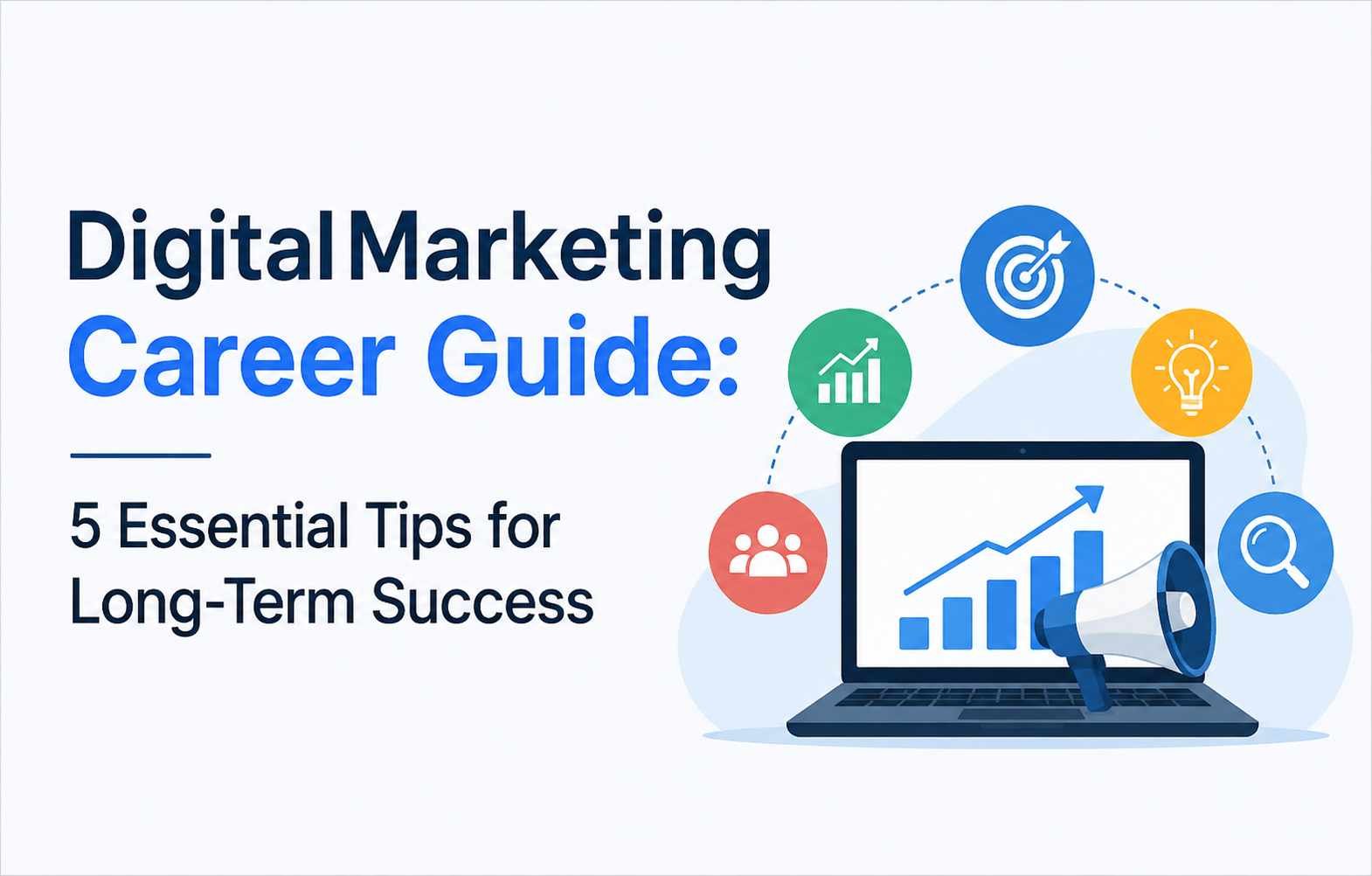
  • DigitalMarketing Career Guide: 5 Essential Tips for Long-Term Success

    DigitalMarketing Career Guide: 5 Essential Tips for Long-Term Success

    DigitalMarketing Career Guide: 5 Essential Tips for Long-Term Success

    In today’s digital-first world, businesses are increasingly relying on online platforms to connect with customers, promote products, and grow their brands. This shift has created enormous opportunities for professionals who want to build a career in Digital Marketing. Whether you’re a student exploring career options, a graduate looking for opportunities, or a working professional planning a career change, digitalmarketing offers a dynamic and rewarding path.

    The rise of social media, search engines, e-commerce, and mobile technology has transformed how companies communicate with their audiences. Traditional marketing methods are no longer sufficient on their own. Businesses now need skilled digitalmarketing professionals who can create effective online campaigns, attract customers, and generate measurable results.

    One of the biggest advantages of digitalmarketing is its versatility. It combines creativity, technology, communication, analytics, and strategy into a single profession. Professionals can specialize in various fields such as Search Engine Optimization (SEO), Social Media Marketing (SMM), Content Marketing, Email Marketing, Pay-Per-Click Advertising (PPC), Affiliate Marketing, and Marketing Analytics.

    The future of digitalmarketing looks brighter than ever. As technology continues to evolve, companies will continue investing in digital channels to stay competitive. This means the demand for talented digitalmarketing professionals is expected to grow steadily for years to come.

    However, building a successful career in digitalmarketing requires more than simply learning a few tools or completing a certification course. It requires continuous learning, practical experience, creativity, strategic thinking, and a strong understanding of customer behavior.

    If you are serious about building a successful career in digitalmarketing, the following five tips will help you establish a strong foundation and position yourself for long-term growth.

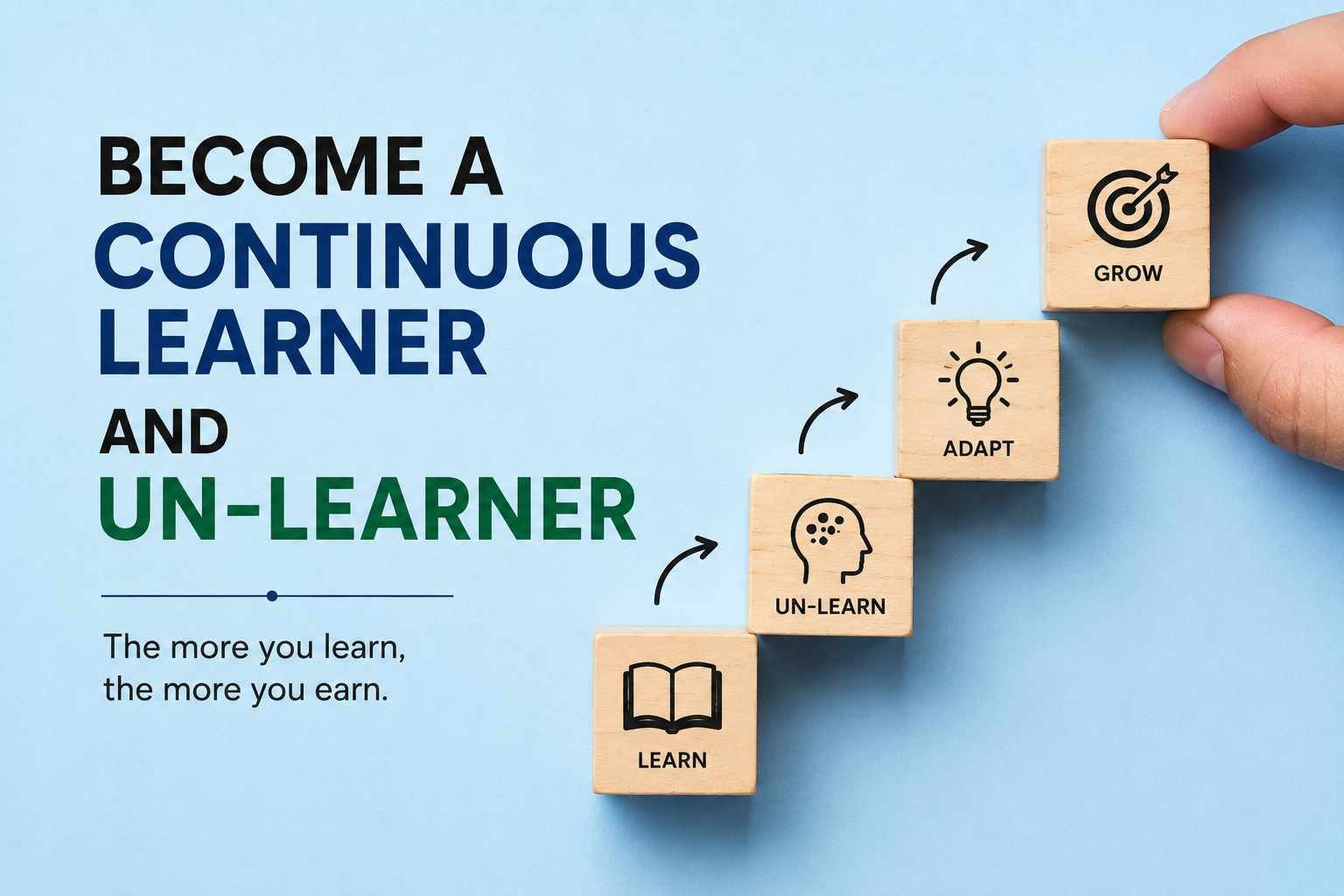
    1. Become a Continuous Learner and Un-Learner

    One of the most important characteristics of successful Digital Marketing professionals is their commitment to continuous learning.

    The digital landscape changes rapidly. Search engine algorithms are updated frequently, social media platforms introduce new features, consumer behavior evolves, and new technologies emerge every year. What worked six months ago may not be as effective today.

    Because of this constant change, Digital Marketing professionals must make learning a lifelong habit. Staying informed about industry trends allows marketers to adapt quickly and maintain their competitive edge.

    There are many ways to continue learning in Digital Marketing:

    • Follow industry-leading blogs and websites.
    • Attend webinars and online workshops.
    • Take professional certification courses.
    • Listen to marketing podcasts.
    • Join digitalmarketing communities and forums.
    • Follow successful marketers on social media.

    Learning alone is not enough. Successful professionals must also learn how to unlearn outdated methods. Some marketing techniques that were once effective may become obsolete due to changes in algorithms, technology, or consumer expectations.

    For example, search engine optimization strategies that worked years ago may no longer produce results because search engines continuously refine their ranking systems. Similarly, social media engagement tactics evolve as platforms update their algorithms and features.

    By embracing continuous learning and being willing to abandon ineffective practices, you can remain relevant and valuable in the digitalmarketing industry.

    The professionals who consistently invest in learning are often the ones who advance faster, secure better opportunities, and achieve long-term career success.

    ย 

    Digital Marketing

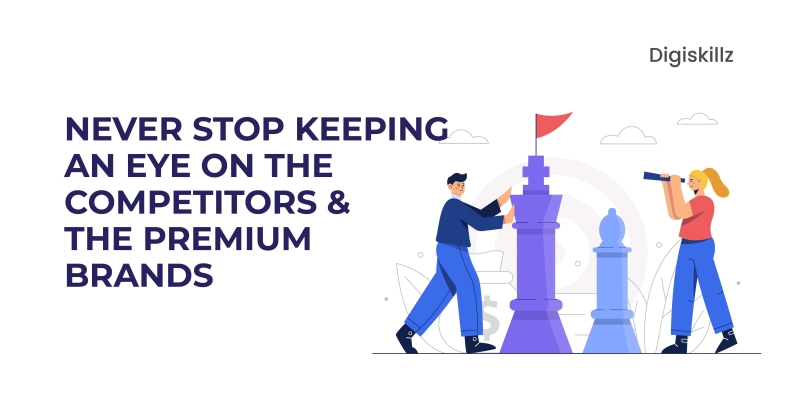
    2. Study Competitors and Industry Leaders

    A powerful way to improve your Digital Marketing carefully observe successful brands and industry leaders.

    Every successful marketing campaign contains valuable lessons. By analyzing what established companies are doing, you can gain insights into customer engagement, content strategies, advertising techniques, and brand positioning.

    Competitor research helps you understand:

    • Market trends
    • Audience preferences
    • Content performance
    • Advertising strategies
    • Customer engagement techniques
    • Emerging opportunities

    Digital Marketing is highly competitive, and businesses constantly experiment with new approaches to attract customers. Studying competitors allows you to identify successful tactics while avoiding common mistakes.

    Pay attention to how leading brands:

    • Create social media content
    • Optimize websites for search engines
    • Run paid advertising campaigns
    • Use email marketing
    • Develop content marketing strategies
    • Build customer relationships

    You should also follow Digital Marketing experts who regularly share industry insights and practical advice. Learning from experienced professionals can help you understand challenges, avoid pitfalls, and develop a more strategic approach to marketing.

    However, competitor analysis should never involve copying someone else’s work. Instead, use your observations to inspire unique ideas and innovative strategies that align with your own goals.

    The most successful Digital Marketing professionals know how to learn from others while maintaining originality and creativity.

    3. Gain Hands-On Experience Through Real Projects

    Knowledge without practical application has limited value in digitalmarketing.

    Many beginners spend months studying theories but hesitate to implement what they have learned. While theoretical knowledge provides a strong foundation, real growth happens when you apply your skills to actual projects.

    Practical experience allows you to understand how marketing concepts work in real-world situations. It also helps you develop confidence and problem-solving abilities.

    Some ways to gain practical experience include:

    • Starting your own blog.
    • Creating a personal website.
    • Managing social media accounts.
    • Running small advertising campaigns.
    • Offering freelance services.
    • Assisting local businesses.
    • Creating content for online platforms.

    Working on real projects teaches you valuable skills such as:

    • Campaign planning
    • Audience targeting
    • Content creation
    • Search engine optimization
    • Data analysis
    • Performance tracking
    • Conversion optimization

    One of the greatest benefits of practical experience is portfolio development. Employers and clients often prioritize candidates who can demonstrate proven results rather than simply listing certifications.

    A portfolio showcasing successful projects, campaigns, and measurable outcomes can significantly improve your credibility and career prospects.

    Digital Marketing is ultimately a results-driven profession. The more experience you gain, the more capable you become at generating meaningful outcomes for businesses.

    ย 

    4. Develop Creativity and Innovative Thinking

    Creativity is a critical component of successful Digital Marketing.

    Every day, consumers encounter thousands of advertisements, social media posts, emails, and promotional messages. To stand out in such a crowded environment, marketers must create content and campaigns that capture attention and leave a lasting impression.

    Creative thinking helps marketers:

    • Generate unique campaign ideas.
    • Create engaging content.
    • Build memorable brands.
    • Improve audience engagement.
    • Increase campaign effectiveness.

    Digital Marketing offers countless opportunities for creativity. Whether you are designing social media content, writing blog posts, creating videos, or developing advertising campaigns, innovative thinking can help you achieve better results.

    Beginners often have an advantage because they are not restricted by established routines. They can experiment with new ideas and test unconventional approaches.

    Some ways to strengthen creativity include:

    • Studying successful campaigns.
    • Reading books from different industries.
    • Following creative professionals.
    • Practicing brainstorming exercises.
    • Exploring new content formats.
    • Experimenting with storytelling techniques.

    Combining creativity with technical skills such as SEO, social media management, and analytics can create powerful marketing campaigns that resonate with audiences.

    In the world of Digital Marketing, creativity often becomes the factor that separates average marketers from exceptional ones.

    Digital Marketing

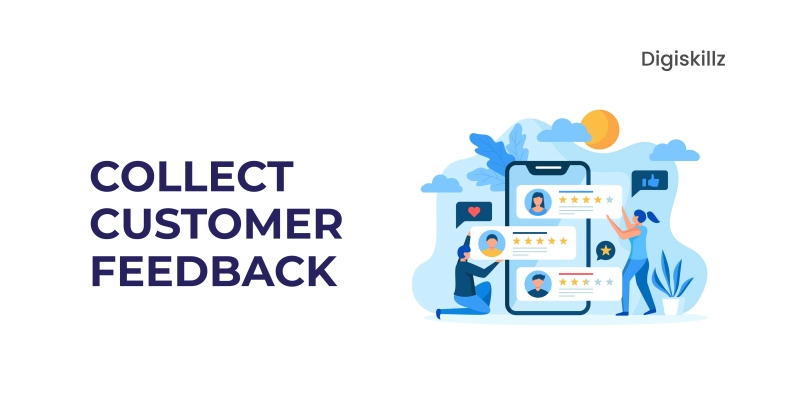
    5. Collect and Analyze Customer Feedback

    Customer feedback is one of the most valuable resources in digitalmarketing.

    Understanding your audience is essential for creating effective marketing strategies. Customer feedback provides direct insights into what people like, dislike, need, and expect from a brand.

    Businesses that actively listen to customers can improve their products, services, and marketing efforts more effectively than those that rely solely on assumptions.

    There are numerous ways to collect customer feedback:

    • Online surveys
    • Customer reviews
    • Social media comments
    • Website feedback forms
    • Email questionnaires
    • Customer interviews

    Modern Digital Marketing tools make it easier than ever to gather and analyze customer data. Analytics platforms, CRM systems, and email marketing tools provide valuable information about customer behavior and preferences.

    By analyzing feedback, businesses can:

    • Improve customer satisfaction.
    • Enhance user experience.
    • Identify market opportunities.
    • Optimize marketing campaigns.
    • Increase customer retention.
    • Build stronger customer relationships.

    Customer feedback also helps marketers understand long-term trends and evolving consumer expectations. This information can guide future marketing decisions and contribute to sustainable business growth.

    For aspiring Digital Marketing professionals, developing strong analytical skills and learning how to interpret customer data can significantly increase career opportunities and professional value.

    Conclusion

    The Digital Marketing industry continues to grow at an incredible pace, creating exciting opportunities for professionals around the world. Businesses of all sizes are investing heavily in digital channels, making digitalmarketing one of the most promising career paths in today’s economy.

    Success in Digital Marketing requires a combination of technical knowledge, practical experience, creativity, adaptability, and customer understanding. Professionals who continuously learn, analyze competitors, gain hands-on experience, think creatively, and leverage customer feedback are more likely to achieve long-term success.

    The journey may not always be easy. The industry is competitive and constantly evolving. However, for those who are willing to learn, adapt, and innovate, digitalmarketing offers endless possibilities for growth and achievement.

    If you’re considering a career in Digital Marketing, now is an excellent time to begin. Start building your skills, work on real projects, stay curious, and embrace continuous improvement. With dedication and persistence, you can establish yourself as a successful digitalmarketing professional and thrive in one of the world’s fastest-growing industries.

    Tags :
    digitdal marketing strategy
    Author : Swetha

    Freelance Digital Marketer passionate about helping businesses grow through SEO, content marketing, and data-driven digital strategies.

    Learner ofย DigiSkillz, Digital Marketing Institute in Kochi.

  • 7 Ways AI Can Transform Your Digital Marketing Strategy

    7 Ways AI Can Transform Your Digital Marketing Strategy

    Digital Marketing Strategy

    7 Ways AI Can Transform Your Digital Marketing Strategy

    The digital marketing landscape is evolving faster than ever before. As customer expectations continue to rise and competition becomes increasingly intense, businesses must find smarter ways to connect with their target audience. This is where Artificial Intelligence (AI) is making a significant impact.

    AI is no longer a futuristic concept reserved for large corporations. Today, businesses of all sizes are using AI-powered tools to improve customer experiences, automate repetitive tasks, analyze massive amounts of data, and make better marketing decisions. Whether it’s personalizing content, predicting customer behavior, or optimizing advertising campaigns, AI is reshaping every aspect of a successful Digital Marketing Strategy.

    Traditional marketing methods often rely on assumptions and manual processes. AI, on the other hand, uses data-driven insights to help marketers understand customers more accurately and deliver highly relevant experiences at scale. This results in improved engagement, higher conversion rates, and better returns on marketing investments.

    In this article, we’ll explore seven powerful ways AI can transform your Digital Marketing Strategy and help your business achieve sustainable growth in the digital era.

    1. Automated Customer Segmentation

    Digital Marketing Strategy

    One of the biggest challenges marketers face is understanding their audience. Every customer has unique interests, behaviors, preferences, and purchasing patterns. Manually segmenting customers can be time-consuming and often lacks precision.

    AI solves this challenge through automated customer segmentation.

    Using machine learning algorithms, AI analyzes customer data from multiple sources, including:

    • Website visits
    • Purchase history
    • Social media engagement
    • Email interactions
    • Demographic information
    • Online behavior

    AI then groups customers into highly targeted segments based on shared characteristics and behaviors.

    For example, an eCommerce business can identify customers who frequently purchase premium products and create specialized campaigns specifically for them. Similarly, marketers can target customers who abandoned their shopping carts with personalized offers.

    Benefits of AI-Powered Segmentation

    • More accurate audience targeting
    • Increased campaign relevance
    • Better customer engagement
    • Improved conversion rates
    • Higher marketing ROI

    Customer segmentation forms the foundation of a successful Digital Marketing Strategy, and AI makes this process faster and more effective than ever.

    2. Optimized Ad Targeting

    Digital advertising consumes a significant portion of most marketing budgets. However, even the most creative advertisements can fail if they reach the wrong audience.

    AI helps businesses optimize ad targeting by identifying users most likely to engage with their products or services.

    AI-powered advertising platforms analyze:

    • Browsing behavior
    • Search history
    • Purchase intent
    • Social media activity
    • Demographic data
    • Previous interactions

    Based on this information, AI determines which audience segments are most likely to convert.

    Additionally, AI continuously learns from campaign performance and automatically adjusts targeting strategies in real time.

    How AI Improves Advertising

    • Reduces wasted ad spend
    • Improves click-through rates
    • Increases conversion rates
    • Enhances customer acquisition
    • Maximizes advertising ROI

    By incorporating AI into your Digital Marketing Strategy, you can ensure your advertising budget is spent more efficiently and effectively.

    3. Enhanced Personalization

    digital marketing strategy

    Today’s consumers expect personalized experiences. Generic marketing messages no longer generate the same level of engagement they once did.

    AI enables businesses to deliver personalized experiences at scale.

    By analyzing customer preferences, browsing history, and behavioral patterns, AI can automatically customize:

    • Website content
    • Product recommendations
    • Email campaigns
    • Promotional offers
    • Social media content

    For example, streaming platforms recommend content based on viewing history, while online retailers suggest products based on previous purchases.

    This level of personalization creates stronger customer relationships and increases brand loyalty.

    Benefits of AI Personalization

    • Improved customer satisfaction
    • Higher engagement rates
    • Increased customer retention
    • More conversions
    • Enhanced user experience

    Personalization has become an essential element of every modern Digital Marketing Strategy, and AI makes it easier to implement effectively.

    4. Automated Insights and Reporting

    Data is one of the most valuable assets in digital marketing. However, collecting, analyzing, and interpreting large amounts of data can be overwhelming.

    AI simplifies this process by automating insights and reporting.

    Instead of spending hours creating reports manually, marketers can use AI-powered analytics tools to gain real-time insights into:

    • Campaign performance
    • Customer behavior
    • Traffic sources
    • Conversion rates
    • Audience demographics
    • Revenue attribution

    AI can also identify trends and opportunities that may otherwise go unnoticed.

    Advantages of AI Reporting

    • Faster decision-making
    • Real-time performance tracking
    • Reduced manual effort
    • Improved campaign optimization
    • Better strategic planning

    A data-driven Digital Marketing Strategy is critical for success, and AI makes data analysis significantly more accessible and actionable.

    Digital Marketing Strategy

    5. Smarter Lead Scoring

    Not every lead has the same potential value. Identifying high-quality leads is essential for maximizing sales and marketing efficiency.

    AI-powered lead scoring helps businesses prioritize leads based on their likelihood to convert.

    AI evaluates multiple factors, including:

    • Website activity
    • Email engagement
    • Demographics
    • Purchase history
    • Content interactions
    • Customer intent signals

    The system then assigns scores to each lead, allowing sales teams to focus on prospects with the highest probability of making a purchase.

    Benefits of AI Lead Scoring

    • Better lead qualification
    • Improved sales productivity
    • Faster conversion cycles
    • Increased revenue opportunities
    • More efficient marketing efforts

    Integrating AI lead scoring into your Digital Marketing Strategy can dramatically improve lead management and overall business performance.

    6. Predictive Analytics

    digital marketing strategy

    Predictive analytics is one of the most powerful applications of AI in marketing.

    Rather than reacting to customer behavior after it occurs, predictive analytics enables businesses to anticipate future actions and trends.

    AI analyzes historical data to predict:

    • Customer purchasing behavior
    • Product demand
    • Campaign performance
    • Churn risk
    • Seasonal trends
    • Market opportunities

    This allows marketers to make proactive decisions instead of reactive ones.

    For example, businesses can identify customers who are likely to stop purchasing and launch retention campaigns before losing them.

    Advantages of Predictive Analytics

    • Improved forecasting
    • Better customer retention
    • Enhanced campaign planning
    • Increased competitive advantage
    • Smarter decision-making

    Predictive analytics strengthens any Digital Marketing Strategy by helping businesses stay ahead of customer needs and market changes.

    7. Increased ROI Through Automation

    One of the primary goals of every Digital Marketing Strategy is maximizing return on investment (ROI).

    AI contributes directly to higher ROI by automating repetitive and time-consuming tasks such as:

    • Email marketing
    • Social media scheduling
    • Customer support
    • Data analysis
    • Campaign optimization
    • Lead nurturing

    Automation reduces operational costs while improving efficiency and productivity.

    AI also continuously monitors campaign performance and recommends improvements that maximize results.

    How AI Improves ROI

    • Reduced marketing costs
    • Increased operational efficiency
    • Higher conversion rates
    • Better resource allocation
    • Improved campaign effectiveness

    Businesses that leverage AI effectively often achieve better results with fewer resources compared to traditional marketing approaches.

    digital marketing strategy

    The Future of AI in Digital Marketing

    As AI technology continues to evolve, its role in marketing will become even more significant.

    Emerging AI capabilities include:

    • Conversational AI chatbots
    • Voice search optimization
    • Hyper-personalized customer experiences
    • Advanced predictive modeling
    • AI-generated content creation
    • Real-time customer journey optimization

    Businesses that embrace these innovations will gain a competitive advantage and build stronger relationships with their audiences.

    AI is no longer just a helpful toolโ€”it is becoming a core component of every successful Digital Marketing Strategy.

    Conclusion

    Artificial Intelligence is transforming the way businesses approach digital marketing. From automated customer segmentation and optimized ad targeting to predictive analytics and personalized customer experiences, AI enables marketers to make smarter decisions and achieve better results.

    Organizations that integrate AI into their Digital Marketing Strategy can improve efficiency, enhance customer engagement, generate higher-quality leads, and maximize return on investment.

    As technology continues to advance, adopting AI-driven marketing solutions will become increasingly important for businesses that want to remain competitive and grow in the digital age. The future of marketing is intelligent, data-driven, and powered by AIโ€”and the time to embrace it is now.

    Tags :
    digitdal marketing strategy
    Author : Akash

    Consectetur sollicitudin cubilia facilisis lobortis lacus a ac phasellus. Mus pulvinar enim suspendisse pharetra id commodo platea nunc aliquet.

    Learner ofย DigiSkillz, Digital Marketing Institute in Kochi.

  • Marketing vs Branding: Key Differences Every Business Should Know

    Marketing vs Branding: Key Differences Every Business Should Know

    Digital marketing course in kochi marketing vs branding

    In today’s competitive business world, many people use the terms marketing and branding interchangeably. Although they work together to help businesses grow, they are not the same. Understanding marketing vs branding is essential for entrepreneurs, business owners, marketers, and students who want to build successful businesses and strong customer relationships.

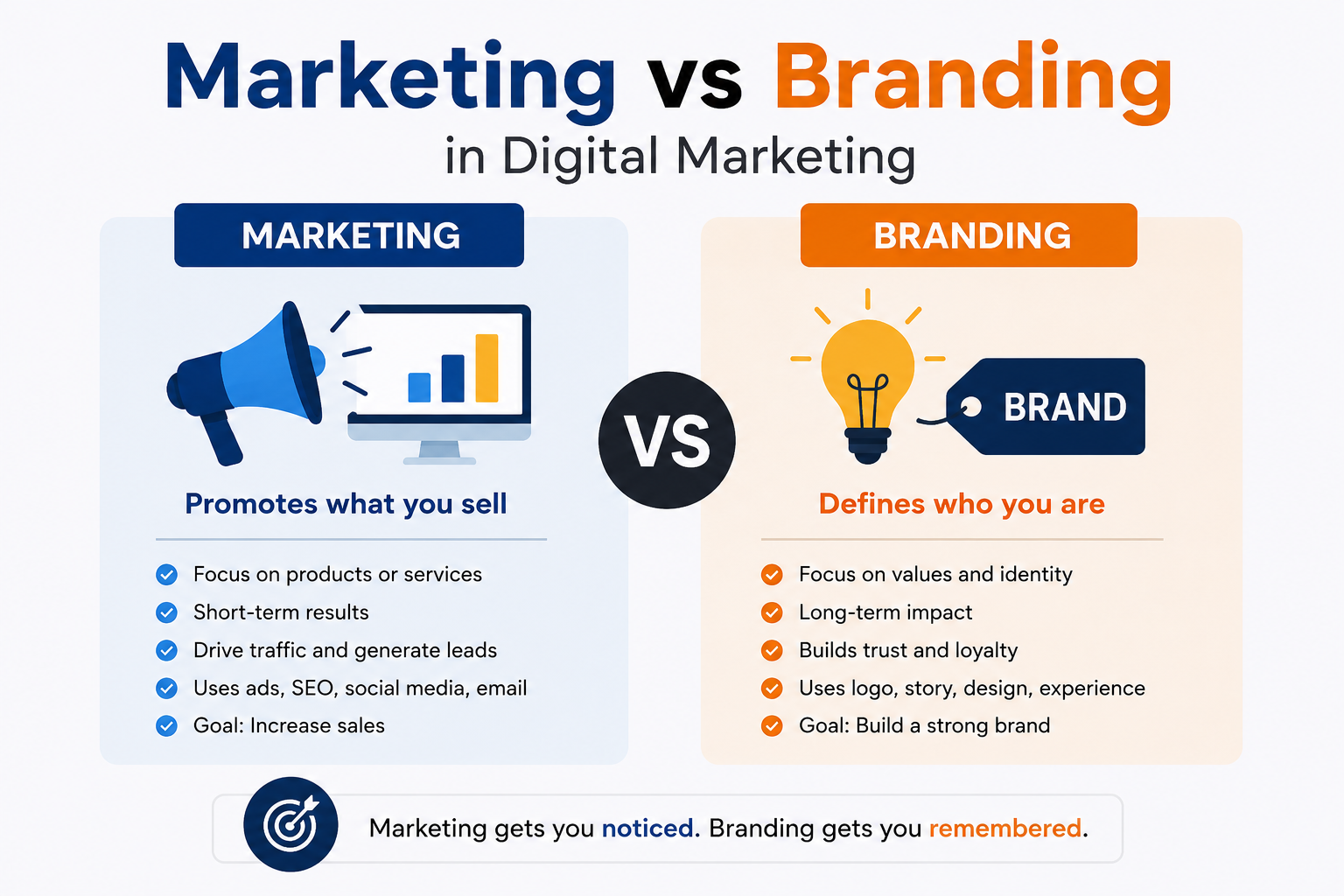
    Marketing focuses on promoting products or services to generate leads and increase sales. Branding, on the other hand, is about creating a unique identity and building trust that keeps customers coming back. A business may run excellent marketing campaigns, but without strong branding, it can struggle to create lasting customer loyalty.

    This guide explains the major differences between marketing and branding, their goals, strategies, benefits, and why businesses need both for long-term success.

    What is Marketing? ย 

    When discussing marketing vs branding, marketing represents the promotional side of a business. It includes advertising, SEO, social media marketing, content marketing, and paid campaigns that help attract potential customers and increase conversions.

    The primary objective of marketing is to increase awareness, generate leads, and boost revenue. Marketing campaigns are often designed for short-term goals and can be adjusted quickly based on customer behavior and market trends.

    Some common marketing strategies include:

    • Search Engine Optimization (SEO)
    • Pay-Per-Click (PPC) Advertising
    • Social Media Marketing
    • Email Marketing
    • Content Marketing
    • Influencer Marketing
    • Video Marketing
    • Affiliate Marketing

    Successful marketing helps businesses reach the right audience at the right time while maximizing return on investment (ROI).Before exploring each concept individually, it’s important to understand how marketing vs branding contributes to overall business growth.

    What is Branding?

    Branding is the process of creating a unique identity that differentiates a business from its competitors. It shapes how customers perceive a company and influences their emotional connection with the brand.

    A strong brand includes more than just a logo or color scheme. It represents the company’s values, mission, personality, customer experience, and reputation.

    Branding helps businesses:

    • Build trust with customers
    • Increase brand recognition
    • Create emotional connections
    • Encourage customer loyalty
    • Stand out in competitive markets

    Unlike marketing, branding is a long-term investment. While marketing attracts customers, branding ensures they remember and return to your business.

    Marketing vs Branding: Understanding the Difference

    The comparison between marketing vs branding becomes easier when you understand that marketing drives customer acquisition, while branding strengthens customer retention. Both are essential for sustainable business growth.

    Marketing focuses on driving immediate sales through promotional activities. Branding focuses on building a lasting reputation that influences purchasing decisions over time.

    Think of branding as the personality of your business and marketing as the communication strategy that introduces that personality to the world.

    For example, a digital marketing campaign may attract visitors to your website, but a strong brand convinces them to trust your company and become loyal customers.

    digital marketing course in kochi marketing vs branding

    Key Differences Between Marketing and Branding

    Comparing marketing vs branding helps businesses understand how promotional activities and brand identity work together.

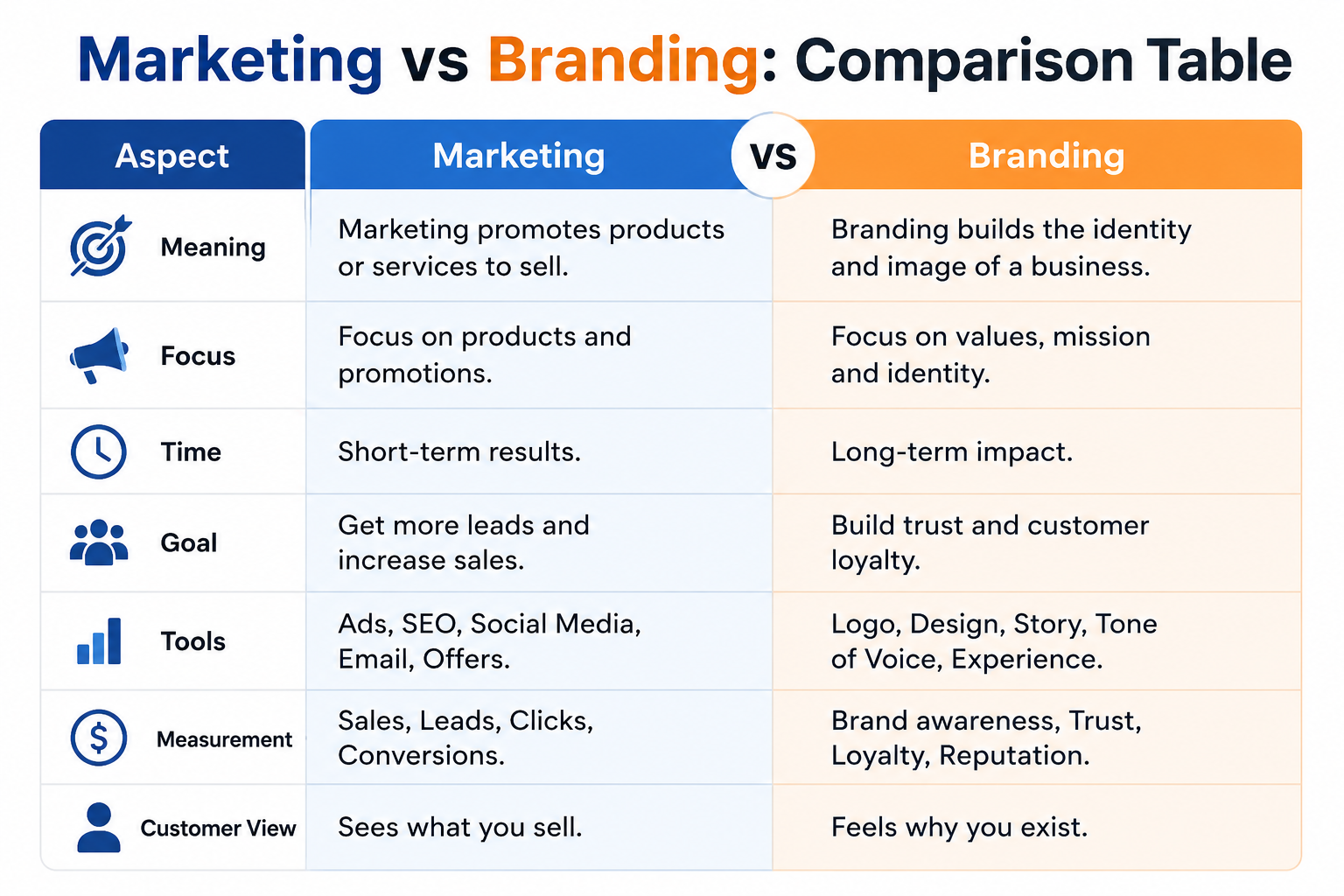
    1. Purpose

    Marketing aims to generate leads, increase sales, and grow revenue through promotional activities.

    Branding aims to create trust, credibility, and long-term customer relationships by establishing a memorable business identity.

    2. Timeframe

    Marketing campaigns usually have short-term objectives. They may run for a few weeks or months depending on business goals.

    Branding is a continuous process that develops over many years through consistent customer experiences and communication.

    3. Focus

    Marketing focuses on products, services, pricing, promotions, and customer acquisition.

    Branding focuses on company values, mission, identity, customer perception, and emotional connection.

    4. Success Metrics

    Marketing performance is measured using data such as:

    • Website traffic
    • Conversion rates
    • Lead generation
    • Click-through rates
    • Return on investment (ROI)
    • Sales revenue

    Branding success is measured through:

    • Brand awareness
    • Customer loyalty
    • Brand recognition
    • Customer trust
    • Reputation
    • Customer retention

    Why Marketing and Branding Work Together

    Many businesses mistakenly believe they only need marketing to succeed. In reality, marketing and branding are most effective when they work together.

    Imagine spending thousands of dollars on advertisements. Your campaigns may attract visitors, but if your business lacks credibility, customers are unlikely to make a purchase.

    Similarly, a business with an excellent brand but no marketing strategy may struggle to reach new customers.

    Marketing creates visibility.

    Branding builds trust.

    Together, they create sustainable business growth.

    Marketing vs Branding in Digital Marketing

    Digital marketing has made the relationship between marketing and branding even more important.

    Businesses now interact with customers through websites, search engines, social media platforms, email campaigns, YouTube, and online advertisements. Every interaction contributes to both marketing performance and brand perception.

    For example:

    • SEO improves website visibility.
    • Content marketing builds authority.
    • Social media strengthens brand personality.
    • Email marketing nurtures customer relationships.
    • PPC advertising generates immediate leads.
    • Online reviews improve brand trust.

    A successful digital strategy combines these elements to create both short-term results and long-term brand value.

    Common Marketing Channels

    Businesses today use multiple channels to reach their audience, including:

    • Google Search
    • Facebook and Instagram Ads
    • LinkedIn Marketing
    • YouTube Marketing
    • Email Campaigns
    • Content Marketing
    • Search Engine Optimization (SEO)
    • Influencer Marketing
    • Affiliate Marketing
    • Mobile Marketing

    Choosing the right channels depends on your target audience, business goals, and budget.

    How to Build a Strong Branding Strategy

    A successful branding strategy helps businesses create a memorable identity and establish long-term relationships with customers. Here are the key steps to building a strong brand:

    1. Define Your Brand Identity

    Start by identifying your mission, vision, values, and unique selling proposition (USP). These elements form the foundation of your brand and communicate what your business stands for.

    2. Know Your Target Audience

    Understanding your audience is essential for both marketing and branding. Research their demographics, interests, challenges, and purchasing behavior to create messaging that resonates with them.

    3. Create a Consistent Brand Voice

    Your communication style should remain consistent across your website, social media, advertisements, emails, and customer support. A consistent tone strengthens brand recognition and builds trust.

    4. Design a Memorable Visual Identity

    Your logo, typography, color palette, and website design should reflect your brand personality. A professional and consistent visual identity makes your business instantly recognizable.

    5. Deliver Excellent Customer Experience

    Every customer interaction shapes your brand. Providing exceptional products, services, and support encourages positive reviews, repeat business, and word-of-mouth referrals.

    Marketing vs Branding: Comparison Table

    Digital marketing course in kochi marketing vs branding

    Real-World Example of Marketing vs Branding

    Imagine two coffee shops opening in the same neighborhood.

    The first coffee shop spends heavily on social media ads and promotional offers. Customers visit because of the discounts, but many don’t return once the offers end.

    The second coffee shop invests in creating a welcoming atmosphere, consistent branding, friendly service, quality products, and an engaging online presence. Customers remember the experience, recommend it to friends, and become loyal visitors.

    The first business relied mainly on marketing.

    The second combined effective marketing with strong branding.

    This example highlights why marketing vs branding is not a competition. The most successful businesses integrate both strategies to achieve sustainable growth.

    This example clearly demonstrates why marketing vs branding should be treated as complementary strategies rather than competing concepts.

    Common Mistakes Businesses Makeย Digital marketing course in kochi marketing vs branding

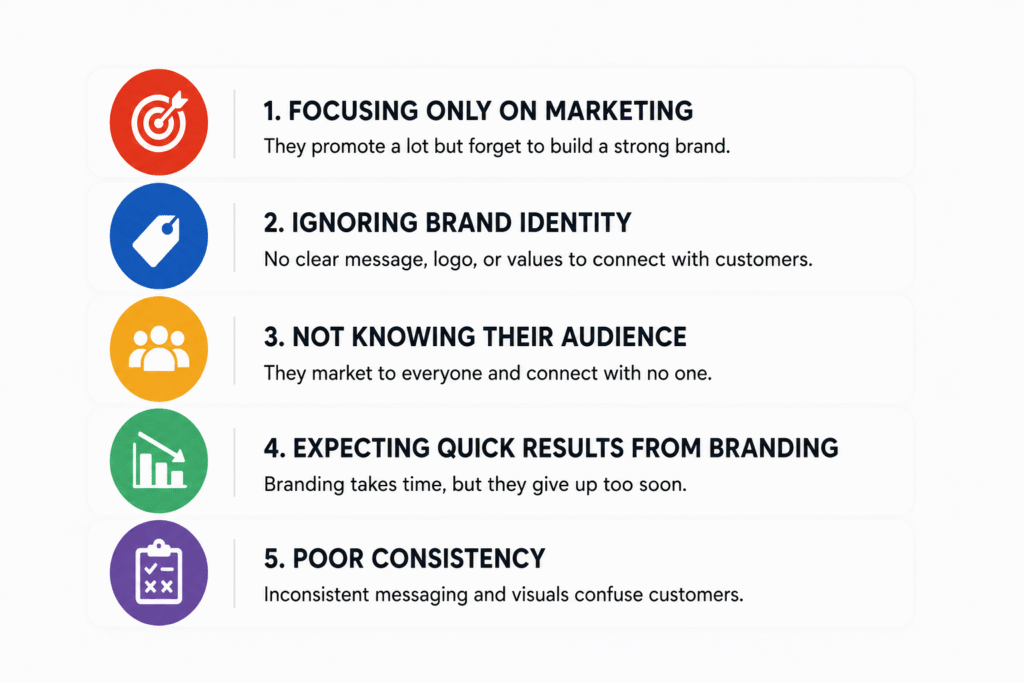
    Many businesses struggle because they misunderstand the relationship between marketing and branding. Some common mistakes include:

    • Running advertising campaigns without a clear brand identity.
    • Frequently changing logos, colors, or messaging.
    • Focusing only on sales instead of customer relationships.
    • Ignoring customer feedback and online reviews.
    • Creating inconsistent content across different platforms.
    • Investing in branding but neglecting marketing efforts.

    Avoiding these mistakes helps businesses build credibility and maximize the impact of their marketing campaigns.Many businesses fail because they misunderstand marketing vs branding and focus on one while ignoring the other.

    Best Practices for Combining Marketing and Branding

    To achieve long-term success, businesses should integrate marketing and branding into a single strategy.

    Some best practices include:

    • Maintain consistent messaging across all marketing channels.
    • Create valuable, informative content that reflects your brand values.
    • Invest in SEO to increase organic visibility.
    • Use social media to engage with your audience and strengthen relationships.
    • Monitor marketing performance using analytics.
    • Collect customer feedback to improve both your marketing and branding efforts.
    • Continuously adapt your marketing strategies while maintaining a consistent brand identity.

    Why Both Marketing and Branding Matter

    Businesses often ask whether marketing or branding is more important. The truth is that both are essential.

    Marketing helps businesses reach new audiences, generate leads, and increase revenue.

    Branding transforms first-time buyers into loyal customers by creating trust, credibility, and emotional connections.

    Without marketing, potential customers may never discover your business.

    Without branding, customers may forget your business after making a purchase.

    The most successful companies combine strategic marketing with strong branding to create sustainable growth and long-term customer loyalty.

    Frequently Asked Questions

    Is marketing the same as branding?

    No. Marketing promotes products and services to generate sales, while branding builds a company’s identity, reputation, and customer trust.

    Which comes first: marketing or branding?

    Branding should come first. A strong brand identity provides the foundation for effective marketing campaigns and consistent communication.
    Can a business succeed with marketing alone?

    Marketing can generate short-term sales, but long-term success requires strong branding to build customer loyalty and brand recognition.

    Why is branding important in digital marketing?

    Branding creates consistency across websites, social media, email campaigns, and online advertisements. It improves trust, recognition, and customer engagement.
    Conclusion

    Understanding marketing vs branding is essential for building a successful business. Whether you are a student, entrepreneur, or business owner, understanding marketing vs branding gives you a competitive advantage. Although they serve different purposes, they complement each other and work best when combined.
    Marketing helps attract potential customers through promotional strategies, advertising, SEO, content marketing, and digital campaigns. Branding builds the trust, credibility, and emotional connection that encourages customers to stay loyal and recommend your business to others.

    Whether you’re launching a startup, managing an established company, or learning digital marketing, investing in both marketing and branding will create stronger customer relationships, improve business visibility, and support long-term growth.

    By developing a consistent brand identity and implementing effective marketing strategies, businesses can stand out in competitive markets and achieve lasting success.ย Mastering marketing vs branding allows businesses to create effective campaigns while building a strong and memorable brand.ย 

    Tags :
    digitdal marketing strategy
    Author : Sneha

    Freelance Digital Marketer passionate about helping businesses grow through SEO, content marketing, and data-driven digital strategies.

    Learner ofย DigiSkillz, Digital Marketing Institute in Kochi.

  • Free Business listing Websites Listed 2026: Your Ultimate Guide

    Free Business listing Websites Listed 2026: Your Ultimate Guide

    Free Business Listing Websites

    Free Business listing Websites Listed 2026: Your Ultimate Guide

    Are you searching for the best free business listing websites to promote your business online? You’ve come to the right place! We’ve curated a list of the top free business listing websites for 2026 that can help boost your online visibility, improve search engine rankings, strengthen your local SEO, and connect you with a wider audience.

    Before exploring the list of free business listing websites, let’s take a closer look at why business directories are so important in today’s digital world.

    What Are Business Listing Websites?

    Free business listing websites, also known as business directories, are online platforms that display important business information such as your business name, address, phone number, and website URL. These directories make it easier for customers to find local businesses while helping companies improve their online visibility, strengthen local SEO, increase credibility, and attract more potential customers.

    Free Business listing Websites Listed 2023

    Why Are Business listing websites Important?

    Business directories are important for several reasons. First, they help businesses increase their online visibility. Byย listing your businessย on a directory website, you can improve your search engine rankings, making it easier for potential customers to find you online.

    Second, free business listing websites help businesses build credibility. When consumers see your business listed on trusted directory websites, they are more likely to trust your brand and make a purchase.

    Finally, free business listing websites make it easier for consumers to find local businesses. With just a few clicks, potential customers can access important information such as your business location, phone number, website URL, and operating hours, helping you attract more local leads and grow your business.

    Free Business listing Websites Listed 2023

    Top Free Business Listing Websites for 2026

    In this article, we provide a comprehensive list of the best free business listing websites for 2026. Our team has carefully researched the most trusted and reliable business directories that can help increase your online visibility and drive more traffic to your business. By submitting your business to these free business listing websites, you can improve your local SEO, reach potential customers, and grow your online presence with ease.

    1.Google My Business

    Free Business listing Websites Listed 2023

    Google My Businessย is an essential tool for any business looking to improve their online presence. This free business listing website allows you to create a profile for your business that appears in Googleโ€™s search results and on Google Maps. By listing your business on Google My Business, you can improve your visibility online and make it easier for potential customers to find you.

    2.Bing Places

    Bing Places is a free business listing site that allows you to create a profile for your business that appears in Bingโ€™s search results and on Bing Maps. This platform offers a range of features including the ability to add photos, videos, and descriptions of your business. By listing your business onย Bing Places, you can improve your search engine rankings and attract new customers.

    3.Yelp

    Free Business listing Websites Listed 2023

    Yelpย is a popular business listing site that allows customers to leave reviews and ratings for businesses. By creating a profile for your business on Yelp, you can improve your online reputation and attract new customers. This platform also allows you to add photos and descriptions of your business, making it easier for potential customers to find you.

    4.Yellow Pages

    Free Business listing Websites Listed 2023

    Yellow Pagesย is a free business listing site that allows you to create a profile for your business that appears in their search results. This platform also offers a range of advertising options to help you promote your business and attract new customers.

    • Yahoo Local

    Yahoo Localย is a free business listing website offered by Yahoo. It allows businesses to create a free profile that includes information such as name, address, phone number, website URL, and hours of operation. This profile appears in Yahoo search results and on Yahoo Maps.

    • Facebook

    Free Business listing Websites Listed 2023

    Facebook is a social media platform that also serves as a business listing site. Businesses can create a free Facebook Page that includes information such as name, address, phone number, website URL, and hours of operation. This Page appears in Facebook search results and on the businessโ€™s Facebook profile.

    • LinkedIn

    LinkedIn is a professional networking platform that also serves as a business listing website. Businesses can create a free LinkedIn Page that includes information such as name, address, phone number, website URL, and hours of operation. This Page appears inย LinkedInย search results and on the businessโ€™s LinkedIn profile.

    5.Foursquare

    Foursquareย is a location-based social media platform that allows users to check in at businesses and leave reviews and ratings. By creating a profile for your business on Foursquare, you can improve your online reputation and attract new customers. This platform also allows you to add photos and descriptions of your business, making it easier for potential customers to find you.

    6.TripAdvisor

    TripAdvisor is a popular travel website that allows users to leave reviews and ratings for hotels, restaurants, and other travel-related businesses. By creating a profile for your business onย TripAdvisor, you can improve your online reputation and attract new customers. This platform also offers a range of advertising options to help you promote your business to travelers.

    7.Manta

    Free Business listing Websites Listed 2023

    Mantaย is a free business listing site that allows you to create a profile for your business that appears in their search results. This platform also offers a range of marketing solutions to help you promote your business and attract new customers.

    8.Angieโ€™s List

    Angieโ€™s List is a business directory that focuses on providing reviews and ratings for local service providers. By creating a profile for your business onย Angieโ€™s List, you can improve your online reputation and attract new customers. This platform also offers a range of advertising options to help you promote your business to local customers.

    9.Better Business Bureau

    The Better Business Bureau (BBB) is a nonprofit organization that provides ratings and reviews for businesses across a range of industries. By becoming accredited by theย BBBย and creating a profile for your business on their website, you can improve your online reputation and attract new customers.

    Free Business listing Websites Listed 2023

    10.Hotfrog

    Hotfrogย is a free business directory that allows you to create a profile for your business that appears in their search faster and easier and provide potential leads.

    Conclusion

    Listing your business on free business directories is one of the simplest and most effective ways to boost your online visibility. Theย Free Business Listing Websites Listed 2026ย in this guide provide a valuable opportunity to reach a wider audience, improve your search engine rankings, and establish credibility with potential customers.

    Remember, consistency is key ensure your business information is accurate and up to date across all free business listing websites. By leveraging these platforms, you can drive more traffic to your website, improve local SEO, attract potential customers, and stay ahead of the competition. Start listing your business on free business listing websites today and take your online presence to the next level.

    Tags :
    digitdal marketing strategy
    Author : Shahul

    Consectetur sollicitudin cubilia facilisis lobortis lacus a ac phasellus. Mus pulvinar enim suspendisse pharetra id commodo platea nunc aliquet.

    Learner ofย DigiSkillz, Digital Marketing Institute in Kochi.

  • The Future of SEO: Constantly Evolving and Adapting to Change

    The Future of SEO: Constantly Evolving and Adapting to Change

    future of SEO

    Ultimate Future of SEO: Constantly Evolving and Adapting to Change

    The future of SEOย is an ever-changing landscape. As technology and consumer behaviour continue to evolve, itโ€™s important for businesses and marketers to keep up with the latest trends in order to stay ahead of the competition. In this blog post, weโ€™ll be taking a closer look at how the future of SEO is constantly evolving and adapting to the ever-changing digital environment.future-of-seo

    SEO is Constantly Evolving

    Search engine optimization (SEO) is constantly evolving in order to keep up with the ever-changing digital landscape. It is important for SEO experts and marketers to be aware of the latest trends and strategies in order to remain competitive. As search engine algorithms and user expectations evolve, it is essential to stay up to date on the most recent SEO best practices.

    One of the topย SEO future trendsย that marketers must be aware of is local search optimization. With the increasing popularity of mobile devices, local searches have become increasingly important for businesses that want to attract nearby customers. Therefore, optimizing for local search results has become an essential component of a comprehensive SEO strategy.

    Additionally, voice search is also a trend that is gaining traction as more consumers are using voice-activated devices to find information. For this reason, it is important to optimize content for conversational search queries so that they can be easily discovered by voice search.

    Furthermore, artificial intelligence (AI) is also a major factor in the future of SEO. AI technologies are being used to analyze vast amounts of data quickly and accurately, enabling companies to better target potential customers and optimize their content for higher rankings. All of these emerging trends underscore the importance of keeping up with the latest SEO best practices.

    future-of-seo

    Changes in Technology

    As the world becomes increasingly more digital, so too does the way businesses conduct their marketing and search engine optimization. Technology is constantly improving and advancing, and the future of SEO will have to adjust to keep up with these changes. For example, the increasing popularity of mobile devices has changed the way we access the internet and search for information, meaning that companies must now focus on optimizing their content for mobile users.

    Additionally, voice search technology is rapidly developing, with more and more people now using voice-activated virtual assistants like Alexa or Google Home to search for content online. This means that businesses must optimize their websites for conversational searches, making sure that they are providing accurate answers to relevant questions. In order to stay ahead of the curve, itโ€™s important to be aware of current trends in technology and how they may affect the future of SEO.

    Changes in Consumer Behavior

    The future of SEO is closely tied to changes in consumer behaviour. Consumers today are increasingly using mobile devices, spending more time online, and expecting tailored content. Companies must respond to these changes in order to stay ahead of the competition. To do so, they must understand how their target audience uses the web and optimize their SEO strategies accordingly.

    One of the most important changes to keep an eye on is how users search for information. As people become more comfortable with voice search, for example, companies will need to adjust their SEO strategies to target long-tail keywords that better match the way people talk.ย 

    The future of SEO will also require companies to provide a better user experience, which includes faster page load times, mobile optimization, and quick response times.

    Additionally, companies must create content that appeals to users by being engaging and helpful. Finally, as social media continues to be a major influence in the world of search engine optimization, companies should prioritize developing a strong presence on platforms such as Facebook, Twitter, and Instagram.ย 

    By keeping an eye on changes in consumer behaviour, companies can stay one step ahead of the competition and position themselves well for success in the ever-evolving world of SEO.

    future-of-seo

    The Future of SEO

    As SEO continues to evolve, it is important to stay on top of the latest trends in order to stay ahead of the competition. It is essential to recognize and understand the changes in technology and consumer behaviour that can affect SEO in order to develop an effective strategy for success.

    Technology is always changing, and it is no different when it comes to SEO. As new technologies become available, they can have a significant impact on how search engines rank websites. For example, Googleโ€™s algorithm is constantly being updated and improved to better understand user queries and deliver more relevant results. Therefore, keeping up with the latest updates and changes in technology is critical for any website trying to stay ahead of the competition.

    Consumer behaviour is also changing, as more people are using mobile devices and voice assistants to search for information online. As a result, businesses must ensure that their websites are optimized for these new technologies in order to appear higher in search engine rankings.

    Additionally, SEO must be tailored to meet the needs of these consumers, such as using relevant keywords in content and optimizing for local searches.

    The future of SEOย will continue to include the importance of staying up-to-date with the latest technologies and trends in order to remain competitive.

    Additionally, businesses should focus on providing valuable content that meets the needs of their target audiences, as well as optimizing their websites for both desktop and mobile devices. Taking advantage of SEO future trends such as voice search optimization, artificial intelligence (AI), and structured data will also be important to maintain high rankings in the future.

    Conclusion

    In conclusion, the future of SEO is constantly evolving and adapting to changes in technology and consumer behaviour. As search engines become more advanced and user behaviour shifts, SEO professionals will need to stay informed and adapt their strategies to stay ahead of the curve. From the increasing importance of artificial intelligence and machine learning to the growing importance of mobile optimization and local SEO,ย the future of SEOย is filled with exciting opportunities and challenges. By staying informed and staying ahead of the curve, SEO professionals can continue to deliver the best possible results for their clients and help their businesses stay ahead of the competition in the digital marketplace.

    Tags :
    digitdal marketing strategy
    Author : Anjana

    Consectetur sollicitudin cubilia facilisis lobortis lacus a ac phasellus. Mus pulvinar enim suspendisse pharetra id commodo platea nunc aliquet.

    Learner ofย DigiSkillz, Digital Marketing Institute in Kochi.

  • A Practical Guide to Building a Successful Career in Digital Marketing

    A Practical Guide to Building a Successful Career in Digital Marketing

    Digital Marketing

    A Practical Guide to Building a Successful Career in Digital Marketing

    Digital Marketing has become one of the most exciting and rewarding career options in today’s digital-first world. As businesses increasingly rely on online platforms to reach customers, the demand for skilled Digital Marketing professionals continues to grow. Whether you are a student, graduate, entrepreneur, or someone looking for a career change, learning Digital Marketing can open the door to numerous job opportunities across industries.

    Unlike traditional marketing, Digital Marketing focuses on promoting products and services through online channels such as search engines, social media, websites, email, and paid advertising. It combines creativity, data analysis, and technology, making it an ideal career for individuals who enjoy learning and solving problems. If you are planning to build a successful career in Digital Marketing, here are five practical tips to help you get started.

    1. Keep Learning and Stay Updated

    The world of Digital Marketing evolves rapidly. Search engine algorithms, social media platforms, AI tools, and customer preferences change frequently, making continuous learning essential. Successful digital marketers invest time in learning new strategies, testing new tools, and staying informed about industry updates.

    Follow trusted marketing blogs, attend webinars, complete online certifications, and practice with real projects. At the same time, be willing to unlearn outdated techniques that no longer produce results. The ability to adapt is one of the most valuable skills in Digital Marketing and will help you stay competitive throughout your career.

    start-a-career-in-digital-marketing

    2. Learn from Competitors and Industry Leaders

    One of the fastest ways to improve your Digital Marketing skills is by studying successful brands and experienced marketers. Observe how leading companies create engaging content, optimize their websites, run advertising campaigns, and communicate with their audience.

    Analyze their SEO strategies, social media presence, email marketing campaigns, and website design. Understanding what works in your industry can inspire new ideas and help you build better marketing strategies. Instead of copying competitors, use their success as motivation to create unique campaigns that reflect your own creativity and expertise.

    3. Build Practical Skills Through Hands-on Experience

    Practical experience is more valuable than theoretical knowledge in Digital Marketing. Employers prefer candidates who can demonstrate real-world skills rather than simply listing certifications on a resume.

    Start your own blog, build a website, manage social media pages, or work on freelance projects to gain experience. Learn essential areas such as Search Engine Optimization (SEO), Google Ads, Meta Ads, content marketing, email marketing, Google Analytics, and social media marketing. These skills will help you build a strong portfolio and increase your confidence when applying for jobs or working with clients.

    The more projects you complete, the stronger your understanding of Digital Marketing becomes.

    4. Develop Creativity and Problem-Solving Skills

    Creativity plays a major role in Digital Marketing. Every business wants to stand out online, and creative campaigns often attract more attention than ordinary ones. Successful marketers combine creativity with data to produce content that engages audiences and drives results.

    Experiment with blog writing, video marketing, graphic design, storytelling, and social media campaigns. Don’t be afraid to test new ideas and learn from your mistakes. Every campaign teaches valuable lessons that improve your skills.

    In addition to creativity, problem-solving is equally important. Every marketing campaign presents new challenges, and the ability to analyze data, identify issues, and find effective solutions will make you a more valuable Digital Marketing professional.

    start-a-career-in-digital-marketing

    5. Listen to Customer Feedback

    Understanding your audience is the foundation of successful Digital Marketing. Customer feedback provides valuable insights into what people like, dislike, and expect from a brand. Collecting feedback helps businesses improve products, services, and marketing campaigns.

    Use online surveys, social media comments, Google Reviews, email questionnaires, and website feedback forms to gather customer opinions. Analyze this information to understand customer behavior and improve future marketing strategies.

    Listening to your audience helps build trust, strengthen customer relationships, and create marketing campaigns that deliver better results.

    Build Your Personal Brand

    Build a strong online presence by creating a professional LinkedIn profile, sharing valuable content, and showcasing your Digital Marketing projects. A personal portfolio can help demonstrate your skills and attract employers or clients.

    Network with Industry Professionals

    Connect with Digital Marketing professionals through webinars, events, and online communities. Networking helps you learn new skills, stay updated with industry trends, and discover career opportunities.

    Career Opportunities in Digital Marketing

    A career in Digital Marketing offers various roles, including SEO Specialist, Social Media Manager, Content Marketer, Google Ads Expert, Content Writer, and Digital Marketing Manager. You can also work as a freelancer or start your own agency.

    Conclusion

    Digital Marketing offers excellent career opportunities for those willing to learn and grow. By building practical skills, staying updated, and gaining real-world experience, you can build a successful and rewarding career in this fast-growing industry.

    Tags :
    digitdal marketing strategy
    Author : Swetha

    Consectetur sollicitudin cubilia facilisis lobortis lacus a ac phasellus. Mus pulvinar enim suspendisse pharetra id commodo platea nunc aliquet.

    Learner ofย DigiSkillz, Digital Marketing Institute in Kochi.

  • Chatbot Marketing: Transforming Customer Engagement in the Digital Age

    Chatbot Marketing: Transforming Customer Engagement in the Digital Age

    chatbot marketing

    Chatbot Marketing: Transforming Customer Engagement in the Digital Age

    What is Chatbot Marketing?

    Chatbot Marketing: Transforming Customer Engagement in the Digital Age

    Chatbot marketingย is the use of AI-powered conversational tools to engage with customers, streamline interactions, and drive conversions. These automated agents simulate human conversations on platforms like websites, messaging apps, and social media. Chatbots can answer customer inquiries, recommend products, collect leads, and even process transactions, making them a powerful tool for businesses.

    Unlike traditional communication methods, chatbots operate 24/7, providing instant support and personalized experiences. They range from simple rule-based systems, which follow predefined scripts, to advanced AI-driven models that leverage machine learning and natural language processing (NLP) to understand and respond to complex queries.

    This technology enhances customer engagement, reduces operational costs, and scales effortlessly to handle multiple conversations simultaneously. By integrating chatbots into marketing strategies, businesses can improve customer satisfaction, boost retention, and increase sales, making chatbot marketing an essential component of modern digital marketing.

    Types of Chatbots

    Chatbot Marketing: Transforming Customer Engagement in the Digital Age

    Based on their capabilities and underlying technology,ย chatbotsย are divided into several categories:

    1. Rule-Based Chatbots:ย To respond, these adhere to pre-programmed guidelines and scripts.They are ideal for handling simple queries like FAQs or guiding users through basic processes. While limited in scope, rule-based chatbots are reliable for predictable interactions.

    2. AI-Powered Chatbots:ย AI-powered chatbots use natural language processing and machine learning to understand user intent and context.Unlike rule-based bots, they learn from past interactions, improving their ability to deliver personalized and accurate responsesย 

    3. Hybrid Chatbots:ย A combination of rule-based and AI-powered systems, hybrid chatbots offer the best of both worlds. They automate routine tasks while seamlessly transferring complex queries to human agents, ensuring a smooth customer experience.

    Benefits of Chatbot Marketing

    hatbot markeChatbot Marketing: Transforming Customer Engagement in the Digital Age

    Cting offers a multitude of advantages for businesses and customers alike:

    1. 24/7 Availability:ย Chatbots provide round-the-clock support, ensuring that customers receive assistance regardless of time zones or working hours.

    2. Instant Responses:ย By eliminating wait times, chatbots enhance customer satisfaction and reduce bounce rates, particularly on websites.

    3. Cost Efficiency:ย Automating repetitive tasks reduces the need for extensive human support teams, resulting in significant cost savings.

    4. Enhanced Engagement:ย Interactive conversations captivate users, fostering stronger connections and higher retention rates.

    5. Scalability:ย Chatbots are perfect for companies with expanding clientele since they can manage several chats at once.

    How Chatbots Work

    Chatbot Marketing: Transforming Customer Engagement in the Digital Age

    Chatbots rely on a blend of technologies to simulate human-like conversations:

    1. Natural Language Processing (NLP):ย NLP enables chatbots to interpret and process human language. By breaking down user input into smaller components, chatbots understand context and intent, facilitating accurate responses.

    2. Machine Learning (ML):ย Machine learning models help chatbots learn from past interactions, improving their ability to handle diverse queries and deliver personalized solutions.

    3. Automation:ย Chatbots automate repetitive processes like order confirmations, appointment scheduling, and FAQ responses, freeing up human agents for more complex tasks.

    Chatbot Platforms and Tools

    Chatbot Marketing: Transforming Customer Engagement in the Digital Age

    Chatbot platforms and tools have become essential for businesses to implement conversational marketing strategies effectively. These tools enable the creation, deployment, and management of chatbots across various channels like websites, social media, and messaging apps.

    1. Drift:ย Drift specializes in conversational marketing, helping businesses engage website visitors, qualify leads, and book meetings in real time.It is popular for B2B marketing and sales automation.

    2. HubSpot:ย HubSpotโ€™s chatbot builder integrates seamlessly with its CRM, enabling businesses to create personalized customer experiences, automate support, and streamline sales processes.

    3. ManyChat:ย Designed for Facebook Messenger and Instagram, ManyChat allows businesses to create bots for social media engagement, lead generation, and customer support with an easy-to-use interface.

    4. WhatsApp Business API:ย Ideal for global businesses, this tool enables customer interaction on WhatsApp, offering features like notifications, customer support, and transactional updates.

    5. Intercom:ย Known for its versatility, Intercom supports customer service, sales, and marketing with AI-driven chatbots that integrate with various platforms.

    Because every platform has different characteristics, itโ€™s critical to select one that complements your companyโ€™s objectives. Implementing the right chatbot tool can enhance customer interactions, improve efficiency, and drive measurable results.

    Chatbot Marketing Use Cases

    Chatbot Marketing: Transforming Customer Engagement in the Digital Age

    Chatbotsย can be used in many different industries:

    1. E-commerce:ย Provide instant product recommendations based on user preferences.Assist customers during checkout by addressing queries.Send updates on order status, shipping, and delivery.

    2. Lead Generation:ย Qualify leads by gathering information through interactive conversations.Send quality leads to the sales department so they may be followed up upon.Engage website visitors in real-time to convert them into prospects.

    3. Customer Support:ย Offer instant responses to frequently asked questions.Handle refund requests, cancellations, and troubleshooting issues.Reduce support team workload by resolving routine queries.

    4. Upselling and Cross-Selling:ย Make recommendations for related goods or services while the customer is making a purchase.Use data insights to recommend upgrades or premium versions of products.

    5.Event Marketing:ย Register attendees, provide event details, and answer logistical questions.Send reminders and updates about schedules or last-minute changes.

    Integrating Chatbots with Marketing Channels

    Chatbots can seamlessly integrate into various marketing channels to enhance overall effectiveness:

    1.ย Email Campaigns:ย Embed chatbots into email campaigns to provide direct interaction options. For instance, a chatbot can address common customer concerns highlighted in emails, driving engagement.

    2. Social Media:ย Deploy chatbots on platforms like Facebook Messenger, Instagram Direct, or Twitter to manage inquiries, promote products, and interact with followers.

    3. Landing Pages:ย Add chatbots to landing pages to guide visitors, answer questions, and improve conversion rates.

    4. PPC Campaigns:ย Use chatbots to engage users who click on paid ads, capturing leads and providing relevant information instantly.

    Best Practices for Chatbot Marketing

    Chatbot Marketing: Transforming Customer Engagement in the Digital Age

    To ensure successful chatbot marketing campaigns, consider these best practices:

    1. Chatbot marketing: Craft Natural and Engaging Scripts:ย Conversations should feel authentic and human-like.Avoid using too formal or robotic language as this could turn off users.

    2. Chatbot marketing: Focus on Personalization:ย Tailor chatbot responses based on user preferences, browsing history, and past interactions.

    3. Chatbot marketing: Ensure a Seamless Conversational Flow:ย Design intuitive conversation pathways that guide users effortlessly toward their goals.

    4. Chatbot marketing: Offer Escalation Options:ย Always provide the option to connect with a human agent for complex queries or unresolved issues.

    5. Chatbot marketing: Regularly Test and Optimize:ย Monitor chatbot performance and update scripts or workflows to address emerging customer needs and trends.

    Challenges in Chatbot Marketing

    While chatbot marketing offers immense potential, it comes with its own set of challenges:

    1. Miscommunication:ย Chatbots may occasionally misinterpret user intent, leading to frustration.

    Solution: Regularly update and train chatbots using real customer interactions.

    2. Data Privacy Concerns:Consumers are increasingly cautious about sharing personal data.

    Solution: Be transparent about data collection practices and comply with regulations like GDPR or CCPA.

    3. Over-Automation:Excessive reliance on chatbots can make customer interactions feel impersonal.

    Solution: Strike a balance between automation and human intervention for a more personalized experience.

    The Future of Chatbot Marketing

    Chatbot Marketing: Transforming Customer Engagement in the Digital Age

    1. Multichannel Integration:ย Chatbots will expand beyond websites and social media platforms like Facebook Messenger and WhatsApp, integrating seamlessly with voice assistants, IoT devices, and mobile apps. This will enable businesses to engage with customers across multiple touchpoints, offering personalized, real-time interactions wherever the customer is.

    2. Enhanced AI and NLP Capabilities:ย As AI and natural language processing (NLP) technologies continue to advance, chatbots will become better at understanding and responding to user intent. They will be able to recognize emotions, tone, and context in conversations, leading to more accurate and relevant responses tailored to individual customer needs.

    3. Personalized Customer Experiences:ย Future chatbots will provide highly personalized experiences by learning from every interaction. By analyzing user data, chatbots will proactively offer recommendations, reminders, and targeted information, making interactions more relevant and valuable to the user.

    4. Integration with Marketing Automation Tools:ย Chatbots will increasingly work in tandem with marketing automation systems to collect customer data, nurture leads, and execute targeted campaigns. This integration will improve lead generation and conversion rates by guiding customers through the sales funnel in an automated yet personalized manner.

    5. Post-Purchase Engagement:ย Businesses will use chatbots for post-purchase interactions, such as collecting feedback, offering loyalty rewards, and providing personalized product recommendations. One-time consumers will become repeat customers as a result of this ongoing involvement, which will improve brand loyalty and customer relationships.

    6. Proactive Customer Support and Assistance:ย Chatbots will not only respond to queries but will also anticipate customer needs, offering proactive support and assistance. This can include reminders for service renewals, troubleshooting, or helping customers navigate products and services.

    7. Improved Lead Qualification and Conversion:ย As chatbots become smarter, they will be able to more effectively qualify leads by asking the right questions, assessing customer interest, and directing them to relevant products or services. This will result in more efficient lead conversion and higher ROI for marketing campaigns.

    8. Human-like Interactions:ย The ultimate goal for chatbot marketing is to create human-like interactions that feel authentic and engaging. With continuous improvements in AI, chatbots will become capable of having conversations that closely resemble those with human agents, ensuring a more enjoyable and seamless customer experience.

    Conclusion

    Chatbot marketing is redefining customer engagement, making it more dynamic, personalized, and efficient. From automating routine interactions to delivering tailored experiences, chatbots empower businesses to build stronger relationships with their customers.

    By leveraging the right tools, best practices, and strategies, businesses can harness the full potential of chatbot marketing to drive growth and enhance customer satisfaction. The future belongs to brands that embrace this technology to stay ahead in the competitive digital landscape.

    Ready to take the leap? Start integrating chatbots into your marketing strategy today and unlock new possibilities for customer engagement and business growth.

    Tags :
    digitdal marketing strategy
    Author : MOHAMMED SAVAD

    Consectetur sollicitudin cubilia facilisis lobortis lacus a ac phasellus. Mus pulvinar enim suspendisse pharetra id commodo platea nunc aliquet.

    Learner ofย DigiSkillz, Digital Marketing Institute in Kochi.

  • The Importance of Real-Time Marketing in Digital Marketing

    The Importance of Real-Time Marketing in Digital Marketing

    Real-Time Marketing in Digital Marketing Course in Kochi

    In today’s fast-paced digital world, customer expectations are higher than ever. People expect brands to respond instantly, engage with trending conversations, and provide personalized experiences across multiple channels. This is where Real-Time Marketing in Digital Marketing becomes essential.

    Real-time marketing allows businesses to create and deliver relevant content based on current events, customer interactions, and live market trends. Instead of relying solely on pre-planned campaigns, brands can respond immediately to opportunities, increasing engagement, improving customer satisfaction, and building stronger relationships.

    In this article, we’ll explore the importance of Real-Time Marketing in Digital Marketing, its benefits, strategies, real-world examples, and how businesses can successfully implement it.

    Real-Time Marketing in Digital Marketing Course in Kochi

    What is Real-Time Marketing in Digital Marketing?

    Real-Time Marketing in Digital Marketing is the practice of creating and sharing marketing content based on live events, customer behavior, trending topics, or immediate feedback. It enables businesses to communicate with their audience at the right moment using real-time insights.

    Unlike traditional marketing campaigns that are scheduled weeks or months in advance, real-time marketing focuses on delivering timely and relevant content that captures audience attention instantly.

    Businesses use real-time marketing across multiple channels, including:

    • Social media
    • Email marketing
    • Live chat
    • Websites
    • Mobile apps
    • Push notifications

    By responding quickly to customer needs and market changes, brands can stay relevant and competitive.

    Why is Real-Time Marketing Important in Digital Marketing?

    Consumers expect brands to be active, responsive, and relevant. Businesses that react quickly to trends and customer interactions are more likely to build trust and increase engagement.

    Some key reasons why Real-Time Marketing in Digital Marketing is important include:

    • Builds stronger customer relationships
    • Increases brand visibility
    • Improves customer satisfaction
    • Encourages higher engagement
    • Boosts conversion rates
    • Helps brands stay relevant
    • Supports faster decision-making
    • Strengthens customer loyalty

    Real-time marketing also enables businesses to identify opportunities and respond before competitors do.

    Benefits of Real-Time Marketing in Digital Marketing

    1. Better Customer Engagement

    Responding quickly to comments, messages, and customer feedback makes audiences feel heard and valued. This improves engagement and strengthens brand loyalty.

    2. Increased Brand Awareness

    Participating in trending conversations and viral topics helps businesses reach wider audiences and increase brand visibility.

    3. Improved Customer Experience

    Fast responses to customer inquiries create a positive experience that builds trust and encourages repeat business.

    4. Data-Driven Marketing Decisions

    Real-time analytics allow marketers to monitor campaign performance and make immediate improvements based on customer behavior.

    5. Competitive Advantage

    Brands that quickly adapt to changing trends can outperform competitors by delivering relevant content at the perfect moment.

    Effective Real-Time Marketing Strategies

    To succeed with Real-Time Marketing in Digital Marketing, businesses should implement the following strategies:

    Monitor Industry Trends

    Use social listening tools to track trending topics, hashtags, and customer conversations across digital platforms.

    Engage on Social Media

    Respond promptly to customer comments, reviews, and direct messages to build stronger relationships.

    Personalize Customer Communication

    Use customer data to send personalized emails, product recommendations, and promotional offers based on user behavior.

    Use Marketing Automation

    Automation tools help businesses deliver timely messages while reducing manual effort. Automated workflows ensure customers receive relevant communication at every stage of their journey.

    Track Campaign Performance

    Monitor important metrics such as:

    • Website traffic
    • Click-through rate (CTR)
    • Conversion rate
    • Customer engagement
    • Social media reach
    • Return on Investment (ROI)

    Regular analysis helps optimize future campaigns.

    Real-Time Marketing Examples

    Several global brands have successfully used Real-Time Marketing in Digital Marketing to increase engagement.

    Oreo’s Super Bowl Campaign

    During the Super Bowl power outage, Oreo quickly posted the famous “You can still dunk in the dark” message on social media. The campaign became one of the most successful examples of real-time marketing.

    Samsung’s Charger Campaign

    When Apple announced that iPhones would no longer include chargers, Samsung immediately launched social media content highlighting that its Galaxy phones still came with chargers. The campaign generated significant attention and brand awareness.

    Wendy’s Social Media Strategy

    Wendy’s is known for responding to customers with humorous, engaging posts on social media. Their real-time interactions have helped build a strong online community and increase brand recognition.

    Best Tools for Real-Time Marketing

    The right tools make real-time marketing easier and more effective.

    Popular tools include:

    • Google Analytics
    • Hootsuite
    • Buffer
    • Sprout Social
    • HubSpot
    • Mailchimp
    • Meta Business Suite
    • Google Trends

    These platforms help businesses monitor conversations, schedule content, analyze performance, and engage with audiences efficiently.

    Best Practices for Successful Real-Time Marketing

    To maximize results, follow these best practices:

    1. Monitor trends consistently.
    2. Respond quickly to customer interactions.
    3. Create relevant and engaging content.
    4. Personalize communication whenever possible.
    5. Use analytics to improve campaigns.
    6. Maintain a consistent brand voice.
    7. Prepare a crisis management plan.
    8. Test and optimize campaigns regularly.

    Consistency and speed are key to building a successful real-time marketing strategy.

    Conclusion

    Real-Time Marketing in Digital Marketing has become an essential strategy for businesses that want to stay competitive in today’s rapidly changing digital landscape. By responding to customer interactions, trending topics, and market events as they happen, brands can improve engagement, build trust, and create memorable customer experiences.

    Whether you’re a small business, startup, or established brand, investing in Real-Time Marketing in Digital Marketing can help you increase brand awareness, strengthen customer relationships, improve marketing performance, and drive long-term business growth. Businesses that embrace real-time communication and data-driven decision-making will be better positioned for success in 2026 and beyond.

    Tags :
    digitdal marketing strategy
    Author : Sana

    Freelance Digital Marketer passionate about helping businesses grow through SEO, content marketing, and data-driven digital strategies.

    Learner ofย DigiSkillz, Digital Marketing Institute in Kochi

Call Now Button