

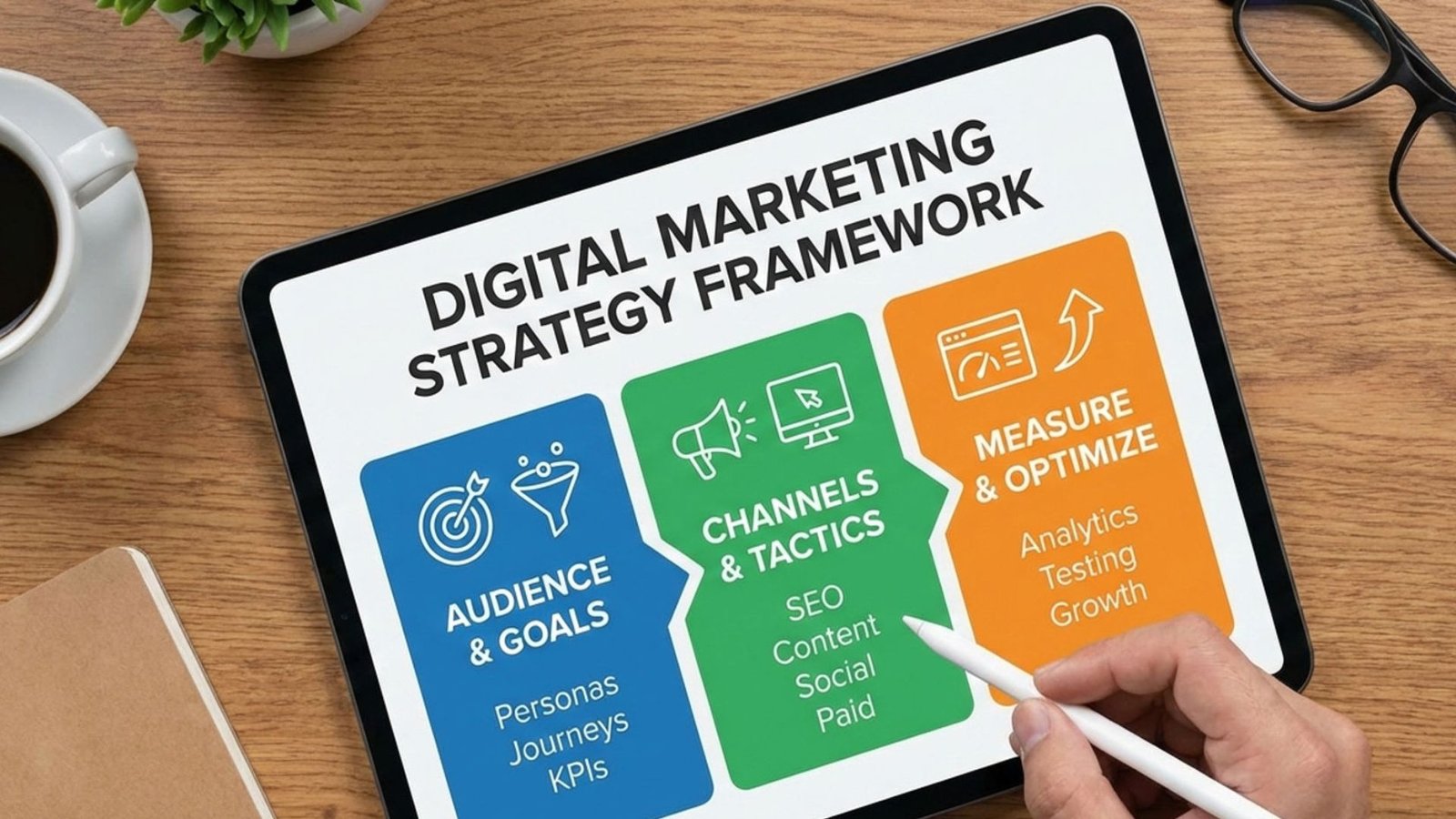
In the digital era, marketing success is no longer driven by isolated campaigns or the random use of online platforms. Businesses today operate in a highly competitive, data-driven, and customer-centric environment where digital presence directly influences brand perception and revenue growth. Organizations that achieve consistent and scalable success rely on a clearly defined digital marketing strategy framework.
A digital marketing strategy framework acts as a structured roadmap that aligns business objectives, customer needs, marketing channels, content creation, technology, and performance measurement into one integrated system. Rather than reacting to trends or relying on trial-and-error tactics, businesses with a framework approach digital marketing strategically and systematically.
Without a framework, digital marketing efforts often become fragmented, reactive, and inefficient. Budgets are spent without clarity, messaging becomes inconsistent, and performance is difficult to measure. With the right framework in place, organizations can move from experimentation to execution, and from short-term wins to long-term sustainable growth.
This blog provides a detailed explanation of a digital marketing strategy framework, covering its definition, importance, core components, implementation process, challenges, and future relevance.
Table of Contents
Understanding the Digital Marketing Strategy Framework
A digital marketing strategy framework is a structured model that guides how businesses plan, execute, manage, and optimize their digital marketing activities. Instead of focusing on individual tactics such as social media posting, search engine optimization, or paid advertising in isolation, the framework considers the entire digital marketing ecosystem. It connects the following key elements:
. Business vision and long-term goals
. Target audience insights and customer behavior
. Market and competitor intelligence
. Digital channels and platforms
. Content and brand messaging
. Data, analytics, and continuous optimization
By using a digital marketing strategy framework, businesses ensure that every digital activity contributes to a measurable and meaningful objective. This alignment turns marketing from a mere expense into a powerful engine for business growth Importance of a Digital Marketing Strategy Framework
Many organizations invest heavily in digital marketing tools, platforms, and campaigns but still fail to achieve significant results. The primary reason is not lack of effort or resources, but the absence of a structured strategy.
Key benefits of a digital marketing strategy framework include:
. Clear alignment between marketing activities and business goals
. Better utilization of budgets, tools, and human resources
. Consistent brand messaging across all digital channels
. Improved customer experience and engagement
. Data-driven decision-making instead of assumptions
. Scalable, repeatable, and sustainable growth
A well-defined framework transforms digital marketing from guesswork into a systematic, results-oriented process.
Core Components of a Digital Marketing Strategy Framework
A successful digital marketing strategy framework consists of multiple interconnected components. Each component builds upon the previous one, creating a cohesive and effective marketing system.
Step 1: Business Goals and Strategic Alignment

The foundation of any digital marketing strategy framework is goal definition. Marketing exists to support business outcomes, not to generate vanity metrics.
Key considerations:
. Marketing goals must directly support overall business objectives
. Goals should focus on outcomes rather than activities
. Clear timelines and success metrics must be established
Examples of strategic goals:
. Increase qualified website traffic
. Generate high-quality leads
. Improve customer acquisition efficiency
. Increase online sales and revenue
. Enhance brand awareness and customer trust
Using SMART goals (Specific, Measurable, Achievable, Relevant, Time-bound) ensures clarity, accountability, and focus.
Step 2: Target Audience and Buyer Persona Development

A digital marketing strategy framework must be customer-centric. Understanding the target audience is essential for delivering relevant and personalized marketing experiences.
Buyer persona development includes:
. Demographic details (age, gender, location, income)
. Psychographic traits (interests, values, lifestyle)
. Pain points and challenges
. Buying motivations and decision-making factors
. Preferred digital platforms and content formats
Data sources for audience research:
. Website analytics
. CRM and customer databases
. Social media insights
. Customer surveys and interviews
Well-defined buyer personas allow marketers to communicate more effectively, increase engagement, and improve conversion rates.
Step 3: Market, Industry, and Competitor Analysis

Understanding the competitive environment is a critical element of the digital marketing strategy framework. Businesses must know where they stand in the market and how competitors attract and retain customers.
Key analysis areas include:
. Competitor digital presence and positioning
. Keyword and SEO performance
. Content strategies and messaging approaches
. Paid advertising tactics
. Social media engagement and community-building efforts
SWOT Analysis:
. Strengths: Internal advantages
. Weaknesses: Internal limitations
. Opportunities: External growth potential
. Threats: External risks
This analysis helps businesses identify gaps, opportunities, and areas for differentiation.
Step 4: Channel Selection and Omnichannel Strategy

Every business has unique needs, so not all digital channels are equally effective for every organization. A strong digital marketing strategy framework emphasizes selecting channels based on audience behavior and business goals.
Types of digital channels:
. Owned Media
. Website and blog
. Email marketing
. Mobile applications
. Earned Media
. Search engine optimization (SEO)
. Online reviews
. Media mentions
. Paid Media
. Search engine advertising
. Social media advertising
. Display and video ads
An omnichannel approach ensures consistent messaging and a seamless customer experience across all platforms.
Step 5: Content Strategy and Funnel Mapping
Content is the core driver of engagement within a digital marketing strategy framework. It educates, informs, persuades, and nurtures customers throughout the buying journey.
Funnel-based content planning:
. Awareness Stage
. Educational blog posts
. Videos and infographics
. Social media content
. Consideration Stage
. Case studies
. Webinars
. Comparison guides
. Conversion Stage
. Landing pages
. Product demonstrations
. Testimonials and customer reviews
. Retention Stage
. Email newsletters
. Loyalty programs
. Personalized content
Effective content guides users logically from awareness to conversion and long-term loyalty.
Step 6: SEO and Keyword Strategy Integration
SEO is a long-term pillar of the digital marketing strategy framework. It ensures sustainable visibility and organic growth.
Core SEO elements include:
. Keyword research based on search intent
. Technical SEO improvements
. Content optimization and internal linking
. Authority building through backlinks
Keyword categories:
. Informational keywords
. Navigational keywords
. Commercial intent keywords
. Transactional keywords
SEO reduces dependency on paid advertising and delivers compounding results over time.
Step 7: Technology, Tools, and Marketing Automation
Modern digital marketing frameworks rely heavily on technology to manage complexity and scale efficiently.
Essential tools include:
Analytics platforms
. Customer relationship management (CRM) systems
. Email marketing and automation tools
. Advertising management platforms
. Content management systems
Marketing automation improves personalization, operational efficiency, and scalability while reducing manual effort.
Step 8: Budget Allocation and Resource Planning

A digital marketing strategy framework provides clarity in budget allocation and resource management.
Budget planning principles:
. Invest more in proven high-ROI channels
. Allocate resources for testing and innovation
. Balance short-term performance with long-term brand building
. Align budgets with strategic priorities
. Effective budgeting ensures maximum impact with minimal waste.
Step 9: Campaign Execution and Workflow Management
Execution is where strategy turns into action. Without disciplined execution, even the best framework fails.
Key execution elements:
. Campaign calendars
. Content publishing schedules
. Ad creative testing
. Email workflows
. Cross-team coordination
Short execution cycles enable faster learning, optimization, and adaptation.
Step 10: Measurement, Analytics, and Performance Tracking
Measurement is essential to evaluate the success of the digital marketing strategy framework.
Key performance indicators (KPIs):
. Website traffic and traffic sources
. Conversion rates
. Cost per lead and customer acquisition
. Return on ad spend (ROAS)
. Customer lifetime value
Analytics provide insights that guide decision-making and continuous improvement.
Step 11: Optimization and Scaling
Optimization is an ongoing process within the framework, not a one-time task.
Optimization activities include:
- A/B testing
- Audience refinement
- Content performance enhancement
- User experience improvements
- Scaling focuses on expanding successful strategies while maintaining efficiency and quality.
Digital Marketing Strategy Framework Models
Several established models support framework implementation:
. RACE Framework: Reach, Act, Convert, Engage
. AARRR Funnel: Acquisition, Activation, Retention, Referral, Revenue
. S Digital Marketing Model: Sell, Serve, Speak, Save, Sizzle
These models can be integrated into a customized digital marketing strategy framework.
Digital Marketing Strategy Framework for Different Business Types
. Focus on limited but effective channels
. Emphasize local SEO and organic growth
. Use automation to save time and resources
. B2B Organizations
. Longer sales cycles
. Educational and authority-based content
. Lead nurturing and CRM integration
. B2C Brands
. Emotion-driven storytelling
. Social media and influencer marketing
. Conversion-focused campaigns
. Customization ensures relevance and effectiveness across business models.
. Common Challenges in Implementing a Digital Marketing Strategy Framework
Common challenges:
. Lack of clear goals
. Poor use of data and analytics
. Overuse of digital channels
. Inconsistent execution
Solutions:
. Regular performance reviews
. Simplified and focused KPIs
. Continuous learning and optimization
. A structured framework helps address these challenges systematically.
. Future Trends Shaping Digital Marketing Strategy Frameworks
. Digital marketing frameworks must evolve to remain effective.
. Emerging trends include:
. Artificial intelligence and personalization
. Voice search optimization
. Privacy-first and first-party data strategies
Advanced marketing automation
Advanced Marketing Automation uses tools and workflows to automate marketing tasks, nurture leads, personalize customer communication, and improve campaign performance for better efficiency and higher conversions.
Conclusion
A digital marketing strategy framework is far more than just a planning tool—it serves as a comprehensive strategic growth system that guides every aspect of a company’s online marketing efforts. By providing a clear structure for aligning business goals with marketing activities, it ensures that every campaign, message, and channel contributes meaningfully to overall objectives. The framework brings clarity to complex marketing processes, consistency in brand messaging across multiple channels, and control over resource allocation, budgets, and timelines. Beyond operational efficiency, it also enables data-driven decision-making, allowing businesses to analyze performance metrics, understand customer behavior, optimize campaigns in real-time, and anticipate market trends.
Organizations that adopt a well-defined and structured digital marketing framework gain measurable advantages, including predictable marketing performance, stronger customer relationships, improved return on investment, enhanced brand authority, and the ability to scale campaigns sustainably
Organizations that adopt a structured framework gain:
. Predictable marketing performance
. Stronger customer relationships
. Higher return on investment
. Sustainable competitive advantage
In an increasingly digital marketplace, success belongs to businesses that move beyond tactics and build marketing systems guided by a well-defined digital marketing strategy framework.
Author :Irfan









Leave A Comment