Category: Digital Marketing Tips

  • Customer Engagement Metrics: The Complete & Essential Guide for Digital Marketers in 2026

    Customer Engagement Metrics: The Complete & Essential Guide for Digital Marketers in 2026

    Artificial Intelligence (AI): Technologies, Applications, Benefits, Challenges, and Future

    Artificial intelligence

    Artificial Intelligence (AI) is changing the way we live, work, and communicate. What once seemed like science fiction is now a part of our everyday lives. From voice assistants like Siri and Google Assistant to self-driving cars and personalized shopping recommendations, AI is everywhere.

    Businesses, healthcare providers, educational institutions, and governments are using AI to improve efficiency, automate repetitive tasks, and make better decisions. As AI technology continues to evolve, it is creating new opportunities while also raising important ethical and social questions.

    In this blog, you’ll learn what Artificial Intelligence is, the technologies behind it, its real-world applications, benefits, challenges, and what the future of AI looks like.

    What is Artificial Intelligence?
    Artificial intelligence

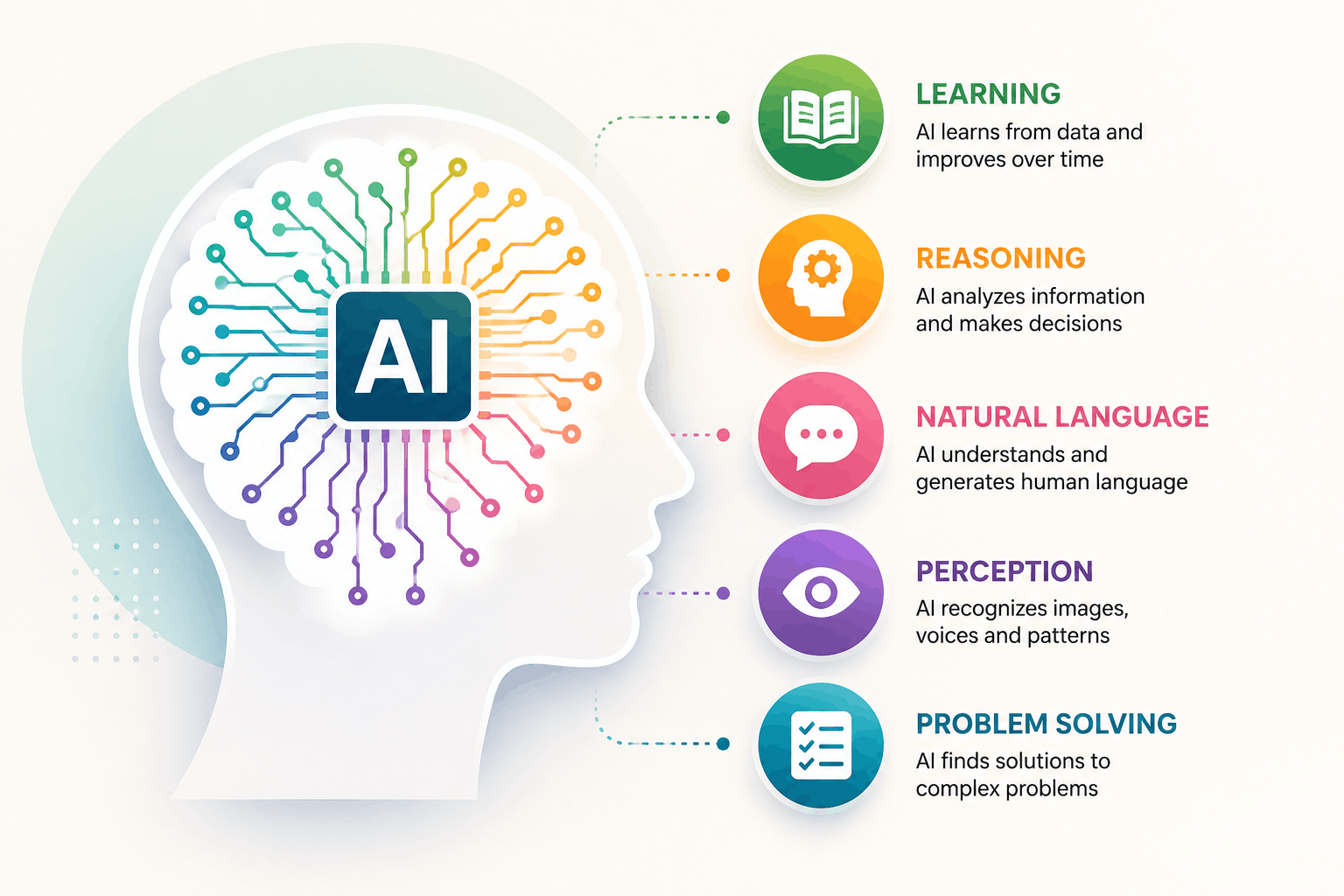
    Artificial Intelligence (AI) refers to the ability of machines and computer systems to perform tasks that normally require human intelligence. These tasks include learning, reasoning, problem-solving, understanding language, recognizing images, and making decisions.

    Unlike traditional software that follows fixed instructions, Artificial Intelligence systems learn from data, recognize patterns, and improve their performance over time without constant human intervention. This ability makes Artificial Intelligence a powerful technology for solving complex problems across a wide range of industries.

    Today, Artificial Intelligence powers many of the digital tools we use every day, including search engines, virtual assistants, online shopping recommendations, fraud detection systems, medical diagnosis tools, and smart automation solutions. As Artificial Intelligence continues to evolve, it is transforming businesses, improving customer experiences, and driving innovation across healthcare, education, finance, manufacturing, and many other sectors.

    Key AI Technologies

    Modern AI is built on several important technologies that work together to create intelligent systems.

    1. Machine Learning (ML)

    Machine Learning is one of the most important branches of AI. It enables computers to learn from data without being directly programmed for every task.

    Machine Learning is divided into three main types:

    • Supervised Learning: Uses labeled data to make predictions.
    • Unsupervised Learning: Finds hidden patterns in data.
    • Reinforcement Learning: Learns by receiving rewards or penalties based on actions.

    Machine learning is widely used in recommendation systems, spam filtering, fraud detection, and predictive analytics.


    2. Deep Learning

    Deep Learning is a specialized form of machine learning that uses artificial neural networks with multiple layers.

    It is highly effective for processing complex data such as:

    • Images
    • Videos
    • Speech
    • Text

    Applications include facial recognition, speech recognition, medical image analysis, and autonomous vehicles.

    Popular frameworks include TensorFlow and PyTorch.


    3. Natural Language Processing (NLP)

    Natural Language Processing enables computers to understand, interpret, and generate human language.

    Common NLP applications include:

    • Chatbots
    • Virtual assistants
    • Language translation
    • Sentiment analysis
    • Text summarization

    This technology helps businesses improve customer service and communication.


    4. Computer Vision

    Computer Vision allows machines to interpret visual information from images and videos.

    It is commonly used in:

    • Facial recognition
    • Medical imaging
    • Security systems
    • Self-driving vehicles
    • Quality inspection in manufacturing

    5. Robotics

    Robotics combines AI with engineering to create intelligent machines capable of performing physical tasks.

    AI-powered robots are used in:

    • Manufacturing
    • Healthcare
    • Warehousing
    • Agriculture
    • Space exploration

    6. Expert Systems

    Expert systems use predefined rules and knowledge to solve specific problems.

    They are commonly used in:

    • Medical diagnosis
    • Banking
    • Insurance
    • Customer support
    • Financial planning

    Types of Artificial Intelligence

    AI can be divided into different categories based on its capabilities.

    Reactive Machines

    These AI systems only react to current information and cannot learn from previous experiences.

    Example:
    IBM Deep Blue chess computer.


    Limited Memory AI

    Most modern AI systems belong to this category. They learn from historical data to improve future decisions.

    Examples include:

    • Self-driving cars
    • Recommendation systems
    • Fraud detection software

    Theory of Mind AI

    This type of AI aims to understand human emotions, beliefs, and social interactions.

    Although researchers are making progress, this technology is still under development.


    Self-Aware AI

    Self-aware AI is a theoretical concept where machines possess consciousness and emotions similar to humans.

    At present, this remains a future possibility rather than a reality.


    Real-World Applications of AI

    Artificial Intelligence is transforming almost every industry.

    Healthcare

    AI is improving healthcare through:

    • Disease detection
    • Medical imaging analysis
    • Drug discovery
    • Virtual health assistants
    • Personalized treatment plans

    Doctors use AI to detect diseases earlier and improve patient care.


    Automotive

    AI plays an important role in the automotive industry by enabling:

    • Self-driving vehicles
    • Driver assistance systems
    • Traffic prediction
    • Collision avoidance
    • Lane detection

    These technologies improve road safety and driving experiences.


    Finance

    Banks and financial institutions use AI for:

    • Fraud detection
    • Credit scoring
    • Investment management
    • Customer support chatbots
    • Algorithmic trading

    AI helps reduce risks while improving financial services.


    E-Commerce

    Online businesses use AI to deliver personalized shopping experiences.

    Applications include:

    • Product recommendations
    • Customer support
    • Inventory management
    • Dynamic pricing
    • Demand forecasting

    These features improve customer satisfaction and increase sales.


    Entertainment

    Streaming platforms and gaming companies use AI to recommend personalized content.

    Examples include:

    • Movie recommendations
    • Music suggestions
    • Smart playlists
    • AI-powered gaming characters

    AI helps users discover content based on their interests.


    Education

    AI is making education more personalized and accessible.

    Applications include:

    • Smart tutoring systems
    • Automated grading
    • Personalized learning plans
    • Virtual classrooms
    • Student performance analysis

    Teachers can use AI to provide better learning experiences for students.


    Industry Impact of AI

    Artificial Intelligence is driving innovation across many industries.

    Manufacturing

    Manufacturers use AI for:

    • Predictive maintenance
    • Quality inspection
    • Industrial automation
    • Supply chain optimization

    This reduces downtime and improves productivity.


    Agriculture

    AI helps farmers improve crop production through:

    • Precision farming
    • Crop monitoring
    • Pest detection
    • Weather prediction
    • Smart irrigation

    These technologies increase agricultural efficiency while reducing waste.


    Logistics and Supply Chain

    AI improves logistics through:

    • Route optimization
    • Warehouse automation
    • Inventory forecasting
    • Delivery tracking

    Businesses can reduce costs and improve delivery times.


    Human Resources

    HR departments use AI for:

    • Resume screening
    • Candidate matching
    • Employee engagement analysis
    • Performance evaluation

    AI helps recruiters make faster and more informed hiring decisions.


    Benefits of Artificial Intelligence

    AI offers numerous advantages for businesses and individuals.

    Increased Productivity

    AI automates repetitive tasks, allowing employees to focus on more valuable work.

    Better Decision-Making

    AI analyzes large amounts of data quickly, helping organizations make smarter business decisions.

    24/7 Availability

    Unlike humans, AI systems can work continuously without breaks or fatigue.

    Personalization

    AI delivers customized recommendations based on user preferences, improving customer experiences.

    Cost Reduction

    Automation reduces operational costs and increases business efficiency.

    Improved Accuracy

    AI minimizes human errors and delivers consistent results in many applications.

    Innovation

    AI enables the development of new products, services, and business models that drive economic growth.


    Challenges and Ethical Concerns

    Despite its many benefits, AI also presents several challenges.

    Job Displacement

    Automation may replace some jobs, especially those involving repetitive tasks. However, it also creates demand for new skills and careers.


    Bias in AI

    AI systems can inherit bias from the data used for training, leading to unfair decisions.

    Developers must ensure datasets are diverse and unbiased.


    Privacy Issues

    AI relies heavily on data collection, raising concerns about user privacy and data security.

    Organizations must handle personal information responsibly.


    Lack of Transparency

    Many AI systems are difficult to understand because their decision-making process is not fully transparent.

    This is often called the “black box” problem.


    Security Risks

    AI can be misused for:

    • Deepfake videos
    • Cyberattacks
    • Automated scams
    • Fake news generation

    Strong cybersecurity measures are essential.


    The Future of Artificial Intelligence

    The future of AI is exciting and full of possibilities.

    Researchers are working toward Artificial General Intelligence (AGI), where machines can perform a wide variety of intellectual tasks similar to humans.

    Other emerging trends include:

    • Explainable AI for greater transparency
    • Human-AI collaboration in workplaces
    • AI-powered healthcare innovations
    • Edge AI for faster processing
    • AI for climate change and sustainability
    • Quantum AI for solving complex scientific problems

    As AI technology advances, it will become an even more important part of our personal and professional lives.


    Responsible AI Development

    To maximize the benefits of AI while reducing its risks, responsible development is essential.

    Organizations should focus on:

    • Fairness and inclusion
    • Transparency
    • Accountability
    • Privacy protection
    • Human oversight
    • Ethical decision-making

    Governments, businesses, researchers, and society must work together to ensure AI benefits everyone.


    Conclusion

    Artificial Intelligence has become one of the most powerful technologies of the digital age. From healthcare and education to finance, manufacturing, and entertainment, Artificial Intelligence is transforming industries and improving the way people live and work. Its ability to automate tasks, analyze data, and support better decision-making is creating new opportunities for businesses and individuals alike.

    While Artificial Intelligence offers tremendous benefits, it also presents challenges related to privacy, ethics, transparency, and employment. Addressing these concerns through responsible Artificial Intelligence development, strong regulations, and ethical practices will help create a future where AI is used safely, fairly, and responsibly.

    As Artificial Intelligence continues to evolve, it is expected to play an even greater role in solving global challenges, driving innovation, and enhancing human capabilities. Individuals and businesses that understand and embrace Artificial Intelligence today will be better prepared for the opportunities and advancements of tomorrow.


    Tags :
    digitdal marketing strategy
    Author : Swetha

    Consectetur sollicitudin cubilia facilisis lobortis lacus a ac phasellus. Mus pulvinar enim suspendisse pharetra id commodo platea nunc aliquet.

    Learner of DigiSkillz, Digital Marketing Institute in Kochi.

  • Customer Engagement Metrics: The Complete & Essential Guide for Digital Marketers in 2026

    Customer Engagement Metrics: The Complete & Essential Guide for Digital Marketers in 2026

    In today’s digital-first world, where consumers are constantly connected and empowered with endless choices, simply reaching your target audience is no longer a guarantee of success. It’s no longer about how many people see your message—it’s about how many truly connect with it. Engagement has become the new benchmark for brand success, and understanding customer engagement metrics is critical for achieving it. Whether it’s through clicks, likes, shares, comments, or time spent on a website, customer engagement metrics reflect the level of interest, attention, and emotional connection customers have with your brand. These metrics go beyond surface-level interactions—they provide actionable insights into what your audience values, how they behave, and which of your marketing efforts are most effective.

    The importance of customer engagement metrics has grown exponentially as brands seek to move beyond vanity numbers and focus on meaningful interactions. These metrics are essential tools for evaluating performance, refining strategies, and ensuring that every piece of content, campaign, or communication delivers real value while encouraging genuine engagement. By tracking customer engagement metrics, marketers can identify which messages resonate most, which channels perform best, and how to optimize campaigns to achieve higher retention, loyalty, and conversions.

    Importantly, understanding customer engagement metrics isn’t reserved for large corporations with massive marketing budgets. Freelancers, small business owners, and digital marketing professionals alike can benefit from leveraging these insights. Whether you are running a personal brand on social media, managing an eCommerce store, or creating content for a local business, customer engagement metrics help you make smarter, data-driven decisions. They guide you toward content that resonates with your audience, platforms that deliver results, and strategies that foster meaningful interactions.

    When used effectively, customer engagement metrics can significantly improve customer satisfaction, strengthen brand loyalty, and increase conversions over time. They allow marketers to move from guesswork to informed strategy, ensuring that every marketing effort is purposeful, measurable, and impactful. In this comprehensive guide, we will explore the most important customer engagement metrics, explain why they matter, and demonstrate how you can leverage them to enhance your brand’s visibility, build trust, and drive sustainable growth in 2026 and beyond. By the end of this guide, you will have a clear understanding of how customer engagement metrics can transform your marketing approach, improve user experience, and create lasting connections with your audience.

    What Are Customer Engagement Metrics?

    Customer engagement metrics are powerful quantitative indicators that provide a clear and comprehensive picture of how your audience interacts with your business across various digital platforms. These metrics go far beyond surface-level numbers—they offer deep insights into user behavior, content effectiveness, and the overall impact of your brand in the digital space. Whether it’s tracking clicks on a website, likes and comments on social media posts, email open rates, newsletter click-throughs, video views, or even actual purchases, each interaction tells a story about what your customers find relevant, engaging, or useful.

    More importantly, customer engagement metrics help marketers understand not only how often users connect with a brand, but also how deeply they engage with content, how likely they are to return for repeat interactions, and how satisfied they are with their overall experience. These insights allow businesses to identify patterns, preferences, and potential pain points in the customer journey, providing actionable data to enhance marketing strategies. By analyzing customer engagement metrics, marketers can determine which types of content resonate most, which campaigns drive the highest engagement, and which touchpoints need optimization to improve user experience.

    In today’s highly competitive online landscape, understanding and leveraging customer engagement metrics is essential for moving beyond guesswork and assumptions. Brands that consistently track these metrics can create more meaningful, personalized, and impactful marketing efforts. They can tailor content to match audience interests, optimize communication channels, and deliver messages that foster trust, increase retention, and drive long-term growth. From small business owners and freelancers to large digital marketing teams, customer engagement metrics serve as a critical tool for measuring performance, refining strategies, and ensuring that every campaign delivers measurable value.

    Ultimately, integrating customer engagement metrics into your digital marketing strategy empowers your business to build stronger connections with your audience, predict customer behavior, and make data-driven decisions that enhance both customer satisfaction and brand loyalty. By actively monitoring these metrics, businesses can not only evaluate the success of current campaigns but also anticipate trends, identify opportunities for improvement, and continuously evolve their marketing approach for sustained success.

    They help answer questions like:

    • Are users finding your content useful?
    • Are they coming back?
    • Are they talking about your brand?
    • Are they progressing from awareness to loyalty?

    These metrics allow businesses to transition from assumption to data-driven decision-making, ensuring that marketing efforts actually resonate with their audience.

    Why Customer Engagement Metrics Matter

    In 2025, digital consumers are constantly overwhelmed by a nonstop stream of content across multiple platforms. Your challenge isn’t just visibility—it’s meaningful interaction. Here’s why engagement metrics are key:

    • Predict Customer Behavior

    Users who are highly engaged are more likely to make a purchase and stay loyal to your brand over time. By tracking their actions, you can predict who’s ready to buy or who might churn.

    • Boost Retention and Loyalty

    Engaged customers tend to stay longer. Measuring engagement can help identify what keeps them coming back.

    • Optimize Marketing ROI

    Rather than investing in strategies that don’t work, metrics guide you toward channels, messages, and formats that drive real interaction.

    • Refine Content and Campaigns

    Engagement metrics help identify what kind of content resonates most with your audience, allowing for more personalized and targeted strategies.

    • Track Brand Sentiment

    Social media engagement, reviews, and mentions show how customers feel about your brand in real-time.

    Top 12 Customer Engagement Metrics to Track

    Let’s explore the key engagement metrics every marketer should monitor in 2025:

    • Click-Through Rate (CTR)

    What it measures: The percentage of users who click a link after seeing it.
    Formula: (Clicks ÷ Impressions) × 100
    Why it matters: A high CTR indicates that your offer, ad, or email subject line is compelling. Low CTR suggests the need for better targeting or messaging.

    • Time on Site / Session Duration

    What it measures: How long visitors stay on your site during a session.
    Why it matters: More time = more interest. If users are reading blog posts or watching videos, they’re clearly engaged.

    • Pages per Session

    What it measures: The number of pages a user views during one visit.
    Why it matters: Indicates how deep users are exploring your site, which can signal trust and content quality.

    • Bounce Rate

    What it measures: The percentage of visitors who leave after viewing only one page.
    Why it matters: A high bounce rate may mean your page didn’t deliver value or match expectations.

    • Scroll Depth

    What it measures: How much of a webpage a visitor scrolls through during their visit.
    Why it matters: Reveals whether users are actually consuming your content or just skimming.

    • Social Media Engagement Rate

    What it measures: The ratio of user interactions—such as likes, shares, and comments—to the total number of followers or reach.
    Why it matters: High engagement signals content relevance and emotional connection.

    • Email Open and Click Rates

    What it measures: Percentage of recipients who open emails and click links.
    Why it matters: Good open rates reflect strong subject lines; good click rates mean your message is compelling.

    • Customer Retention Rate

    What it measures: Percentage of customers who continue buying or interacting over time.
    Why it matters: It’s cheaper to retain an existing customer than to acquire a new one.

    • Net Promoter Score (NPS)

    What it measures: The likelihood that customers will recommend your brand to others.

    Why it matters: A high Net Promoter Score (NPS) reflects strong customer satisfaction, trust, and long-term loyalty.

    • Customer Satisfaction Score (CSAT)

    What it measures: Customer satisfaction based on surveys or feedback.
    Why it matters: Helps track how happy users are after interacting with your service or content.

    • Churn Rate

    What it measures: The percentage of users who stop interacting or unsubscribe.
    Why it matters: High churn is a red flag and often indicates poor engagement or unmet expectations.

    • User-Generated Content (UGC) and Mentions

    What it measures: How often customers create content or mention your brand.
    Why it matters: UGC builds credibility and signals strong brand engagement.

    How to Use Engagement Metrics Effectively


    Simply tracking numbers isn’t enough—you must turn insights into actions. Here’s how:

    • Set Clear Goals

    Know what you want to achieve: better retention, more purchases, increased loyalty, etc. Choose metrics that align with those goals.

    • Segment Your Audience

    Monitor engagement by segmenting your audience based on demographics, user behavior, or their stage in the sales funnel. This helps you personalize your campaigns.

    • Monitor Trends Over Time

    Don’t panic over day-to-day changes. Focus on patterns over weeks or months to make informed decisions.

    • Use Tools Like GA4, HubSpot, or Hotjar

    Modern tools give deep insights into behavior and engagement. Use them to track heatmaps, sessions, conversions, and more.

    • A/B Test Your Content

    Run split tests on email subject lines, ad creatives, or landing pages. Use engagement metrics to see which performs better.

    • Optimize for Mobile

    A significant share of user engagement originates from mobile devices. Ensure your content is fast, readable, and interactive on all screen sizes.

    • Create Interactive Content

    Polls, quizzes, calculators, and comment sections drive engagement. Don’t just talk—invite response.

    Real-World Example: Engagement in Action

    Imagine you’re a freelance marketer managing campaigns for a local fashion brand. You run an Instagram campaign promoting a new summer collection. Here’s how engagement metrics help:

    • CTR on “Shop Now” shows how effective your call-to-action is.
    • Comment and share counts reflect content quality and relatability.
    • Bounce rate on your product page can uncover UX issues.
    • Retention metrics on returning customers show whether your email marketing keeps them engaged.

    By tracking these metrics and iterating on them, you’re able to refine your campaign and improve ROI over time.

    Common Mistakes to Avoid

    • Focusing only on vanity metrics (likes, views) without analyzing conversions.
    • Not setting benchmarks or comparing to industry standards.
    • Ignoring negative signals like high churn or bounce rates.
    • Relying on a single metric instead of a combination for a full picture.

    Future of Customer Engagement Metrics

    With AI, machine learning, and predictive analytics shaping the digital marketing space, engagement tracking is becoming even more sophisticated. In 2025 and beyond, expect:

    • Deeper personalization based on real-time behavior.
    • Voice and gesture interaction tracking (for smart devices).
    • Emotion and sentiment analysis in content and video responses.
    • Advanced automation based on engagement scores.

    Final Thought:

     In today’s dynamic digital ecosystem, customer engagement metrics are far more than just vanity figures or performance snapshots—they are the heartbeat of your brand’s relationship with its audience. These customer engagement metrics tell a story: how users discover your brand, how they interact with your content, how they respond to your messaging, and whether they perceive lasting value in what you offer. By closely analyzing key customer engagement metrics such as click-through rates, session duration, bounce rates, and social interactions, marketers can gain invaluable insights into user behavior, preferences, and trends.

    The true power of customer engagement metrics lies not merely in collecting the numbers—it is in interpreting them, understanding what they signify, and taking strategic actions that enhance audience experiences. Leveraging these metrics effectively allows marketers to move from guesswork to informed strategy, from assumptions to actionable clarity. In a world where consumers are constantly overwhelmed with content and choices, consistent, meaningful engagement—measured through robust customer engagement metrics—is what builds trust, fosters loyalty, and drives sustainable business growth.

    Brands that actively monitor, analyze, and act on customer engagement metrics can adapt quickly, prioritize authentic connections over superficial reach, and ensure their marketing resonates in meaningful ways. For digital marketers looking to make a real impact in 2025 and beyond, embedding customer engagement metrics at the core of every strategy isn’t optional—it’s essential for long-term success.

    Digital Marketing Institute in Kochi

    Tags :
    digitdal marketing strategy
    Author : Swetha

    Consectetur sollicitudin cubilia facilisis lobortis lacus a ac phasellus. Mus pulvinar enim suspendisse pharetra id commodo platea nunc aliquet.

    Learner of DigiSkillz, Digital Marketing Institute in Kochi.

Call Now Button