
Table of Contents
TogglePreparing for a digital marketing interview is the first step toward landing your dream job in this fast-growing industry. This guide covers the Top 50 Digital Marketing Interview Questions and Answers to help you prepare with confidence. Whether you are a beginner, a fresher, or an experienced professional, these Digital Marketing Interview Questions and Answers will help you understand key concepts, improve your knowledge, and answer interview questions effectively. From SEO and PPC to social media marketing and Google Analytics, this comprehensive guide provides simple explanations to help you succeed in your next interview.
Getting ready for a digital marketing interview is really important. First, it boosts your confidence. Knowing the Digital Marketing Interview Questions and Answers means you’ll be more relaxed and clear during the interview.Second, preparation helps you show off your skills. When you understand these questions and answers, you can highlight your expertise in areas like SEO and social media. This makes you look more knowledgeable and serious about the job.Third, being prepared means you can handle surprises better. If you know a lot of Digital Marketing Interview Questions and Answers, you’ll be ready for unexpected questions.Lastly, preparation helps you stand out. By knowing these key questions and answers, you show that you’re committed and ready for the role.
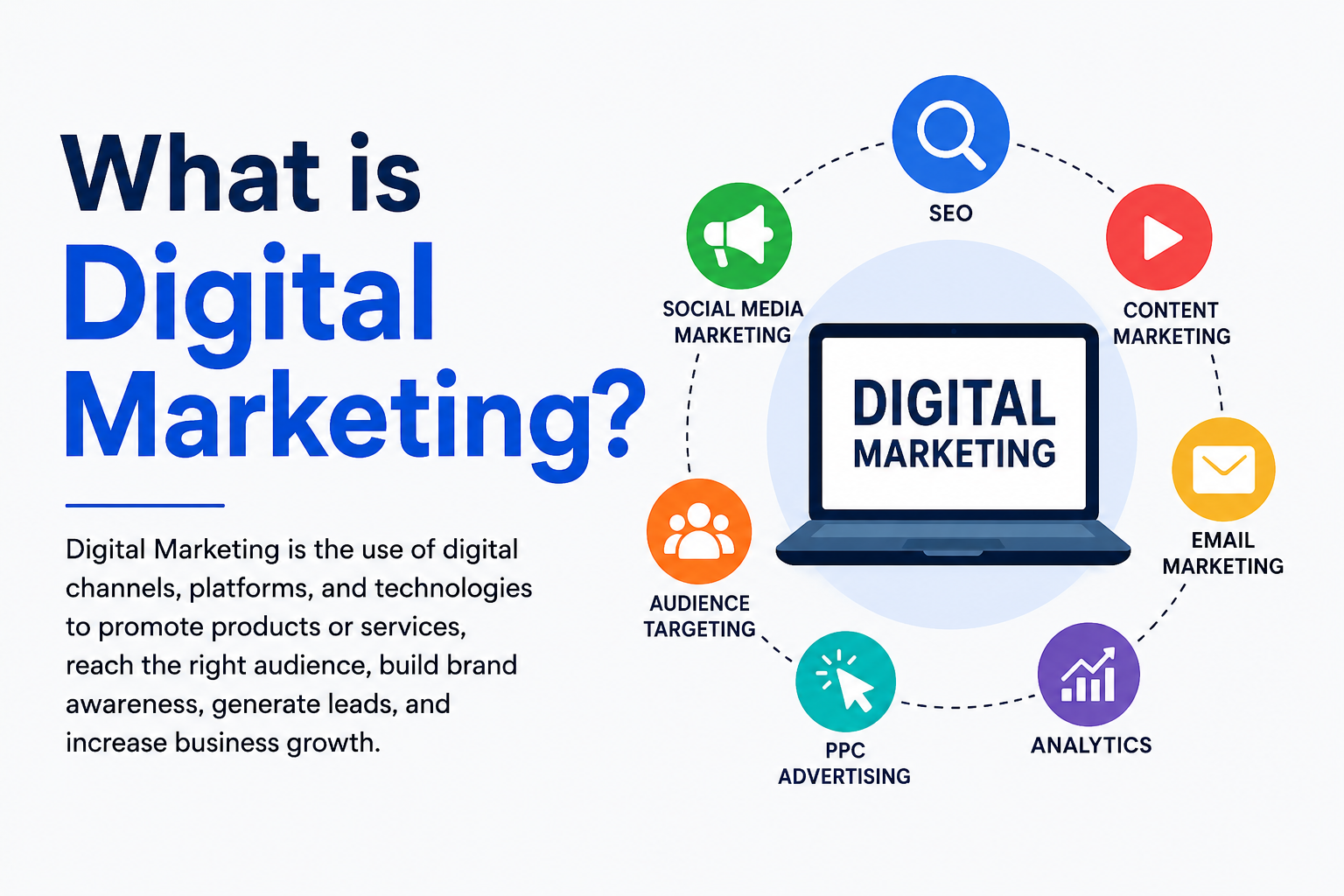
Digital marketing involves promoting products or services through digital channels such as search engines, websites, social media, email, and mobile apps. It includes strategies like SEO, content marketing, social media marketing, and more.
Search Engine Optimization (SEO) is the practice of optimizing web pages to rank higher in search engine results. It includes keyword research, on-page SEO (like meta tags and content optimization), off-page SEO (like backlinks), and technical SEO (like site speed and mobile-friendliness).
A keyword is a term or phrase that users enter into search engines. Keywords are essential for SEO as they help search engines understand the content’s relevance to user queries.
Pay-Per-Click (PPC) is an online advertising model where advertisers pay a fee each time their ad is clicked. It’s a method of buying visits to your site rather than earning them organically.
Content marketing focuses on creating and distributing valuable, relevant content to attract and engage a target audience, ultimately driving profitable customer actions.
Key Google algorithms include:
A backlink is a link from one website to another. Backlinks are vital for SEO as they signal to search engines that your content is authoritative and trustworthy.
Social media marketing uses platforms like Facebook, Twitter, and Instagram to promote products, services, or brands through content creation, engagement, and paid advertising.
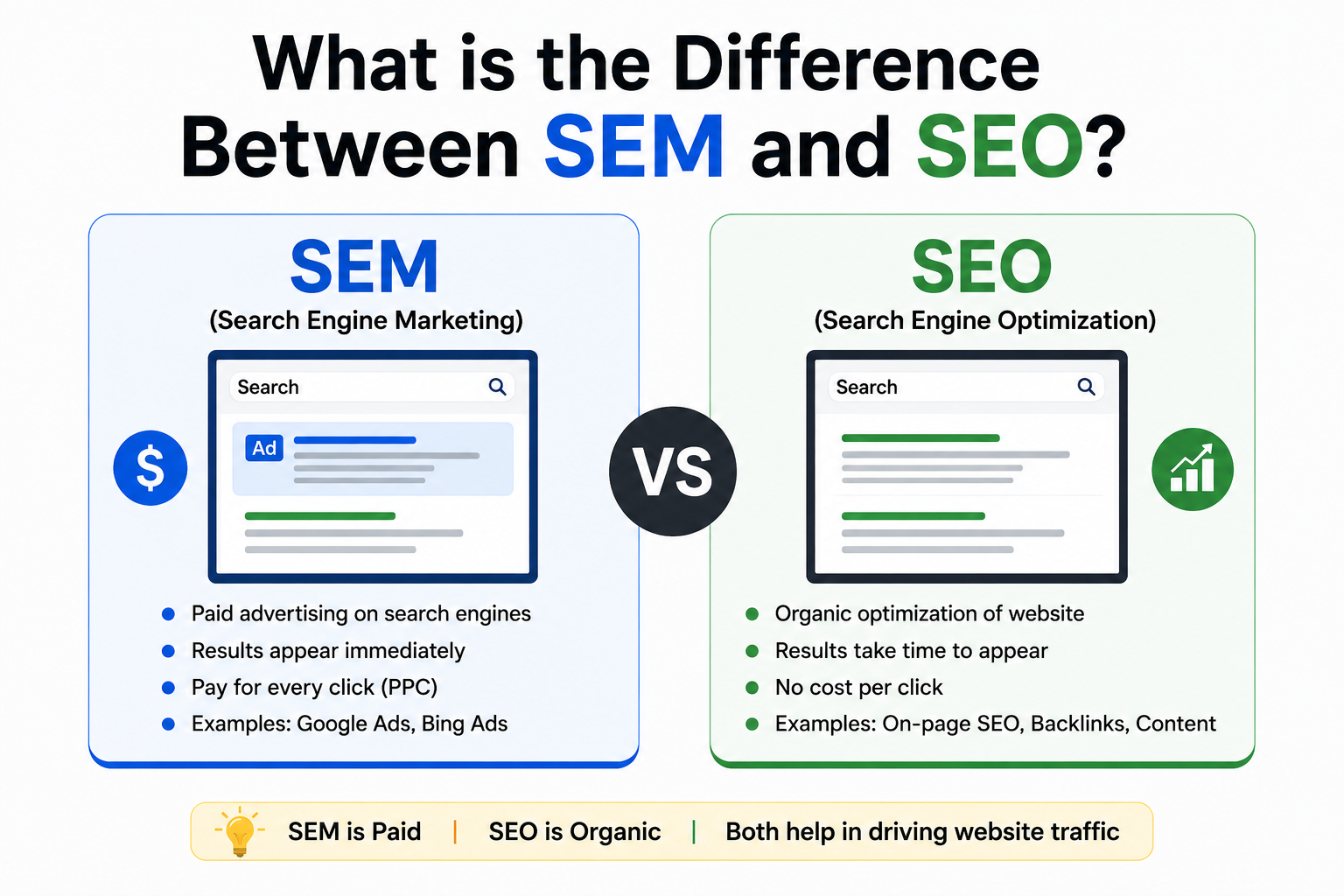
SEO (Search Engine Optimization) aims to improve organic search rankings, while SEM (Search Engine Marketing) involves paid advertising to increase search visibility.
Success can be measured using metrics like:
Email marketing involves sending emails to prospects and customers to nurture relationships, promote products, and drive conversions.
Mobile marketing targets users on smartphones and tablets. With increasing mobile usage, it’s crucial to ensure marketing strategies are mobile-optimized.
Analytics provide data on user behavior, campaign performance, and ROI, enabling marketers to make informed decisions and optimize strategies.
Popular tools include:
A buyer persona is a detailed representation of your ideal customer, based on market research and real data. It helps tailor marketing efforts to better meet the audience’s needs.
Influencer marketing involves partnering with influential people in your industry to promote your brand. Influencers have large followings and can impact purchasing decisions.
A landing page is a standalone web page created for a marketing or advertising campaign. Its primary goal is to convert visitors into leads or customers.
CRO involves increasing the percentage of website visitors who take a desired action through A/B testing, improving usability, and optimizing content and calls to action.

Effective strategies include:
Google AdWords (now Google Ads) is an online advertising platform where advertisers bid to display brief ads, service offerings, product listings, and video content to web users.
The customer journey is the process customers go through from initial awareness of your brand to making a purchase and beyond. It includes stages like awareness, consideration, decision, and retention.
Affiliate marketing is a performance-based marketing strategy where a business rewards affiliates for each visitor or customer brought by the affiliate’s marketing efforts.
Remarketing involves showing targeted ads to users who have previously visited your website or used your mobile app, helping to keep your brand top-of-mind and encourage return visits.
A/B testing compares two versions of a webpage or app to determine which performs better, crucial for optimizing user experience and improving conversion rates.
Market segmentation involves dividing a broad target market into subsets of consumers with common needs and priorities, allowing for more targeted and effective marketing strategies.
Programmatic advertising uses automated technology to buy and sell online advertising, leveraging data and algorithms to deliver ads to the right audience at the right time.
Engagement rate measures the level of interaction content receives from an audience, including likes, shares, comments, and other forms of interaction.
A Call to Action (CTA) is a prompt on a website that encourages the user to take a specified action, such as “Sign Up,” “Buy Now,” or “Learn More.”
A content calendar schedules what and when content will be published, ensuring consistent delivery and alignment with marketing goals and campaigns.
B2B (Business-to-Business) marketing targets other businesses, focusing on logic and ROI, while B2C (Business-to-Consumer) marketing targets individual consumers, focusing on emotions and benefits.
Social media marketing can increase brand awareness, improve engagement, drive website traffic, generate leads, and enhance customer loyalty.
Video marketing is crucial as it engages audiences, increases conversion rates, improves SEO, and provides a high ROI.
Native advertising involves creating ads that match the look, feel, and function of the media format in which they appear, providing a less intrusive advertising experience.
Marketing automation uses software to automate repetitive marketing tasks, such as email campaigns, social media posting, and ad campaigns, improving efficiency and effectiveness.
Branding builds a strong, positive perception of your company, helping to differentiate it from competitors, foster customer loyalty, and drive long-term success.
A conversion occurs when a user completes a desired action, such as making a purchase, filling out a form, or subscribing to a newsletter.
User-generated content (UGC) involves content created by customers or users, such as reviews, testimonials, and social media posts, which can enhance credibility and engagement.
Customer lifetime value (CLV) measures the total worth of a customer to a business over the entirety of their relationship, helping to inform marketing and retention strategies.
Local SEO optimizes your online presence to attract more business from relevant local searches, crucial for businesses with a physical location or serving a specific geographic area.
Organic search results are listings that appear due to their relevance to the search terms, while paid search results are ads that appear at the top of or alongside the organic results.

Google Analytics is a powerful tool that provides comprehensive insights into your website’s performance and user behavior. Here are key ways to utilize Google Analytics for digital marketing:
Google Analytics helps you monitor the number of visitors to your website. You can track total visits, unique visitors, and page views to understand your site’s reach and audience engagement—making it one of the key topics covered in Top 50 Digital Marketing Interview Questions and Answers.
Identify where your traffic is coming from with the traffic sources report. This includes:
Understand how users interact with your site:
Set up Goals and Conversions to track specific actions you want visitors to take, such as completing a purchase, signing up for a newsletter, or filling out a contact form. This helps measure the effectiveness of your campaigns.
Use the Behavior report to see which pages receive the most traffic, have the highest engagement, and drive the most conversions. This helps you understand what content resonates with your audience.
Gain insights into your audience’s demographics, interests, geographic locations, and devices they use to access your site. This information helps you tailor your marketing strategies to better meet their needs.
Track the performance of your marketing campaigns through UTM parameters. This allows you to see which campaigns are driving traffic and conversions, enabling you to allocate resources effectively.
Analyze the Acquisition report to understand how organic search contributes to your traffic. Identify high-performing keywords and optimize your content to improve search engine rankings.
Use the Site Speed report to monitor your website’s loading times. Faster websites provide a better user experience and can improve search engine rankings.
Create custom dashboards and reports to monitor the metrics that matter most to your business. This helps you stay focused on your goals and quickly identify areas that need improvement.
By leveraging Google Analytics, you can gain valuable insights into your digital marketing efforts, make data-driven decisions, and continuously optimize your strategies for better results
A marketing funnel represents the stages a customer goes through from awareness to purchase. The stages typically include:
Storytelling in digital marketing involves creating compelling narratives that engage the audience, build emotional connections, and communicate the brand’s values and messages effectively.
Competitive analysis involves researching and evaluating your competitors’ strengths and weaknesses. Key steps include:
Customer reviews influence potential buyers’ decisions, enhance credibility, and improve SEO by generating fresh, user-generated content that search engines value.
A lead magnet is an incentive offered to potential customers in exchange for their contact information. Examples include ebooks, whitepapers, free trials, and webinars.
Social proof leverages the influence of other people’s actions and opinions to build trust and encourage others to take similar actions. This can include customer reviews, testimonials, endorsements, and case studies.
Inbound marketing focuses on attracting customers through valuable content and experiences tailored to them, rather than pushing products directly. It aims to create meaningful connections and build lasting relationships.
An editorial calendar helps plan, organize, and schedule content production and publication. It ensures consistency, aligns with marketing goals, and helps manage resources efficiently.
To optimize for voice search, consider the following strategies:
By following these tips, you’ll be ready to handle Digital Marketing Interview Questions and Answers with confidence and make a great impression.
Preparing for a digital marketing interview can be a game-changer for your career. By studying these Top 50 Digital Marketing Interview Questions and Answers, you’ll be better prepared to answer common interview questions with confidence. This guide covers the most important Digital Marketing Interview Questions and Answers to help you showcase your knowledge, skills, and practical understanding of digital marketing concepts.
Being well-prepared not only boosts your confidence but also demonstrates your commitment to potential employers. Keep learning the latest digital marketing trends, practice your responses, and review these Digital Marketing Interview Questions and Answers regularly to improve your interview performance.
With a strong understanding of these Digital Marketing Interview Questions and Answers, you’ll be ready to impress recruiters, stand out from other candidates, and take the next step toward building a successful career in digital marketing.

Consectetur sollicitudin cubilia facilisis lobortis lacus a ac phasellus. Mus pulvinar enim suspendisse pharetra id commodo platea nunc aliquet.
Learner of DigiSkillz, Digital Marketing Institute in Kochi.

Conubia lacus magnis torquent pretium etiam dictum potenti.

We provide practical education that prepares you with real-world skills for lasting success.
DigiSkillz Kochi: Second Floor, Lamy Arcade, Peyoli Rd, Near MG Road, North Kaloor, Kacheripady, Kochi, Ernakulam, Kerala 682018
DigiSkillz Kottakkal : Veepees Tower, 2nd Floor, Edarikode, Kottakkal, Kerala 676501
DigiSkillz Manjeri: 2nd Floor, Nilambur – Malappuram Rd, opposite Paravathani, Kuthukal, Manjeri, Kerala 676123
info@digiskillzz.com
+91 7561 80 5000
Copyright © 2026 DigiSkillz by Conseltex Pvt Ltd. All rights reserved.